


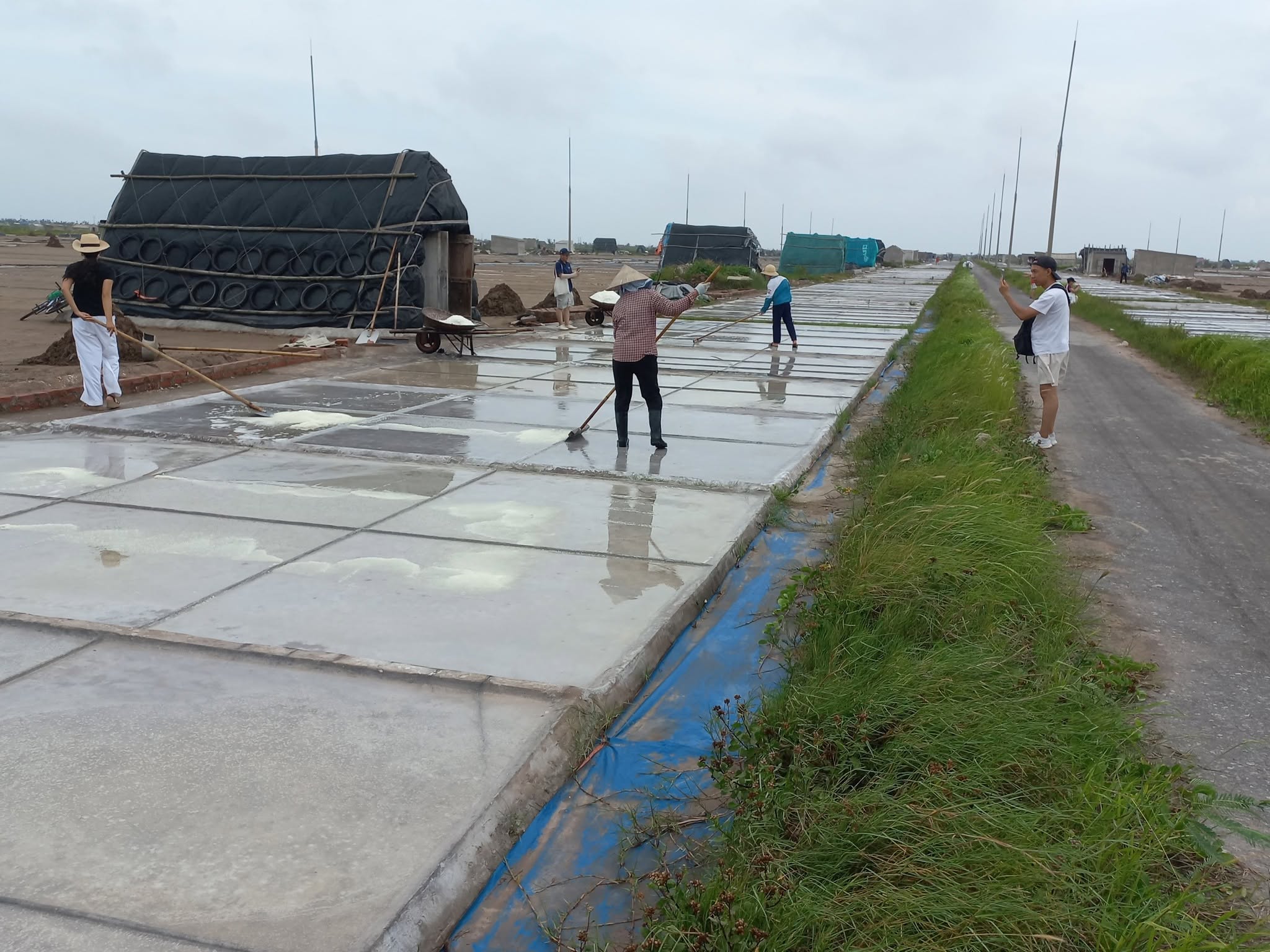
Bach Long Salt-Making Village, located in Giao Binh Commune, Ninh Binh Province, is one of the traditional salt-producing communities along Vietnam’s northern coast. Situated in the former Giao Thuy area, the village is known for its expansive salt fields, hardworking salt farmers, and distinctive techniques that have been passed down through generations.
Unlike some coastal regions where salt is produced by evaporating seawater directly in shallow pans, Bach Long is particularly associated with the traditional sand-based salt-making method. This labor-intensive process involves spreading sand, concentrating salt through natural evaporation, filtering brine, and allowing salt crystals to form under the sun.
During the salt-making season, the fields come alive with farmers preparing sand beds, managing seawater, collecting salt, and transporting their harvests. Under the bright coastal sunlight, the white crystallization pans create a remarkable landscape that reflects the daily rhythms of life in northern Vietnam’s coastal communities.
Beyond its economic importance, salt-making in Bach Long represents generations of traditional knowledge about weather, tides, sand, seawater, and natural evaporation.
Today, alongside efforts to improve product quality and maintain local production, Bach Long has growing potential as a destination for experiential tourism, offering visitors an opportunity to discover the lives of salt farmers and appreciate the craftsmanship behind an everyday ingredient.
History of Bach Long Salt-Making Village and the Lives of Coastal Salt Farmers
Bach Long is situated in the coastal area formerly known as Giao Thuy, where natural conditions have long supported traditional sea salt production.
Before administrative restructuring, Bach Long belonged to Bach Long Commune, Giao Thuy District, Nam Dinh Province. Under the current administrative arrangement, the salt-making area is part of Giao Binh Commune, Ninh Binh Province.
The surrounding coastal landscape is relatively flat and influenced by tidal movements and the tropical monsoon climate.
During periods of prolonged sunshine, warm temperatures and coastal winds accelerate evaporation, creating favorable conditions for salt crystallization.
Taking advantage of these natural characteristics, local communities gradually developed salt-making activities and established areas dedicated to traditional production.
Over generations, the craft became an important part of the village’s economy and cultural identity.
For the people of Bach Long, salt-making is not simply a production activity. It requires a close understanding of the natural environment.
Salt farmers, known in Vietnamese as diem dan, must observe weather patterns, anticipate sunny days, determine when to introduce seawater into their production areas, and adjust their work to minimize the effects of rainfall.
Unlike many handicrafts that can be carried out indoors, traditional salt production depends directly on climatic conditions.
An unexpected rainstorm can interrupt crystallization, dilute concentrated brine, and force farmers to repeat certain stages of the process.
As a result, practical knowledge has traditionally been passed down within families through daily work.
From an early age, many villagers become familiar with the sight of their parents and grandparents heading to the salt fields shortly after sunrise, preparing equipment and taking advantage of favorable weather.
As they grow older, they learn how to prepare sand beds, manage water, filter concentrated brine, and harvest salt.
These skills are not only essential for efficient production but also form part of the community’s cultural heritage.
In village life, the image of salt farmers wearing traditional conical hats, carrying shoulder poles, pulling carts, and working with simple tools has become a familiar sight.
Under intense sunlight, farmers spend long hours in exposed fields, frequently coming into contact with saltwater and hot sandy surfaces.
The work is physically demanding, and household income can fluctuate according to weather conditions and market prices.
Nevertheless, many families continue the craft as a traditional livelihood and an important connection to their homeland.
The white salt crystals produced here are therefore more than a basic seasoning. They represent the labor, patience, and accumulated experience of generations of coastal residents.
Traditional Sand-Based Salt Production in Bach Long
One of the most distinctive features of Bach Long’s salt-making tradition is its use of sand to help concentrate seawater before the final crystallization stage.
This technique, commonly known as sand-based salt production, has historically been practiced in several coastal areas of northern Vietnam.
Unlike methods that rely primarily on the direct evaporation of seawater in crystallization ponds, sand-based production involves several stages designed to produce concentrated saltwater, known locally as nuoc chat, or brine.
The exact process may vary according to field conditions and the experience of individual households, but traditional production generally follows several main stages.
Preparing the salt fields and sand beds
Before the production season begins, farmers clean and repair the areas used for drying sand, filtering brine, and crystallizing salt.
The production surfaces must be properly prepared to allow sand to be spread, water to be distributed, and materials to be collected efficiently.
Sand used in the process needs to meet appropriate cleanliness and handling requirements.
Farmers spread it in relatively thin layers to encourage even contact with saline water and effective evaporation under the sun.
Drying sand and concentrating salt
Seawater or saline water is introduced onto the sand according to the production method used at each site.
Under the combined effects of sunlight and wind, part of the water evaporates, leaving salt concentrated within the sand.
Farmers monitor the moisture level, drying time, and degree of salt accumulation before moving to the next stage.
The process may be adjusted depending on weather conditions, seawater salinity, and local experience.
Extracting concentrated brine
Once the sand contains a suitable amount of accumulated salt, it is collected or transferred to a filtering system.
Water is then used to dissolve the salt held within the sand, producing a more concentrated saline solution.
The mixture is filtered to separate sand and other physical impurities, leaving concentrated brine for the crystallization stage.
This is an important step because the concentration and quality of the brine directly affect the efficiency of salt production.
Crystallizing salt under the sun
The filtered brine is transferred to prepared crystallization pans.
As sunlight causes more water to evaporate, the salt concentration gradually increases until crystals begin to form.
White salt crystals appear on the surface and develop into a layer that can eventually be harvested.
The time required for crystallization depends on the weather, the concentration of the brine, and the production techniques used.
Harvesting and storing salt
When the salt reaches the desired condition, farmers use appropriate tools to rake and gather the crystals.
The harvested salt is collected, allowed to drain, and transferred to storage or processing areas.
Depending on its intended use, the product may undergo additional cleaning, processing, or packaging.
Products such as refined salt and iodized salt require their own processing and quality-control procedures, which differ from the traditional harvesting of raw sea salt.
The entire sand-based production method depends on a combination of practical knowledge, manual labor, and favorable natural conditions.
Salt farmers must understand how sunlight, wind, humidity, and water concentration influence each stage.
This accumulated knowledge is one of the most valuable aspects of Bach Long’s traditional craft and reflects the ability of coastal communities to adapt to their environment.
Bach Long’s Salt-Making Season and Its Economic and Cultural Significance
The main salt-making season in Bach Long generally takes place from March to August, when the region experiences periods of favorable sunshine.
However, the exact beginning and end of the season can vary from year to year depending on weather conditions.
On sunny days, the salt fields become busy from early morning.
Farmers prepare their tools, inspect the production areas, spread sand, manage water, and carry out the tasks required for each stage of production.
As the sun rises higher, its light reflects across the crystallization pans, creating a shimmering coastal landscape.
Groups of farmers carefully rake salt crystals, gather them into small piles, and transport the harvest to collection points.
Their steady movements across the open fields create a distinctive scene of traditional rural labor.
Although the process may appear simple from a distance, salt-making demands physical endurance, patience, and the ability to work in challenging weather conditions.
Farmers are exposed to intense sunlight for extended periods and regularly work on sandy surfaces in a saline environment.
A successful production season is therefore especially important for household income and local livelihoods.
According to previously published local information, Bach Long once maintained more than 60 hectares of salt production areas, with an annual output reported at approximately 10,000 tonnes.
These figures should be understood as historical reference data rather than verified current production statistics.
Alongside the production of raw sea salt, local businesses and households have sought to develop processed salt products with greater commercial value.
Some producers have introduced products such as cleaned sea salt, refined salt, and iodized salt.
According to local promotional materials, certain salt products from the area have received three-star OCOP ratings under Vietnam’s One Commune One Product program.
Participation in OCOP encourages producers to improve product quality, packaging, branding, and market access.
However, OCOP ratings apply to specific products and recognition periods. They should not be interpreted as a certification covering all salt products produced in Bach Long.
Beyond its economic role, salt-making reflects the cultural identity of northern Vietnam’s coastal communities.
Through generations of practice, villagers have developed knowledge about weather observation, water management, sand preparation, brine concentration, and salt storage.
These skills have been transmitted within families and have become part of the community’s collective memory.
Salt-making also encourages cooperation among local households, particularly through the sharing of experience and assistance during demanding stages of production.
As modern economic activities continue to evolve, maintaining traditional salt production helps preserve not only livelihoods but also the distinctive working landscapes and cultural practices of the northern coast.
Visiting Bach Long Salt Fields and Experiencing Traditional Coastal Life
Beyond its role as a production area, Bach Long has the potential to become an appealing destination for travelers interested in traditional crafts and coastal rural life.
Unlike conventional seaside resorts, the village’s attraction lies in its working landscapes, natural surroundings, and the everyday stories of local salt farmers.
During the production season, visitors may encounter expansive salt fields, shimmering white crystallization pans, and farmers carrying out the various stages of salt-making.
The setting is particularly appealing to travelers interested in photography, local culture, and traditional Vietnamese occupations.
At locations where visitor activities are organized, travelers may learn about the history of the craft, the distinctive sand-based production method, and the process through which seawater is transformed into salt.
Observing stages such as spreading sand, introducing saline water, filtering concentrated brine, and harvesting salt can provide a deeper appreciation of the work involved.
Guided experiences may also allow visitors to participate in selected activities under the supervision of local farmers.
Simple tasks such as raking salt, gathering crystals, or learning to use traditional tools can offer meaningful insights into the physical effort required.
However, these experiences must be organized with consideration for weather conditions, workplace safety, and the farmers’ production schedules.
Visitors should contact local organizers or community representatives in advance to confirm whether tours or hands-on activities are available.
Not all salt fields are open to tourists, and working areas should never be entered without permission.
For photography enthusiasts, sunny days during the salt-making season offer opportunities to capture the distinctive geometry of the fields and the daily activities of salt farmers.
Early morning and late afternoon can provide softer light, long shadows, and atmospheric views of workers moving across the salt pans.
However, salt production depends on favorable weather, so visitors should not expect to observe every stage of the process on any given day.
When visiting, it is important to avoid stepping into crystallization pans or production areas without authorization and to respect the farmers’ work.
Travelers can also combine a visit to Bach Long with other natural and cultural attractions in the former Giao Thuy coastal region.
One particularly notable destination is Xuan Thuy National Park, known for its coastal wetlands, tidal flats, and important ecological habitats.
Combining traditional salt-making experiences with coastal nature exploration can provide a broader understanding of the relationship between local communities and their environment.
For residents, community-based tourism may create opportunities to promote locally produced salt, diversify income, and encourage younger generations to appreciate traditional occupations.
Nevertheless, tourism development should respect the livelihoods of salt farmers, protect production environments, and preserve the knowledge accumulated over generations.
As many traditional occupations adapt to industrialization and changing economic conditions, places such as Bach Long retain special value through their combination of traditional knowledge, manual craftsmanship, and cultural landscapes.
Bach Long Salt-Making Village is more than a place where sea salt is produced. It preserves the story of a coastal community shaped by sunlight, wind, seawater, and generations of hard work. From sand carefully prepared beneath the sun to the white crystals gathered by hand, every stage reflects the patience, experience, and dedication of local salt farmers. Along the coast of present-day Ninh Binh Province, Bach Long remains a distinctive expression of northern Vietnam’s traditional salt-making heritage.
Quick Information
| Item | Details |
|---|---|
| Craft village | Bach Long Salt-Making Village |
| Vietnamese name | Làng nghề muối Bạch Long |
| Current location | Giao Binh Commune, Ninh Binh Province, Vietnam |
| Former administrative location | Bach Long Commune, Giao Thuy District, Nam Dinh Province |
| Geographical area | Former Giao Thuy coastal region |
| Craft type | Traditional sea salt production |
| Main specialty | Sea salt making |
| Traditional method | Sand-based salt production, brine filtration, and solar crystallization |
| Main production season | Approximately March to August, depending on weather |
| Historical production area | More than 60 hectares, according to previously published local information |
| Historical annual output | Approximately 10,000 tonnes, according to reported figures |
| Representative products | Sea salt, cleaned salt, refined salt, iodized salt |
| OCOP recognition | Certain local products have reportedly received three-star OCOP ratings |
| Cultural significance | Traditional salt-making knowledge and the livelihoods of coastal salt farmers |
| Visitor experiences | Learning about salt production, observing fieldwork, and participating in guided activities where available |
| Nearby attraction | Xuan Thuy National Park |
| Tourism potential | Craft village tourism, community-based tourism, coastal rural experiences, and photography |







