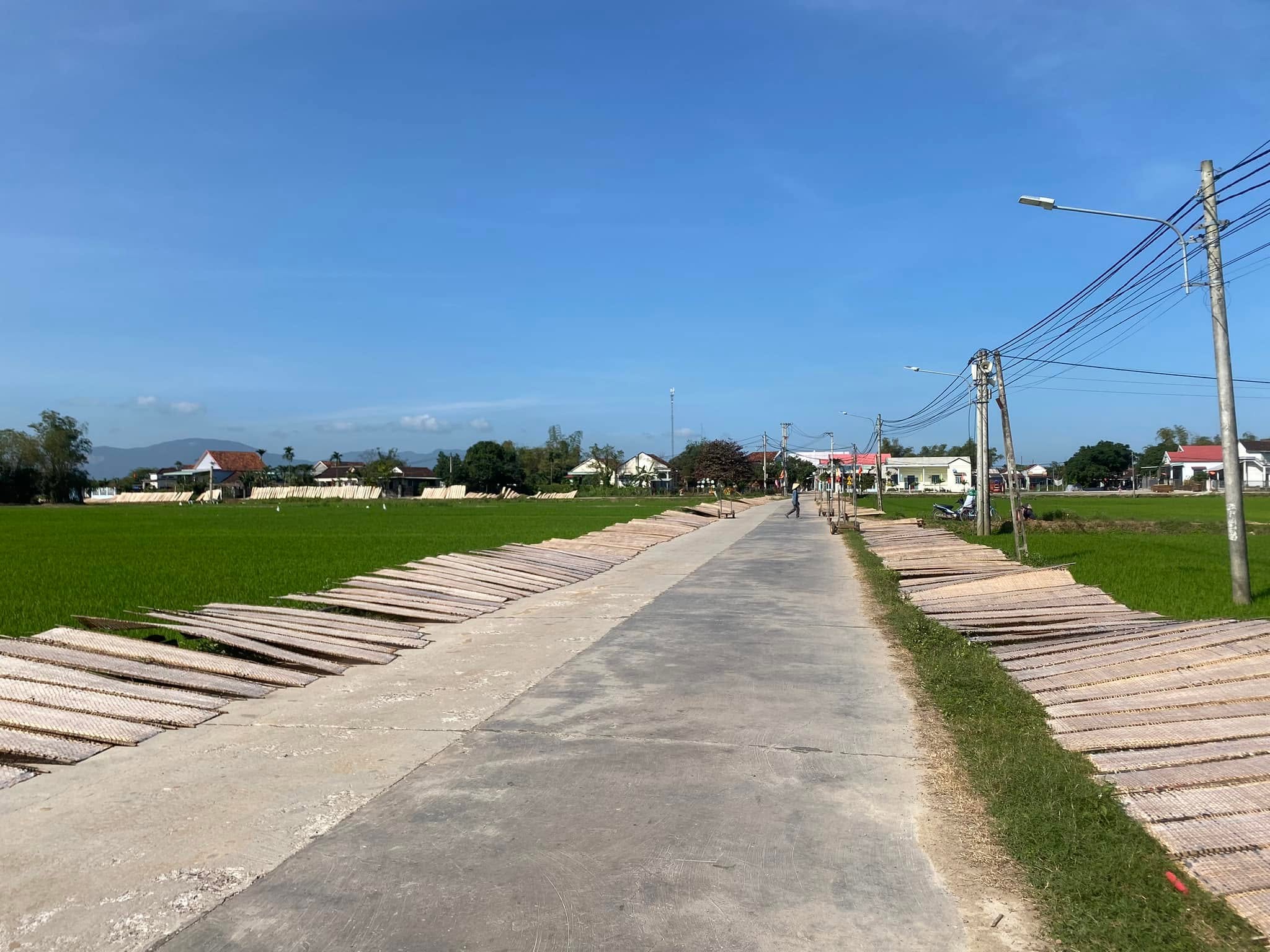
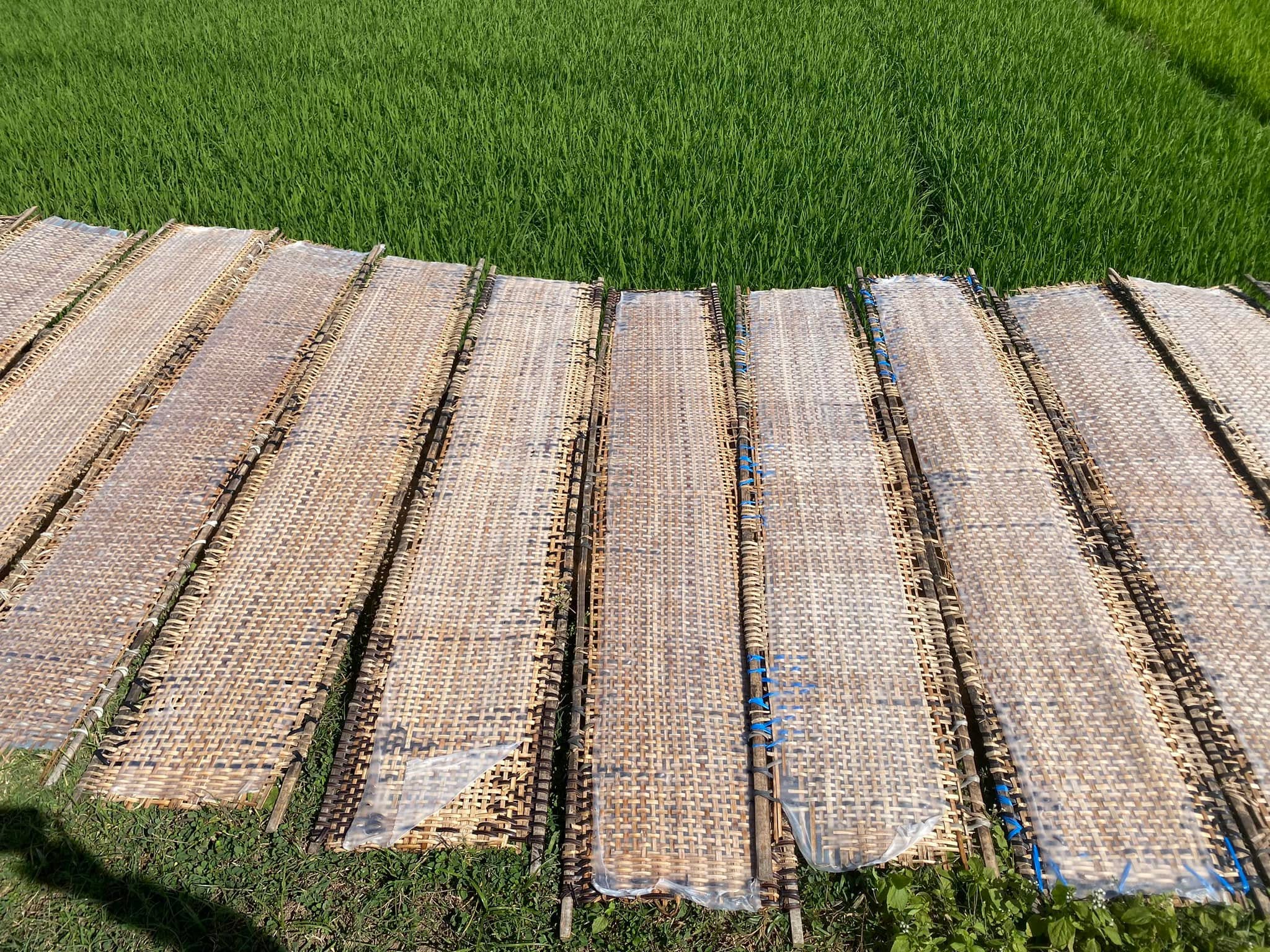
In An Nhon, Gia Lai Province, visitors traveling along the rural roads can easily spot rows of rice paper spread out to dry on bamboo trays and fences. These simple scenes are a familiar part of the countryside, revealing a traditional craft that has long been closely connected with the daily lives of local people.
Among the six hamlets in the area, Truong Cuu is known as the largest center of rice paper production, giving rise to the familiar name Truong Cuu Rice Paper Village.
Unlike the thin, white rice paper commonly found in many other places, Truong Cuu rice paper is characteristically thicker. Depending on the ingredients and the amount of sesame added, the finished sheets may have a dark or golden color. Their rustic appearance and distinctive texture have become part of the village’s culinary identity.
From Rice Grains to Sheets of Rice Paper
The process begins in the early morning. Rice is soaked before being ground into flour and mixed into a smooth batter. At the same time, the fire is lit beneath a large pot of boiling water. A piece of cloth is stretched tightly over the mouth of the pot to create the steaming surface.
Using a small ladle traditionally made from coconut shell, the maker scoops up the rice batter and spreads it evenly across the cloth. The sheet is then covered briefly so that it can steam and cook. Once ready, it is carefully lifted from the cloth with a bamboo slat or a large chopstick before being transferred onto bamboo trays for drying.
The technique may appear simple, but producing an evenly shaped sheet requires experience. The batter must have the right consistency, the amount poured onto the steaming surface must be controlled, and the maker’s hand must move steadily to create a smooth and even layer.
From a few basic ingredients, rice and water, together with sesame in some varieties, the villagers create a familiar food that has become a source of income for many rural households.
A Craft Shaped by the Hands of Rural Women
Rice paper making in Truong Cuu is closely associated with the women of the village. Their daily work begins early, with each stage of production following a rhythm passed down through generations of family experience.
The craft provides a stable livelihood while allowing families to remain closely connected to their homes and agricultural way of life. The sound of grinding rice, the warmth of the cooking fire and the sight of freshly steamed sheets being carried out to dry form a distinctive picture of everyday life in Truong Cuu.
The value of the craft therefore extends beyond the rice paper itself. It is also part of the village’s social and economic fabric, where knowledge is preserved through practice and handed from one generation to the next.
The Busy Season of Truong Cuu Rice Paper Village
While rice paper production takes place throughout the year, the village becomes particularly busy from around August until the twelfth lunar month, when demand rises in preparation for the Lunar New Year.
During this period, households often work from early morning into the evening, and sometimes at night, to keep up with orders. Bamboo trays filled with freshly made rice paper appear throughout the village, turning fences and open spaces into temporary drying areas.
According to the source material, an average household produces around 50 to 70 kilograms of rice paper per day, equivalent to roughly 40 traditional bundles. Some households can produce as much as 100 kilograms a day during busy periods.
The scale of production reflects the importance of the craft to the local economy. At a time when some traditional craft villages face increasing competition and declining markets, Truong Cuu has continued to expand, supported by stable demand, consistent quality, attractive appearance and reasonable prices.
A Rustic Flavor from Truong Cuu
The appeal of Truong Cuu rice paper lies partly in its simplicity. It carries the familiar flavor of rice and the rustic character of a traditional rural food.
The thicker sheets, together with sesame and their naturally darker or golden appearance, distinguish Truong Cuu rice paper from many other varieties. Each sheet reflects not only the ingredients used but also the skill and rhythm of the person making it.
For visitors, seeing the rice paper being steamed and dried offers a glimpse into a form of food production that remains deeply rooted in village life.
Experiencing Truong Cuu Rice Paper Village
A visit to Truong Cuu can be combined with a journey through the countryside of An Nhon. Rather than being defined by grand buildings or elaborate attractions, the village reveals itself through everyday scenes: steaming pots, bamboo drying trays, freshly made rice paper and the busy hands of local families.
Visitors can observe the traditional production process, learn about how rice paper is made and see how a rural household organizes its work during the peak season. The experience provides a closer connection to local food culture and to the people who continue to preserve the craft through their daily labor.
A Traditional Craft Sustained by Everyday Hands
Truong Cuu Rice Paper Village demonstrates how a traditional rural craft can remain relevant in contemporary life. Its continued development is closely tied to the ability of local households to maintain product quality, meet market demand and preserve the techniques that have become part of their way of life.
Behind every sheet of rice paper is a sequence of familiar but carefully practiced actions: soaking rice, grinding flour, tending the fire, spreading the batter, steaming the sheet and drying it under the sun.
These ordinary gestures give Truong Cuu its character. They are also what keep the village craft alive, allowing a simple food made from rice to continue its journey from the village kitchen to tables far beyond the place where it was made.
Basic Information
| Information | Details |
|---|---|
| Name | Truong Cuu Rice Paper Village |
| Vietnamese name | Làng bánh tráng Trường Cửu |
| Location | An Nhon, Gia Lai Province, Vietnam |
| Type | Traditional food craft village |
| Main product | Truong Cuu rice paper |
| Main ingredients | Rice, water and sesame |
| Main production period | Year-round, with peak production from August to the twelfth lunar month |
| Average production | Approximately 50–70 kg per household per day |
| Peak household production | Up to around 100 kg per day |
| Cultural value | Traditional food-making knowledge, rural livelihoods and community life |