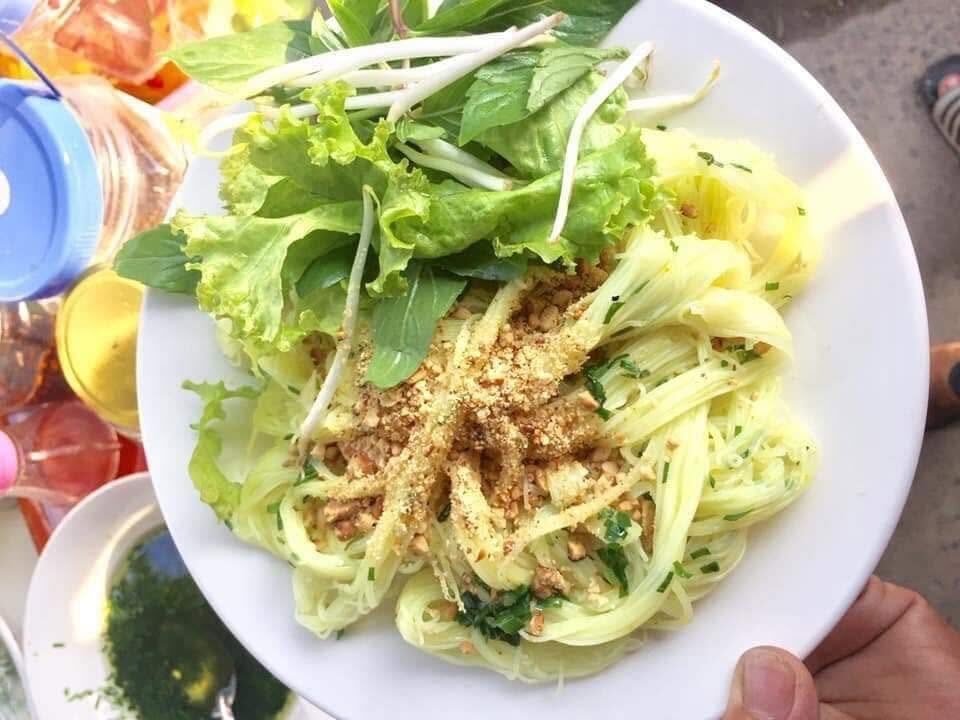
Banh day is a traditional local food originating in Bong Son, Hoai Nhon, Binh Dinh. Made primarily from rice, this simple dish has a distinctive preparation method that produces soft, chewy strands with a characteristic golden color.
From a familiar local food, Banh day has gradually become a specialty associated with Bong Son. The craft has been passed down through generations, preserving not only a traditional flavor but also a livelihood for families who continue to make the dish.
Today, the craft is concentrated mainly in Areas 5 and 6 of Bong Son. According to the source, around nine households continue to make Banh day professionally, with products reaching markets in Nha Trang, Gia Lai and Ho Chi Minh City. Banh day has also been selected as a distinctive Bong Son product under the OCOP program.
From Aged Rice to Bong Son’s Signature Food
One of the distinctive features of Banh day lies in its main ingredient. Unlike many rice-based cakes that can be made with freshly harvested rice, traditional Banh day requires aged rice that has been stored for several months after harvesting.
According to local experience, the rice is carefully selected and soaked in water. Once sufficiently soaked, it is drained and ground into flour. In the traditional method, the grinding was carried out using a stone mortar.
The rice flour is then processed with ash water made from coconut wood. This is one of the techniques associated with the distinctive character of Bong Son Banh day. The ash water contributes to the light golden color and influences the chewiness and texture of the noodles.
These simple ingredients, combined with generations of practical knowledge, produce a food with a distinctive structure and flavor.
A Traditional Process That Requires Experience
After processing, the rice flour is placed in a pot and stirred over low charcoal heat. The artisan must carefully monitor the consistency of the flour and adjust the process so that the mixture reaches the desired level of elasticity.
Once the dough reaches the appropriate consistency, it is removed, rolled or pressed and formed into strands. The strands are arranged into layers before being steamed.
Every stage affects the quality of the finished product. Flour that is too dry or too wet can result in strands that lack the desired chewiness. The artisan’s hand pressure during rolling and pressing also determines the consistency of the strands.
Although the ingredients are simple, making Banh day requires considerable experience. Skilled artisans can often judge the condition of the dough through touch and practical knowledge rather than relying entirely on precise measurements.
Soft, Chewy Golden Strands
After steaming, Banh day develops a light golden color and a soft yet chewy texture. The strands hold together without becoming overly soft, giving the dish a distinctive firmness and elasticity.
Its color and texture result from a series of interconnected stages, from selecting aged rice and soaking and grinding it to processing the flour with ash water, stirring, forming the strands and steaming them.
This process distinguishes Banh day from other rice-based foods. The name itself refers to the appearance of the strands, which are formed into elongated, intertwined pieces.
How Bong Son Banh Day Is Served
Banh day is commonly served with scallion oil, crushed roasted peanuts and diluted fish sauce. Fresh herbs and grilled rice paper may also accompany the dish.
Scallion oil adds fragrance and a gentle richness, while roasted peanuts contribute a nutty flavor. The fish sauce balances the dish, while fresh herbs and grilled rice paper provide freshness and crunch.
This way of serving reflects a characteristic feature of Binh Dinh’s traditional cuisine: simple ingredients are combined carefully to create a balanced and flavorful dish.
Banh day is not an elaborate food. Its appeal lies precisely in its simplicity and in the way local people have preserved a recipe that has become part of Bong Son’s culinary memory.
Banh Day Making and Local Livelihoods
Banh day making has long been associated with many families in Bong Son. Through generations, knowledge of rice selection, flour preparation, strand formation and steaming has been passed down within families and the community.
Today, the number of professional producers has declined, but the craft continues in parts of Bong Son. According to the source, production is concentrated in Areas 5 and 6, with approximately nine professional households.
The products are mainly sold locally, while some producers have expanded distribution to Nha Trang, Gia Lai and Ho Chi Minh City. This has allowed Banh day to move beyond the household kitchen and become a specialty product associated with Bong Son.
One of the establishments mentioned in the source is the Banh day workshop of Thach Thi Lien, whose products have reached markets outside the local area.
Banh Day in the Culinary Memory of Bong Son
Banh day is a distinctly local food. From aged rice, the people of Bong Son developed a unique preparation method that transforms a familiar agricultural ingredient into a food with its own shape, color, texture and way of serving.
The value of Banh day lies not only in its flavor. Behind every batch are the skills of the artisans, the stories of families that continue to preserve the craft and the memories of generations who grew up with this traditional food.
In modern life, when many traditional foods face shrinking production spaces, the continued making and distribution of Banh day demonstrates the enduring connection between a local specialty and its community.
Banh day can therefore be understood as part of Bong Son’s culinary memory, where rice, traditional craftsmanship and community life come together in a simple dish.
A Bong Son Specialty Preserved Through Tradition
Banh day has become one of the distinctive foods associated with Bong Son. Its inclusion among the local OCOP products has created additional opportunities for the traditional craft to reach new consumers and maintain its place in the market.
Yet the most important value of Banh day remains its connection with the locality. Its traditional recipe, processing techniques and serving style all developed from the everyday life of the people of Bong Son.
From a humble rice-based food, Banh day has become a recognizable specialty of Hoai Nhon. Each strand carries the flavor of rice, the skill of the artisan and the story of a traditional craft passed down through generations.
Basic Information
| Item | Information |
|---|---|
| Specialty | Bong Son Banh Day |
| Origin | Bong Son, Hoai Nhon, Binh Dinh |
| Main ingredient | Aged rice |
| Characteristics | Soft, chewy strands with a light golden color |
| Ingredient used for color and texture | Ash water made from coconut wood |
| Traditional process | Soaking rice, grinding flour, processing the flour, stirring, forming strands and steaming |
| Typical accompaniments | Scallion oil, roasted peanuts, diluted fish sauce, fresh herbs and grilled rice paper |
| Professional producers | Approximately 9 households, according to the source |
| Main production areas | Areas 5 and 6 of Bong Son |
| Markets | Local markets, Nha Trang, Gia Lai and Ho Chi Minh City |
| OCOP | Selected as a distinctive Bong Son product |
Cultural Value of Bong Son Banh Day
Bong Son Banh day is a traditional food closely associated with its locality, community and food-making knowledge. Its value comes from techniques for processing rice, preparing the flour, forming the strands and serving the dish, all of which have been transmitted through generations.
Within Binh Dinh’s culinary landscape, Banh day carries a distinctive Bong Son identity. Made from familiar ingredients, the dish demonstrates how local residents transformed agricultural products into a specialty while maintaining livelihoods and culinary memories through traditional food making.