The traditional craft of building houses from bamboo and nipa palm leaves in Cam Thanh is a distinctive expression of the cultural heritage of Hoi An, Da Nang City. Rooted in the natural environment of the Bay Mau Nipa Palm Forest, this centuries-old craft reflects the ingenuity of local communities in transforming familiar natural materials into durable, functional, and aesthetically appealing structures.
Cam Thanh is widely known for its lush nipa palm forests, winding waterways, and revolutionary history. During the resistance wars, the forest provided shelter and protection for local revolutionary forces. The September 1964 uprising, remembered for the use of weapons fashioned from nipa palm fronds, became an important event in the area’s historical memory.
Beyond its historical significance, the nipa palm forest has long provided essential materials for traditional house building. Combined with bamboo, nipa palm leaves have enabled generations of local artisans to develop specialized techniques for constructing houses suited to the riverine environment.
Today, the craft represents an important connection between traditional architecture, indigenous knowledge, environmental adaptation, and community-based tourism.
Cam Thanh and the Ecological Landscape of Bay Mau Nipa Palm Forest
Historically known as Thanh Chau Village or Commune, Cam Thanh was part of Thanh Chau Canton in Hoa Vang District during Vietnam’s feudal period. Located approximately 3 km southeast of Hoi An Ancient Town, the area is now part of Hoi An Dong Ward, Da Nang City.
Cam Thanh occupies a landscape shaped by rivers, canals, alluvial islands, and coastal wetlands. To the south and southwest lies the lower Thu Bon River, while the Ba Chuom River borders the east and northeast. The Do River flows along the northern and northwestern sides, with smaller waterways connecting these river systems.
The surrounding landscape includes places such as Thuan Tinh, Con Ong Hoi, Con Tien, Con Ba Xa, Go Hi, and Go Gia. Together, these waterways and alluvial formations create an intricate ecological environment characterized by extensive nipa palm vegetation.
Located near the Cua Dai Estuary and influenced by several major river systems, Cam Thanh possesses a distinctive estuarine mangrove ecosystem. Nipa palms thrive in this environment, forming dense green forests that provide habitats for birds, fish, and other aquatic species.
According to the source material, the nipa palm forest covers approximately 106.01 hectares, mainly distributed across Thanh Tam, Thanh Nhut, and Van Lang villages. Locally known as the Bay Mau Nipa Palm Forest, it helps protect riverbanks, retain sediment, moderate environmental conditions, and support biodiversity.
This ecosystem forms part of the wider natural landscape associated with the Cu Lao Cham – Hoi An World Biosphere Reserve, designated by UNESCO in 2009.
Bamboo is another important plant in Cam Thanh. Traditionally found along riverbanks, village paths, and household gardens, bamboo provides materials for household objects and building structures.
The availability of both bamboo and nipa palm leaves created favorable conditions for the development of a specialized traditional house-building craft.
Origins and Development of Bamboo and Nipa Palm House Building
Between the 16th and 18th centuries, Thanh Chau developed an active maritime trading tradition. Its proximity to the international trading port of Hoi An enabled local merchants to travel along the central Vietnamese coast and establish commercial connections with southern regions.
According to local historical accounts, merchants operating traditional sailing vessels known as ghe bầu brought nipa palm seedlings from southern Vietnam to Cam Thanh. The plants adapted to the area’s brackish wetlands and gradually developed into extensive forests.
Along with the plants, local residents acquired knowledge of using nipa palm leaves as roofing and wall materials.
Drawing on these resources, Cam Thanh artisans developed a distinctive building method in which bamboo formed the structural framework, while nipa palm leaves provided roofing, walls, and doors.
Over generations, the craft expanded beyond local household needs. Artisans began producing building materials and constructing houses for neighboring communities, and their techniques spread to areas such as Cam Chau, Cam An, and Cam Kim.
Traditional houses generally followed three-bay or five-bay layouts, sometimes incorporating additional side sections. Their construction reflected the practical requirements of local families and the environmental conditions of a coastal river settlement.
More recently, artisans have adapted traditional techniques to create structures for ecological tourism, restaurants, accommodation facilities, and recreational spaces. These contemporary applications have introduced the craft to new audiences while retaining many of its characteristic materials and construction methods.
Traditional Materials and Indigenous Knowledge
The quality of a bamboo and nipa palm house depends heavily on the selection, preparation, and treatment of its materials.
According to the source, Cam Thanh artisans traditionally use more than 40 types of tools across the different stages of production, from harvesting bamboo and preparing palm leaves to assembling structural components and completing a house.
Each stage requires specialized knowledge acquired through practical experience.
Selecting and Treating Bamboo
Artisans generally select mature bamboo approximately four to five years old because of its strength and resistance to deterioration.
Traditional experience identifies the first lunar month as a favorable time for harvesting bamboo. After cutting, bamboo poles are submerged in muddy water or specially prepared pits along local waterways for approximately one to one and a half years.
The poles are carefully arranged, secured with stakes, covered with nipa palm leaves, and buried beneath a layer of earth.
This prolonged treatment is traditionally used to improve durability and reduce damage caused by insects.
Once removed from the water, the bamboo is dried and sorted according to its intended structural function.
Long, straight poles of relatively uniform size are selected for roof purlins. Stronger sections are used for rafters, beams, and other load-bearing elements. Smaller pieces are prepared for joints, fastening components, wall frames, and doors.
Artisans apply different selection criteria to each component, demonstrating a detailed understanding of bamboo’s physical properties.
Harvesting and Preparing Nipa Palm Leaves
Nipa palm leaves are equally important.
According to local artisans, palms growing in sandy soil often produce stronger material than those growing in muddy areas. Such leaves are traditionally preferred for roofing.
Nipa palms can generally begin providing harvestable leaves after approximately five years of growth. Harvesting traditionally takes place twice a year, during the third and eighth lunar months.
Workers cut mature fronds while preserving younger leaves and growing shoots to support future regeneration.
After harvesting, the fronds are transported by boat or carried to processing areas. Depending on their intended use, artisans separate the leaflets from their central ribs or split the fronds into sections.
The materials are then arranged, dried, bundled, and stored in dry conditions. Drying typically takes around 10 to 20 days, depending on the weather.
Proper bundling is an important skill. Artisans must keep the ribs straight and prevent the leaves from breaking or becoming damaged.
Some dried leaves are traditionally soaked again in clean, well-ventilated water for approximately one week before being dried a second time. This additional treatment is believed to improve their durability and resistance to insects.
The prepared materials are used for roofing panels, wall screens, doors, ceiling coverings, and other household or architectural components.
These practices illustrate the close relationship between traditional craftsmanship and local knowledge of plant resources.
Traditional House-Building Techniques
A traditional Cam Thanh bamboo and nipa palm house consists of two principal systems: a bamboo load-bearing framework and an enclosure system made primarily from nipa palm leaves.
The bamboo framework includes columns, rafters, beams, purlins, and the roof ridge. Palm leaves are used to create roofing panels, walls, doors, and other protective elements.
The house is generally constructed on elevated ground, taking account of the surrounding landscape and local environmental conditions.
Preparing the Structural Framework
Before construction begins, artisans determine the house’s dimensions, layout, foundation height, and structural requirements.
Bamboo poles are selected according to the function of each component. Particular attention is given to the roof ridge, traditionally regarded as the backbone of the house.
According to folk beliefs, bamboo chosen for this element should be straight, strong, and neither excessively old nor too young.
Some construction decisions also reflect traditional architectural beliefs, including the selection of favorable measurements using the Lu Ban ruler and customary practices concerning the orientation of structural components.
Historically, artisans relied on hand saws, chisels, drills, knives, and other manual tools. Modern equipment has made certain operations easier, but traditional knowledge remains essential to the preparation and assembly of the structure.
Making Nipa Palm Roofing Panels
Roofing panels are produced by arranging dried nipa palm sections closely together and fastening them to bamboo strips.
Artisans use bamboo tools to secure the leaves, traditionally tying them with rattan fibers and, more recently, synthetic cord.
A completed panel is generally about one meter wide.
The bamboo fastening strips are spaced to correspond with the roof’s structural framework, allowing the panels to be attached securely during construction.
Depending on the building’s dimensions and roof design, different panel sizes and arrangements may be used.
The work requires careful alignment, consistent fastening, and considerable manual precision.
Making Walls and Doors
Traditional nipa palm walls are produced in several styles, including leaf panels, combinations of leaves and palm ribs, and single- or multiple-layer constructions.
Panels may be made as continuous walls or designed to accommodate doorways, windows, and ventilation openings.
Doors typically consist of bamboo frames covered with layered nipa palm leaves.
Many traditional houses feature outward-opening doors supported by bamboo poles. These poles can also serve as fastening devices when the doors are closed.
Other components, including protective coverings at the ends of roof purlins, are prepared using similar bamboo and palm-leaf techniques.
Assembling the House
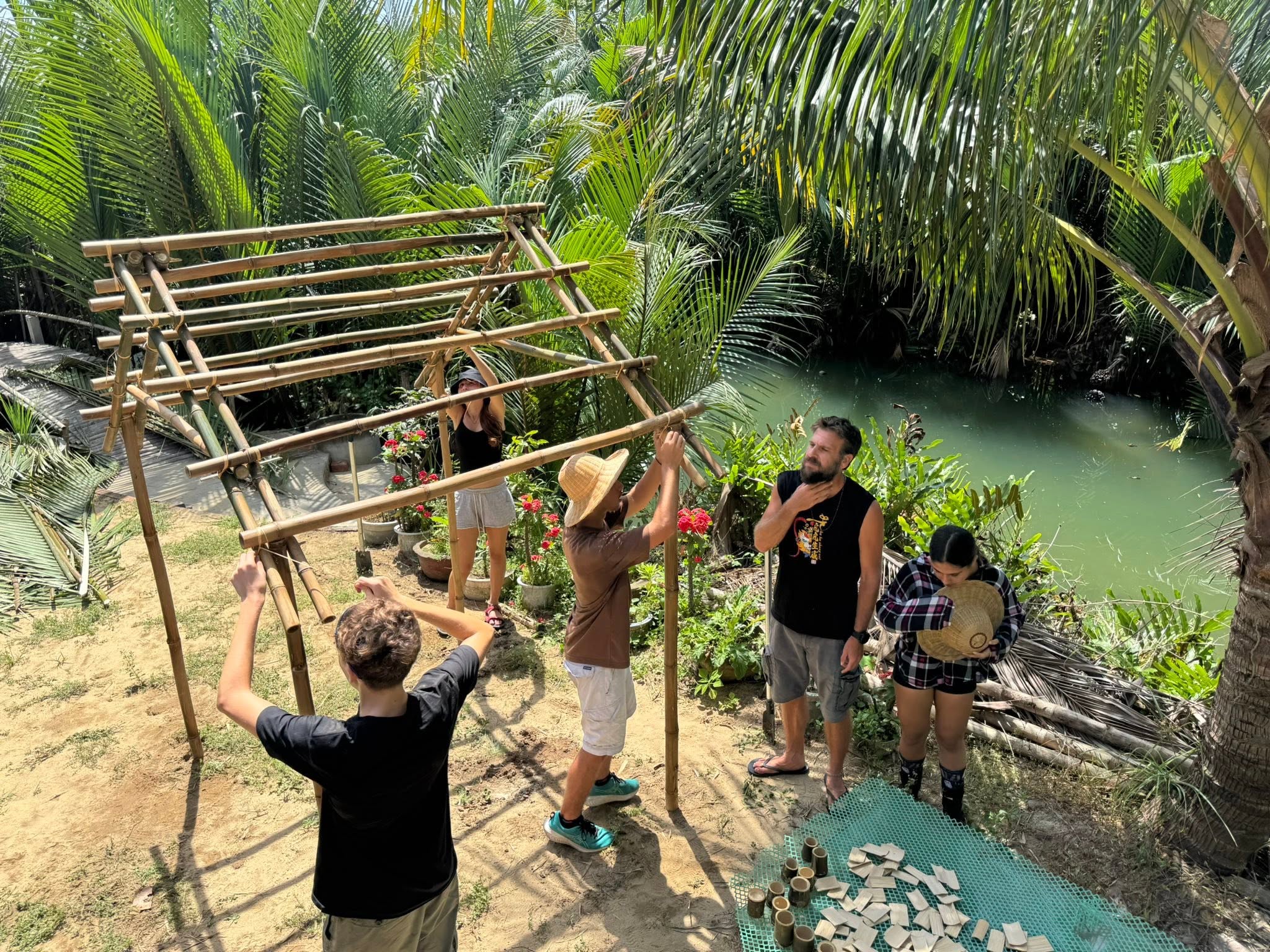
House assembly is one of the most demanding stages and requires coordinated work among several artisans.
The prepared bamboo components are transported to the building site. Rafters and beams are connected using bamboo joints, while roof components are secured with rattan or other binding materials.
The rear and front columns are positioned, and temporary supports are used to raise and stabilize the roof framework.
Artisans carefully adjust the height, spacing, and alignment before securing the columns in the ground.
Once the framework is stable, roofing panels are installed from the lower sections upward. The roof ridge is covered with additional nipa palm leaves and secured with bamboo.
Wall panels, doors, windows, and finishing components are then installed to complete the house.
The entire process combines practical construction knowledge, manual craftsmanship, teamwork, and traditional architectural customs.
Cultural Values and Community Life
Bamboo and nipa palm house building is more than a construction technique. It represents generations of accumulated knowledge about local natural resources, settlement patterns, and the relationship between people and their environment.
The craft demonstrates how Cam Thanh residents have adapted available materials to meet their everyday needs while developing distinctive architectural forms.
Although the craft does not have a separate founding ancestor or an independent system of occupational worship, artisan families traditionally participate in village ceremonies honoring early settlers and praying for peace, favorable weather, and prosperity.
The craft also preserves a rich vocabulary of specialized terms relating to materials, tools, building components, and construction methods.
These expressions form part of the community’s intangible cultural knowledge and are transmitted through practical instruction and shared experience.
For generations, artisans have refined their techniques to improve structural strength, appearance, and material efficiency. Their skills have also enabled them to create new products and architectural forms in response to changing social and economic needs.
Traditional Craft and Sustainable Tourism
The growth of tourism in Cam Thanh has created new opportunities for bamboo and nipa palm craftsmanship.
The Bay Mau Nipa Palm Forest is now associated with ecological and community-based tourism, introducing visitors to the natural environment and traditional livelihoods of the area.
Bamboo and nipa palm structures are increasingly used in tourism facilities, recreational spaces, and landscape design. Their natural appearance and connection to local building traditions make them especially suitable for settings that seek to reflect the character of Hoi An’s riverine countryside.
Visitors may also gain insight into traditional techniques through craft demonstrations and opportunities to observe artisans preparing materials or producing building components.
However, the long-term future of the craft depends on maintaining a balance between economic development and environmental conservation.
Protecting the nipa palm forest, harvesting materials responsibly, and encouraging younger generations to learn traditional skills are essential to preserving both the craft and the ecosystem on which it depends.
Recognition as National Intangible Cultural Heritage
The traditional craft of bamboo and nipa palm house building in Cam Thanh, Hoi An, has been recognized as part of Vietnam’s National Intangible Cultural Heritage.
The ceremony celebrating this recognition took place on September 27, 2024, coinciding with the commemoration of the 60th anniversary of the September 1964 Cam Thanh uprising, according to the source material.
This recognition highlights the cultural significance of the craft, particularly its traditional construction techniques, indigenous environmental knowledge, and intergenerational transmission.
It also acknowledges the contribution of local artisans to the cultural identity of Hoi An.
Today, bamboo and nipa palm house building remains an important expression of Cam Thanh’s heritage. Its preservation is closely connected to the protection of the Bay Mau Nipa Palm Forest, the continuation of traditional skills, and the responsible development of cultural and ecological tourism.
From bamboo frameworks to carefully woven palm-leaf roofs, each structure tells a story of adaptation, craftsmanship, and the enduring relationship between the people of Cam Thanh and their natural surroundings.
Basic Information
| Item | Details |
|---|---|
| Heritage name | Traditional Bamboo and Nipa Palm House Building in Cam Thanh |
| Location | Hoi An Dong Ward, Da Nang City, Vietnam |
| Cultural landscape | Cam Thanh and Bay Mau Nipa Palm Forest |
| Main materials | Bamboo, nipa palm leaves, palm ribs, rattan and binding materials |
| Traditional products | Bamboo and nipa palm houses, roofing panels, wall screens, doors and architectural components |
| Main techniques | Bamboo treatment, palm-leaf preparation, roofing-panel weaving, structural assembly and house construction |
| Traditional house types | Three-bay and five-bay houses, with or without side extensions |
| Cultural significance | Indigenous knowledge, traditional architecture, environmental adaptation and community craftsmanship |
| Heritage recognition | National Intangible Cultural Heritage |
| Recognition ceremony | September 27, 2024 |