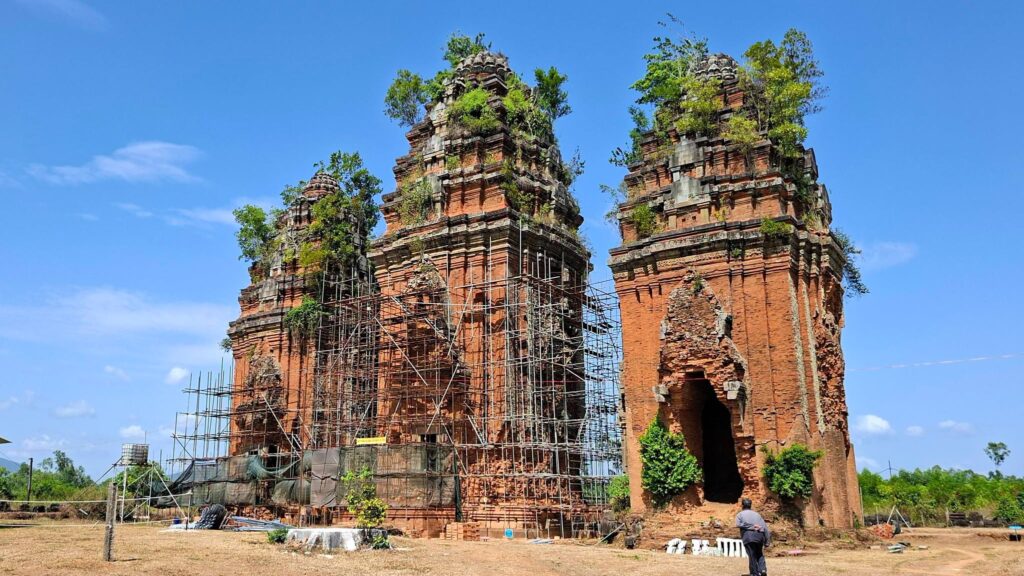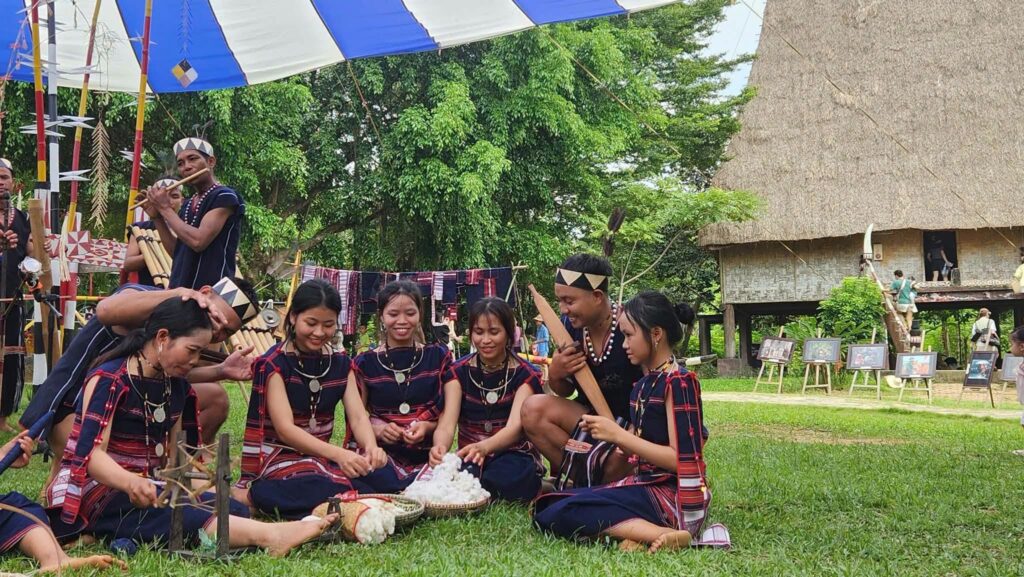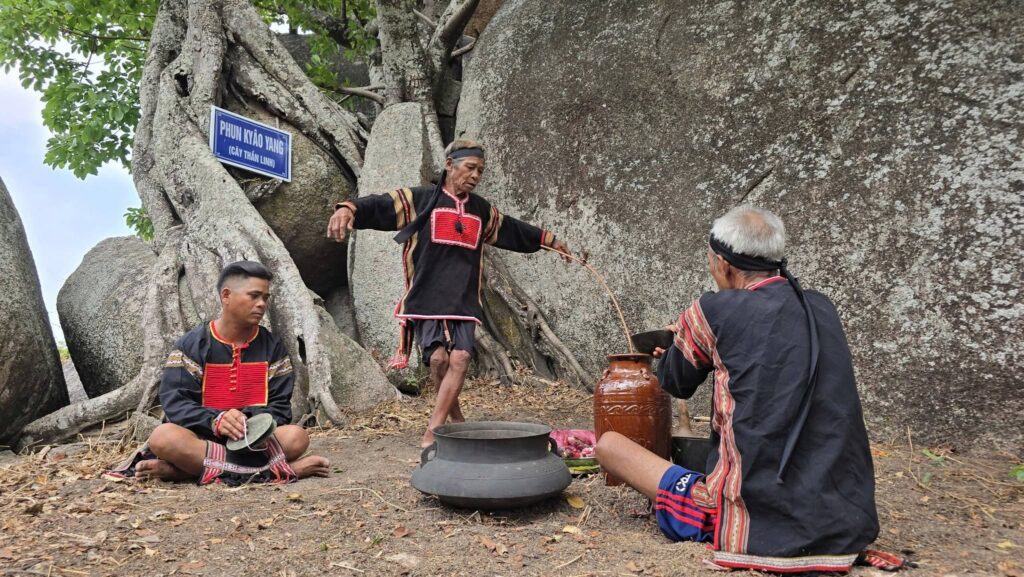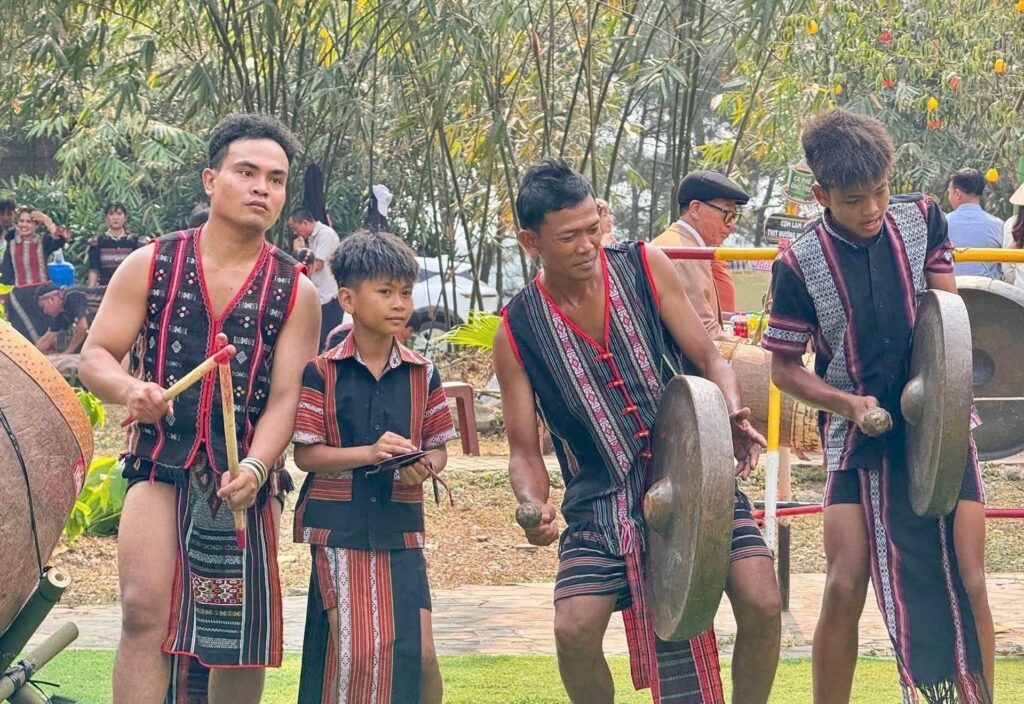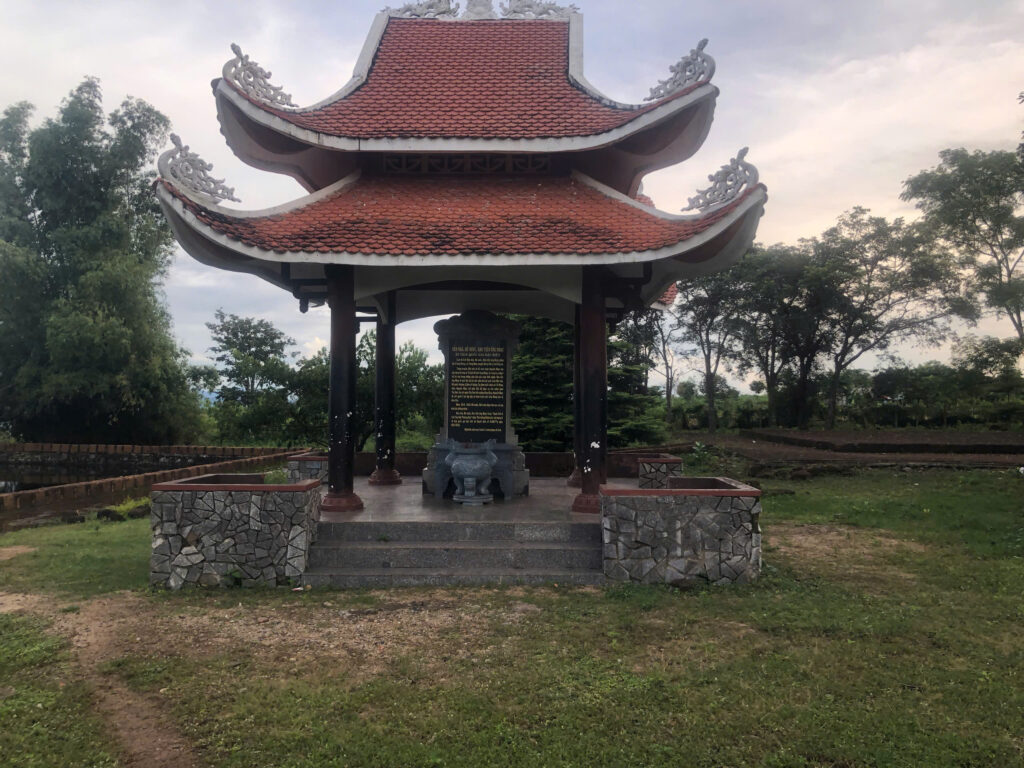
Champa An Phú Archaeological Site is located in Group 11, An Phú Ward, Gia Lai Province. It is an archaeological site of significant historical, cultural and scientific value, providing important evidence for the study of Champa culture, religion and architecture in the Central Highlands.
The site is also known by several names, including Ông Đàn Mound, Gò Tháp, Phú Thọ Cham Tower, An Phú Cham Tower and Rông Yang. From the late 19th to the early 20th century, the site was surveyed and documented by Western priests and French scholars. After decades of agricultural use, excavation and severe alteration, the site was rediscovered through field research in 2021 and subsequently investigated through archaeological excavations in 2023 and 2024.
On 7 August 2026, the People’s Committee of Gia Lai Province issued Decision No. 3317/QĐ-UBND, officially recognizing Champa An Phú as a provincial-level historical and cultural relic. The site covers more than 8,400 m², including Protection Zone I and Protection Zone II. The recognition provides an important legal foundation for protecting, researching and promoting the values of this remarkable archaeological heritage site.
Traces of a Champa Religious Complex in An Phú
What remains visible at An Phú today is largely the archaeological remains of an ancient architectural complex. Excavations, however, have gradually revealed its original layout and provided evidence that the site once served as a religious center.
The name Rông Yang appears in several early records and may have originated from local indigenous terminology. Local Kinh communities have used names such as Ông Đàn Mound, Gò Tháp and Đồng Tháp for the elevated area where the remains are located.
Archaeological evidence indicates that the Champa people occupied this area and established a religious structure here. Particularly significant is the discovery of a sacred deposit, which reveals a carefully organized ritual system associated with the construction and consecration of the religious complex.
Current research indicates that the site was likely a Buddhist religious structure built by the Champa people, with elements associated with Tantric traditions originating in northern India.
Early Records from the Late 19th and Early 20th Centuries
Champa An Phú was already known to Western researchers more than a century ago. During the late 19th and early 20th centuries, a number of priests, scholars and researchers surveyed and documented the remains.
Those who recorded or studied the site included Martial Jannin in 1906; Henri Parmentier in 1906 and 1909; Henri Maspero in 1919; Jean-Yves Claeys in 1928; Jacques Dournes in 1966; and Gerald Hickey in 1967.
These early records are particularly valuable today because many architectural elements of the site have since been destroyed or altered. Comparing the historical descriptions with modern archaeological evidence has enabled researchers to reconstruct aspects of the site’s original appearance.
Later, Kinh communities from central Vietnam, particularly Quảng Ngãi and Bình Định, migrated to the area, established settlements and cultivated the land. Bricks and stones from the Champa ruins were reused for local construction.
During the 1960s and 1970s, the site suffered extensive damage, leaving only fragments of wall foundations, bricks and stones. Further digging during the 1980s and 1990s transformed the former mound into a depression. Much of the present surface has subsequently been filled and leveled for agricultural use.
From a Forgotten Ruin to Rediscovery
Following Gerald Hickey’s research in 1967, Champa An Phú received little further scholarly attention for several decades.
The site was mentioned again in 2019 in History of Gia Lai from Its Origins to 1975 by Dr. Nguyễn Thị Kim Vân, former Director of Gia Lai Museum.
In 2021, a team from Pleiku Museum, including Lưu Hồng Sơn, Hồ Xuân Toản and Huỳnh Bá Tính, conducted a field survey around Phú Thọ Church and identified traces displaying characteristics of Champa architecture.
Nguyễn Quang Tuệ, from the Department of Cultural Management under the Gia Lai Department of Culture, Sports and Tourism, subsequently continued field investigations and published information about the findings in Báo Gia Lai. These discoveries attracted renewed attention from researchers and laid the foundation for further archaeological investigations.
In 2022, Pleiku Museum contacted the Center for Archaeology of the Southern Institute of Social Sciences to develop a systematic archaeological survey and excavation program. Excavations were subsequently conducted in 2023 and 2024.
Archaeological Excavations in 2023
The 2023 excavation helped clarify the structure of the site’s enclosure wall and revealed further remains of the central architectural foundation.
The Enclosure Wall
The enclosure has an approximately square plan, with each side measuring around 32-33 meters and the wall base approximately 1.4-1.5 meters wide. The wall was constructed from large bricks measuring approximately 38-40 × 19-20 × 6.0-6.5 cm.
It was built on a natural mound of lateritic gravel. In the southern section, researchers also identified a laterite slab surface close to the foundation. Some areas suggest that the ground may have been leveled before construction.
The enclosure consisted of a stone foundation and brick wall. The stone foundation was laid relatively tightly and evenly on the ground. The brick wall was constructed in two stepped levels, consisting of a lower base and an upper wall. The lower section was wider, while the upper section became narrower.
Whole bricks were arranged horizontally and vertically along the outer edges, while the inner core contained broken or partially intact bricks laid in courses.
Differences in construction techniques and materials, particularly in the southern section, suggest that the enclosure may have undergone several phases of construction and repair.
The Central Architectural Foundation
Test pits in the central area revealed surviving sections of the foundation of the principal structure.
This discovery provides concrete archaeological evidence supporting earlier descriptions of ancient architecture at An Phú and creates a basis for further research into the site’s layout, function and chronology.
The 2023 excavation also raised important questions concerning the exact date of construction and the position of An Phú within the broader network of Champa sites in the Central Highlands and Central Vietnam.
Early Finds
The excavation uncovered gold and terracotta materials. The gold assemblage included five small fragments discovered in disturbed soil in the southeastern corner of the enclosure.
Terracotta finds consisted mainly of construction bricks, including square bricks, thick bricks, broken bricks and intact rectangular bricks. Some retained stepped notches along their corners, suggesting that the enclosure may originally have incorporated simple decorative courses.
The 2024 Excavation and Discovery of the Sacred Deposit
The 2024 excavation produced particularly important discoveries, providing a clearer understanding of both the architectural structure and religious character of Champa An Phú.
The enclosure was found to be almost completely identifiable as a square, with each side measuring approximately 32-33 meters. The central sections of the southern, northern and western sides featured stepped projections, while the eastern side had been heavily disturbed.
Only part of the main architectural foundation survived in the southern and southwestern areas. More importantly, beneath the stone foundation, archaeologists discovered a structure dug into the natural soil and identified it as a sacred deposit.
The Swastika-Shaped Sacred Deposit
The sacred deposit is among the most important discoveries at An Phú.
The structure features multiple angular sections reinforced with sand and stone. At its center is a circular frame formed by bricks arranged in the shape of a swastika. Inside this structure was a collection of ritual offerings.
The base surrounding the central structure was reinforced and carefully filled with clean sand.
Inside the sacred deposit, archaeologists discovered a remarkable assemblage of gold objects, gemstones and glass.
This discovery is significant because the sacred deposit provides new information about religious rituals, the character of the architectural complex, its chronology and its relationship with comparable religious structures in Central Vietnam, the Central Highlands, Southeast Asia and India.
The Gold Ritual Offering Assemblage
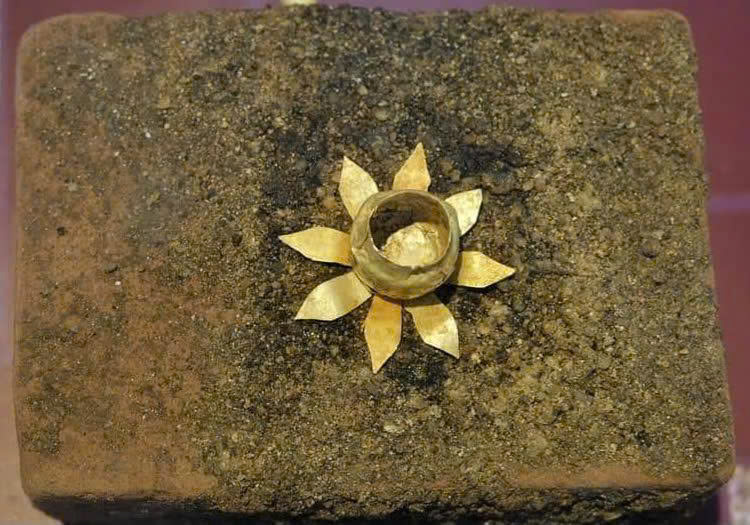
Among the most notable objects recovered from the central sacred deposit are a gold kamandalu vessel, a lotus flower, gold sheets bearing ancient inscriptions, as well as gemstones and glass objects.
These objects were deposited as ritual offerings to a deity or religious figure associated with the structure.
Particularly noteworthy is a small vessel placed within an eight-petaled gold lotus, resting on a brick pedestal at the center of the deposit. This arrangement has been studied in connection with symbolic traditions associated with Brahma in Indian religious culture.
The deposit also contained pieces of glass in different colors, which may have had symbolic associations with directions and light within the ritual system.
One of the gold sheets has been preliminarily interpreted as containing text related to the Buddhist Verse of Dependent Origination.
Buddhist and Tantric Elements
Current research suggests that An Phú was a Buddhist religious structure built by the Champa people.
In addition to the inscription associated with the Verse of Dependent Origination, earlier records reportedly mentioned a bronze standing statue on a stone pedestal and a female deity depicted in the lalitasana posture. These elements raise the possibility that the site incorporated aspects of Tantric traditions originating in northern India.
The sacred deposit may have been directly associated with rituals involving the placement of the first brick and the consecration of the site before construction. Similar practices have existed within Hindu temple and Buddhist architectural traditions in South Asia and Southeast Asia.
The sacred deposit at An Phú is particularly noteworthy when considered alongside ancient religious architectural sites in the Central Highlands, Central Vietnam and the wider Southeast Asian region.
Dating the Champa An Phú Site
The 2023 excavation initially placed the site around the 13th-14th centuries, while also raising the possibility of an earlier date.
Evidence from the 2024 excavation, combined with comparisons of the sacred deposit and ritual offerings, suggests that the complex may have been established considerably earlier, possibly around the 9th-10th centuries, and remained in use until approximately the 12th-13th centuries.
Certain characteristics of An Phú can be compared with archaeological structures at Đại Hữu, Phong Lệ, Po Nagar and Hòa Lai, as well as Buddhist-related sites associated with the later Óc Eo cultural tradition, including Gò Xoài and Chùa Lò Gạch.
This chronological framework remains subject to further archaeological and interdisciplinary research.
An Phú within the Champa Archaeological Network
One important issue in the study of Champa An Phú is determining the relationship between locations recorded in early historical documents and the archaeological remains identified today.
Historical sources indicate that the area may once have contained two locations referred to as Rong Yang and Bơmong Yang. However, the architectural remains of both places have become extremely difficult to identify.
Comparisons between early descriptions and recent fieldwork suggest that the present An Phú site has many characteristics corresponding to the location historically known as Bơmong Yang. This has led researchers to propose that Rong Yang may have been located around the present-day Phú Thọ Church area, more than 500 meters west-northwest of An Phú.
Older records concerning Bơmong Yang also mention a stone statue of a female deity, approximately 0.5 meters high, seated in a royal posture. The statue was reportedly transferred to Kon Tum during the French colonial period.
These records provide important material for continuing research into the network of Champa sites in the region.
Archaeological and Scientific Significance
Research and excavation conducted between 2021 and 2024 have provided an important body of evidence concerning Champa An Phú.
From a ruin previously known primarily through historical descriptions, An Phú has now yielded concrete archaeological evidence of an enclosure wall, central architectural foundation, sacred deposit and ritual offering assemblage.
The correspondence between archaeological discoveries and descriptions recorded by researchers such as M. Jannin, H. Maspero and J.Y. Claeys is particularly valuable, linking historical documentation with archaeological evidence from the site itself.
These discoveries contribute to the study of the history, culture and society of Gia Lai and the Central Highlands, while also expanding knowledge of the geographical reach and development of Champa culture in the region.
The Gold Ritual Assemblage Becomes a National Treasure
Based on research and excavations conducted between 2021 and 2024, Pleiku Museum prepared a scientific dossier in 2025 proposing the recognition of Champa An Phú as a provincial archaeological relic. A separate dossier was also prepared proposing national-treasure status for the gold ritual assemblage discovered inside the sacred deposit.
On 3 February 2026, the gold ritual offering assemblage from Champa An Phú was officially recognized as a National Treasure under Decision No. 236/QĐ-TTg of the Prime Minister, as part of the 14th batch of nationally recognized treasures.
The recognition represents an important milestone in the study and preservation of Champa An Phú and confirms the exceptional significance of the gold objects recovered from its sacred deposit.
Provincial Heritage Recognition and Conservation
On 7 August 2026, the People’s Committee of Gia Lai Province issued Decision No. 3317/QĐ-UBND, officially recognizing Champa An Phú as a provincial-level relic.
The site covers more than 8,400 m², including Protection Zone I and Protection Zone II. An Phú Ward is responsible for managing, protecting and promoting the site’s heritage values in accordance with cultural heritage regulations.
The official recognition establishes an important legal foundation for archaeological protection, research, planning and future heritage development.
With its architectural remains, sacred deposit, gold ritual offerings and Buddhist-related evidence, Champa An Phú opens new avenues for understanding the relationship between Champa culture, the Central Highlands, Central Vietnam and the broader cultural networks of Southeast Asia.
Quick Information
| Item | Information |
|---|---|
| Name | Champa An Phú Archaeological Site |
| Other names | Ông Đàn Mound, Gò Tháp, Phú Thọ Cham Tower, An Phú Cham Tower, Rông Yang |
| Type | Archaeological relic |
| Location | Group 11, An Phú Ward, Gia Lai Province, Vietnam |
| Estimated date | Approximately 9th-10th to 12th-13th centuries |
| Character | Champa religious architecture with Buddhist elements |
| Main structures | Enclosure wall, central architectural foundation and sacred deposit |
| Enclosure | Square plan, approximately 32-33 m per side |
| Wall base | Approximately 1.4-1.5 m wide |
| Construction bricks | Approximately 38-40 × 19-20 × 6.0-6.5 cm |
| Major discovery | Sacred deposit featuring a swastika-shaped brick structure |
| Notable artifacts | Gold kamandalu, gold lotus, inscribed gold sheets, gemstones and glass |
| Religious evidence | A gold sheet preliminarily associated with the Buddhist Verse of Dependent Origination |
| National Treasure | Gold ritual offering assemblage |
| National Treasure decision | Decision No. 236/QĐ-TTg, 3 February 2026 |
| Heritage status | Provincial-level relic |
| Recognition decision | Decision No. 3317/QĐ-UBND, 7 August 2026 |
| Area | More than 8,400 m² |
| Protection zones | Protection Zone I and Protection Zone II |
| Main archaeological research period | 2022-2024 |
| Outstanding values | Archaeology, history, Champa culture, religion and Buddhist studies |
Location: Champa An Phú Archaeological Site, Group 11, An Phú Ward, Gia Lai Province, Vietnam.