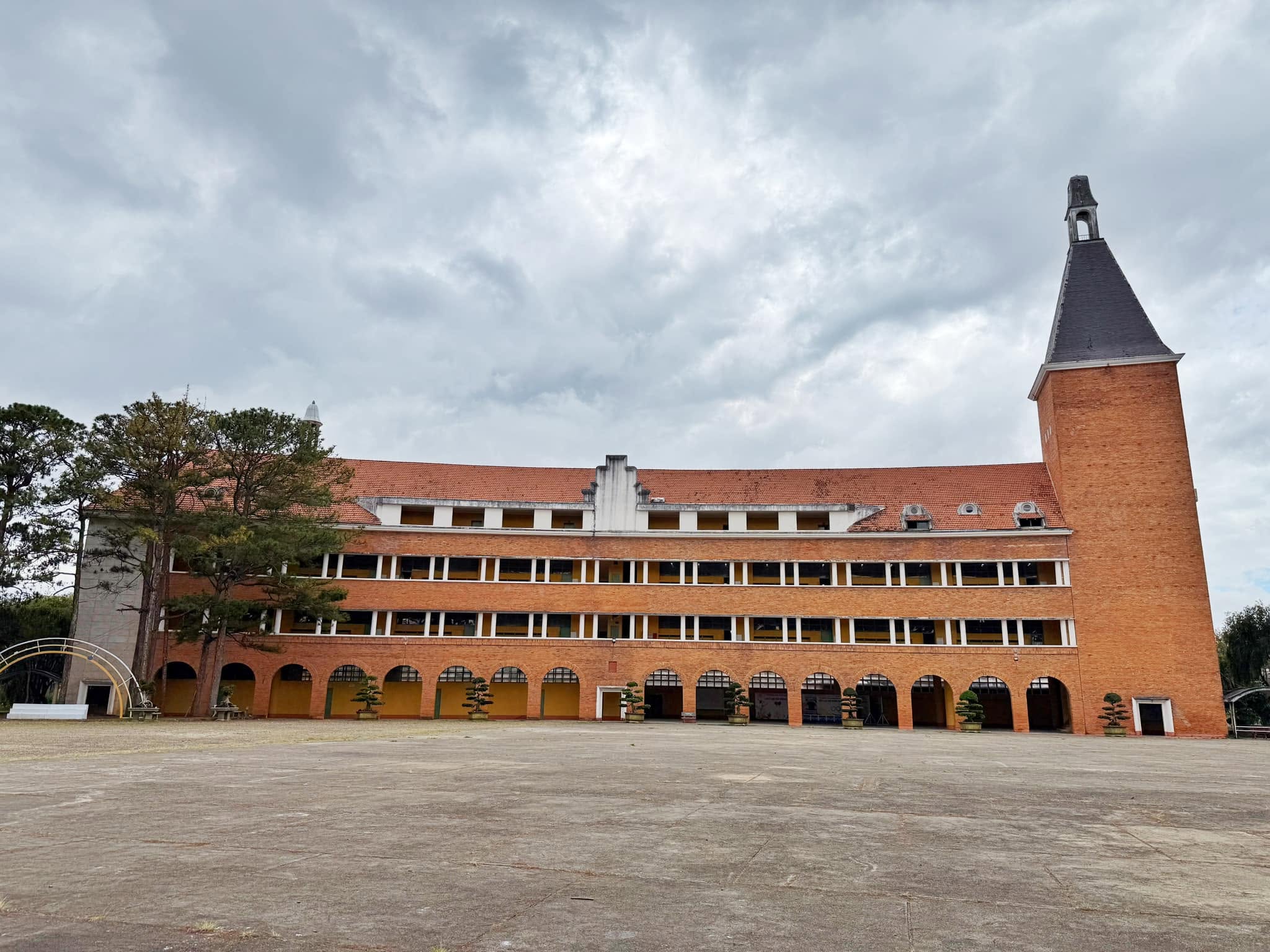
Located on Yersin Street amid the green landscape of Da Lat, the Da Lat College of Education is one of the city’s most distinctive historic architectural landmarks. Formerly known as Lycée Yersin, the school was built during the period when the French were developing Da Lat as a highland resort city.
With its characteristic curved main building, soaring bell tower and weathered red-brick walls, the school has become one of the familiar architectural images of Da Lat. Yet its significance extends far beyond its architecture.
Few visitors may know that in 1946, this very school became the venue for the Da Lat Preparatory Conference, an important diplomatic event held during a particularly turbulent period in Vietnam’s history.
From Lycée Yersin to Da Lat College of Education
Construction of the complex began in 1927 under the design and direction of French architect Paul Moncet, and was completed in 1935.
The school was initially known as Petit Lycée de Dalat before developing into Grand Lycée de Dalat. In 1935, it was renamed Lycée Yersin in honor of physician Alexandre Yersin, whose work was closely associated with the exploration of the Lang Biang Plateau and the early history of Da Lat.
During its early years, the school primarily served children of French families and a number of well-off Vietnamese families.
After 1975, the complex was taken over and became an educational institution serving the local community. On September 3, 1976, Da Lat College of Education was officially established here, providing teacher training and educational personnel for Lam Dong and the Central Highlands.
In 2001, the architectural complex was recognized as a National Architectural and Artistic Monument, affirming its special value within Da Lat’s architectural heritage.
From 2022, Da Lat College of Education was merged into Da Lat College. The campus on Yersin Street continues to play an important role in the institution’s activities.
Distinctive Architecture Amid Da Lat’s Pine Hills
One of the first things visitors notice at Da Lat College of Education is the main building’s graceful curved form.
The building follows an arc across the hillside, embracing the school courtyard. This distinctive curve is often associated with the image of an open book, an appropriate architectural metaphor for an educational institution.
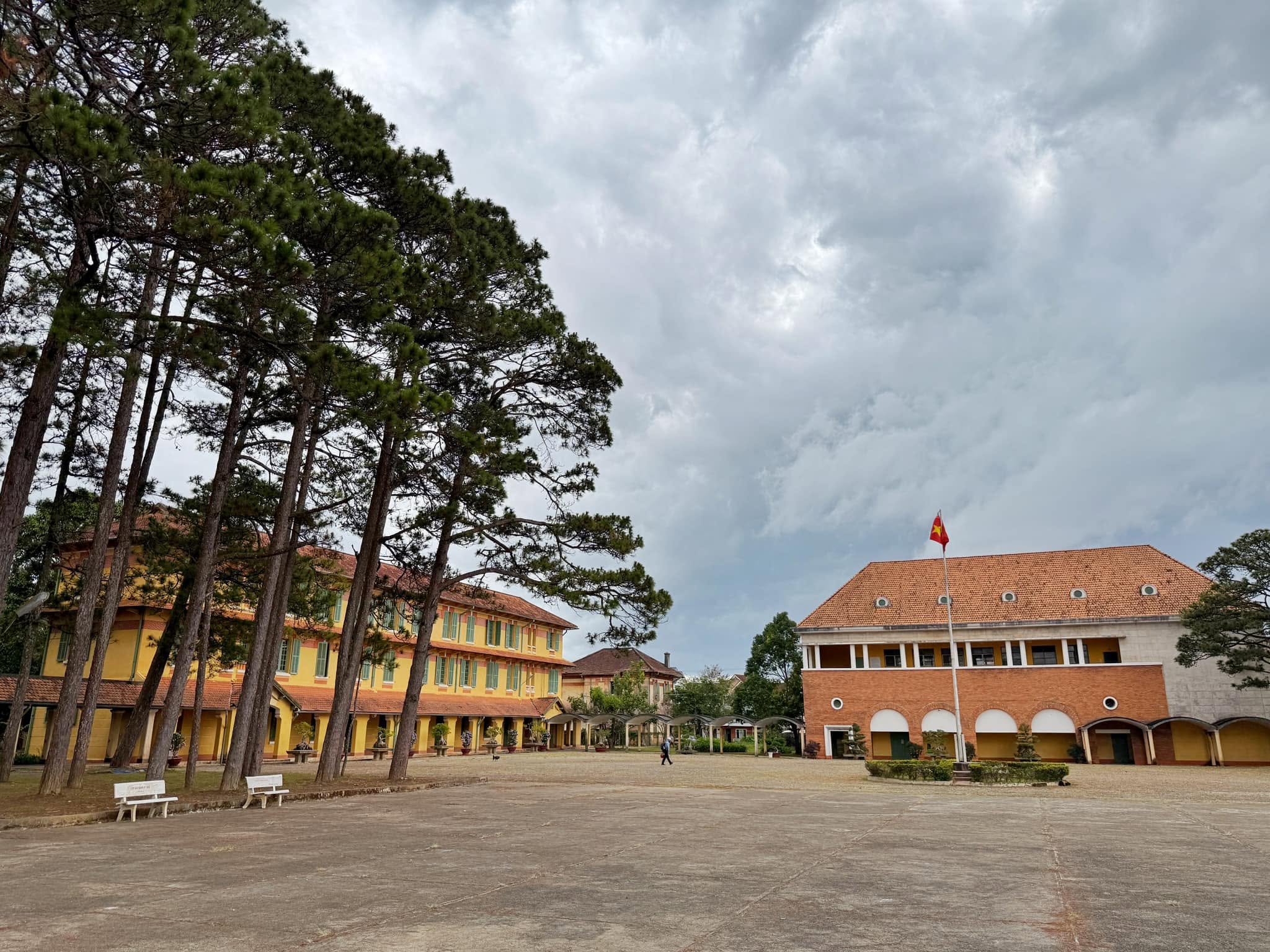
The main structure consists of several levels, with long corridors and arched windows influenced by European architecture. Its exposed red-brick walls provide a striking contrast against the surrounding pine trees and greenery.
At one end of the building stands the bell tower, one of the complex’s most recognizable features. Rising above the Da Lat skyline, the tower creates a distinctive architectural silhouette rarely found elsewhere in the city.
Sloping roofs, red-brick walls, arched windows, long corridors and the surrounding pine-covered hills come together to create a harmonious relationship between European architectural influences and the highland landscape.
This combination has made the school one of the architectural landmarks most frequently associated with old Da Lat.
The 1946 Da Lat Conference: A Remarkable Historical Chapter
Behind the peaceful appearance of the historic school lies an important chapter in Vietnam’s diplomatic history.
In early 1946, Vietnam was facing a complicated political and military situation as French forces returned to Indochina and tensions increased. Following the Preliminary Agreement of March 6, 1946, Vietnam and France agreed to hold a preparatory conference in Da Lat ahead of the Fontainebleau Conference in France.
On April 19, 1946, the Da Lat Preparatory Conference officially opened at Lycée Yersin, now Da Lat College of Education.
The delegation of the Democratic Republic of Vietnam consisted of 13 members, headed by Foreign Minister Nguyen Tuong Tam, with General Vo Nguyen Giap serving as deputy head of the delegation. The French delegation also consisted of 13 members.
The conference addressed a number of issues concerning Vietnam-France relations, including highly sensitive matters such as the ceasefire, Vietnam’s political future, its relationship with the French Union and the question of Cochinchina.
Negotiations were often tense.
One issue particularly emphasized by the Vietnamese side was the implementation of the ceasefire in Cochinchina in accordance with the spirit of the March 6 Preliminary Agreement. During the discussions, General Vo Nguyen Giap repeatedly emphasized the need to seek concrete measures to end the conflict and create conditions for continued negotiations.
The discussions held at Lycée Yersin were therefore more than ordinary diplomatic meetings. They were negotiations taking place at a critical moment in Vietnamese history, when independence, sovereignty and the country’s political future faced major challenges.
The conference ultimately failed to achieve all of the objectives sought by the Vietnamese delegation. Nevertheless, it remains an important episode in Vietnam’s diplomatic history during the early period following the August Revolution.
For this reason, visitors walking through the school grounds today are not simply standing before an architectural landmark nearly a century old. They are also standing at a place that witnessed discussions directly connected with the future of the country.
The Footprints of Historical Figures
The 1946 conference gave Lycée Yersin a special place in the history of Da Lat.
During the conference, members of the Democratic Republic of Vietnam’s delegation worked here, including prominent figures such as Nguyen Tuong Tam, Vo Nguyen Giap, Hoang Xuan Han and Nguyen Manh Tuong.
The meetings held in the school’s rooms carried a significance very different from the ordinary rhythm of school life.
For Da Lat, the 1946 conference is also part of a layer of historical memory that is less visible behind the city’s familiar image as a romantic highland destination.
An Architectural Landmark of Da Lat
Da Lat College of Education is often mentioned alongside Da Lat Railway Station as one of the city’s representative historic architectural works.
What makes the school particularly distinctive is the relationship between architecture and its natural surroundings. The curved building follows the terrain, the bell tower rises among the pine trees, and the courtyard and surrounding green spaces create an atmosphere that is both historic and tranquil.
After nearly a century, the weathered red bricks and distinctive architectural lines have become part of Da Lat’s visual memory.
The complex has also been featured by the International Union of Architects among notable architectural works of the 20th century. Although it has undergone several restoration projects, the school has retained many of its original architectural characteristics.
A Destination for Architecture and History in Da Lat
Today, Da Lat College of Education is not only an educational institution but also a site of architectural and historical significance.
Visitors can observe the curved main building, bell tower, red-brick walls and green surroundings. Yet perhaps the most memorable aspect lies in the story behind the architecture.
A school built nearly a century ago for educational purposes has witnessed many chapters in the transformation of Da Lat. From the colonial period and the years of conflict to the city’s modern development, the complex has continued to stand among the pine-covered hills.
Most significantly, the legacy of the 1946 Da Lat Preparatory Conference gives the site an unusual depth of historical meaning. Its architecture tells the story of an older Da Lat, while the events that once unfolded within its walls reveal another chapter in the history of Vietnam.
For travelers seeking to understand Da Lat through architecture, education and history, rather than simply its familiar scenic attractions, Da Lat College of Education offers a particularly meaningful stop.
Visitor Information
Current name: Da Lat College
Former names: Lycée Yersin / Grand Lycée de Dalat
Address: 109 Yersin Street, Da Lat, Lam Dong Province, Vietnam.
As the site remains an educational campus, visitor access may be restricted depending on teaching activities, examinations and school events. Travelers should check access arrangements before visiting.
Visitors are encouraged to respect the educational environment, maintain cleanliness and follow any regulations in place when entering the historic campus.