Address: Bai But, Son Tra Peninsula, Da Nang, Vietnam.
Perched on the mountainside overlooking the East Sea, Linh Ung Pagoda, Bai But is one of Da Nang’s most prominent spiritual landmarks. From the pagoda, visitors can enjoy sweeping views across the sea, toward Cu Lao Cham, Hai Van Mountain and the Han River as it flows toward the coast.
With the mountains of Son Tra rising behind it and the sea stretching ahead, the pagoda creates a distinctive setting where Buddhist architecture, natural scenery and a sense of tranquility come together. For this reason, Linh Ung Pagoda, Bai But is often described as a Buddhist sanctuary in the midst of the earthly world.
Linh Ung Pagoda Between the Mountains and the Sea
Construction of Linh Ung Pagoda, Bai But began in July 2004, and the pagoda was inaugurated on July 30, 2010. According to the provided information, additional structures have continued to be developed within the complex since its inauguration.
Covering an area of approximately 20 hectares, the pagoda occupies a remarkable location where the mountain meets the sea. The complex includes the Main Hall, Ancestral House, Lecture Hall, Monks’ Quarters and Library, along with a number of supporting structures.
A broad paved road winds along the hillside and leads visitors directly to the pagoda. As the road climbs higher, the urban landscape gradually gives way to green hills, open skies and views across the sea.
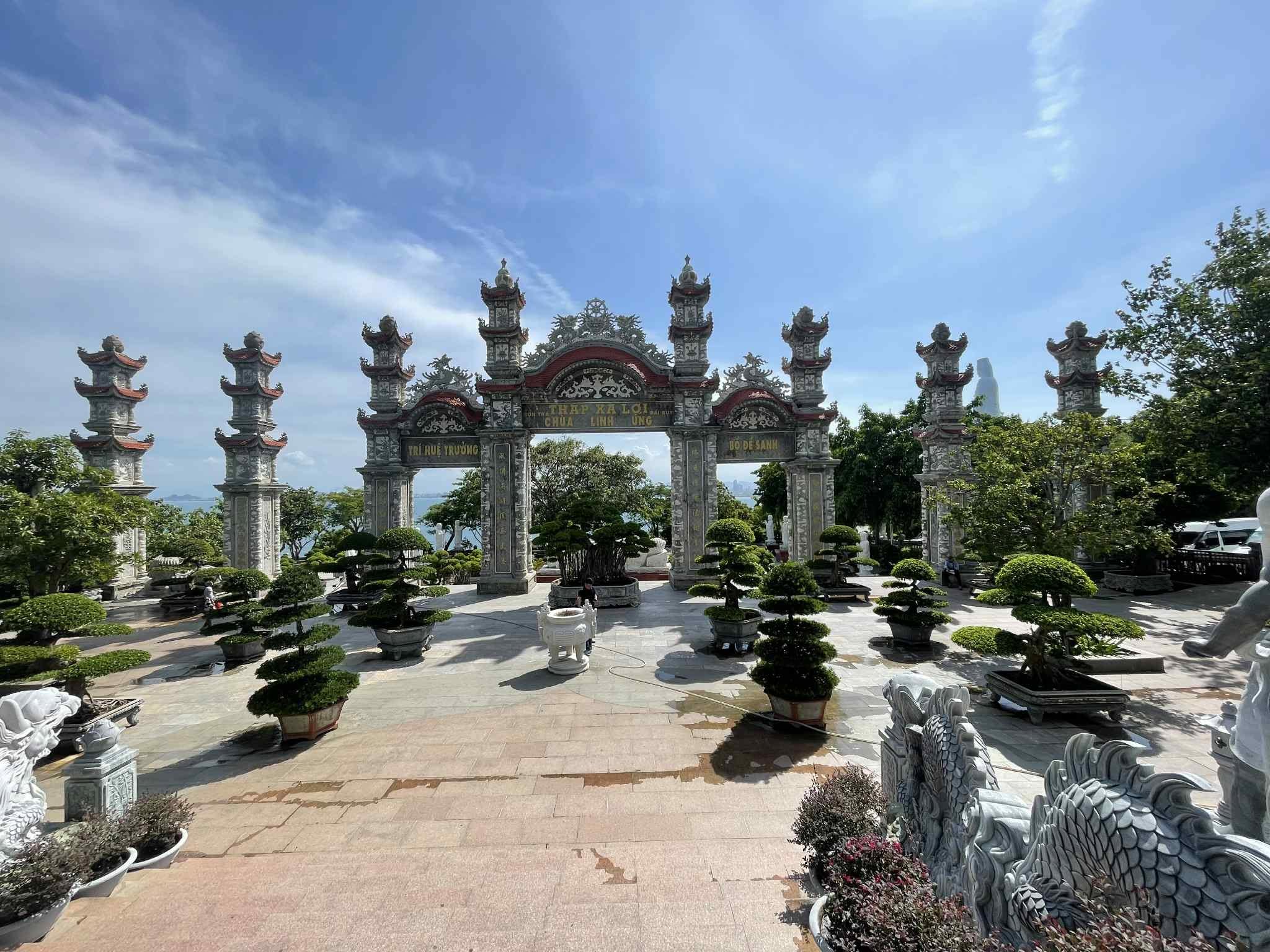
After passing through the main gate, visitors arrive at a spacious courtyard surrounded by carefully arranged ornamental trees. At the center, in front of the Main Hall, stands an image of Shakyamuni Buddha. On the right is Guanyin Bodhisattva, while the left side features the Three Buddhas. Four Dharma Guardians and 18 Arhat statues are arranged in two rows around the Main Hall.
The 67-Meter Guanyin Statue Facing the Sea
The most prominent landmark within the complex is the 67-meter-high statue of Guanyin Bodhisattva, standing on a lotus pedestal measuring approximately 35 meters in diameter and facing the sea.
According to the provided source, the statue is considered the tallest Guanyin statue in Vietnam. It was created by sculptors Thuy Lam and Chau Viet Thanh.
The statue stands with its back against the mountain and its face toward the sea. One hand forms the samadhi mudra, while the other holds a vase of nectar, creating an image associated with compassion, protection and peace.
The interior of the statue consists of 17 levels, each containing an altar. Together, these levels house 21 Buddha statues, each featuring different expressions, postures and forms. This arrangement is known as “Buddha within Buddha.”
The area beneath the lotus pedestal attracts large numbers of Buddhist devotees and visitors who come to pay their respects and admire the statue and surrounding landscape.
With the sea stretching out before it, the statue creates a particularly striking composition of mountain, sky and water. Its gentle expression facing the ocean has also become one of the most recognizable images associated with Son Tra.
At night, the illuminated statue stands prominently against the dark sky. According to the provided information, it can be seen from many locations across Da Nang, becoming a distinctive landmark along the city’s coastline.
The Main Hall and Architectural Complex
The Main Hall is the central religious structure of Linh Ung Pagoda, Bai But. Inside, the main altar features Shakyamuni Buddha at the center, Guanyin Bodhisattva on the right and Ksitigarbha Bodhisattva on the left. According to the source, all three statues are cast in bronze.
The Main Hall is surrounded by a carefully arranged system of statues, courtyards, trees and supporting buildings. The 18 Arhats, Dharma Guardians and other Buddhist figures create a solemn setting while remaining closely integrated with the natural landscape.
Beyond the Main Hall, the complex includes an Ancestral House, Lecture Hall, Monks’ Quarters and Library, as well as other supporting facilities. Some additional structures have continued to be developed over time.
One of the distinctive characteristics of the pagoda is the way its architecture is integrated into the landscape. Green vegetation, blue sea, mountain slopes and Buddhist structures form a harmonious setting rather than existing as separate elements.
Visiting Linh Ung Pagoda, Bai But
Linh Ung Pagoda, Bai But is not only a place of Buddhist worship but also one of the most popular sightseeing destinations on the Son Tra Peninsula.
From the pagoda grounds, visitors can look across the East Sea and along the coastline of Da Nang. On clear days, the view extends toward Cu Lao Cham and Hai Van Mountain, while the Han River can be seen flowing toward the sea.
The journey to the pagoda is itself part of the experience. As the road climbs the mountainside, the city gradually unfolds below, while the blue sea and forested slopes of Son Tra dominate the horizon.
The combination of mountains, sea, greenery and Buddhist architecture provides numerous scenic viewpoints for photography and sightseeing. Yet the appeal of Linh Ung Pagoda goes beyond its visual beauty. Its spacious grounds and peaceful surroundings offer visitors a quiet pause from the energy of the coastal city.
A Spiritual Landmark of Da Nang
Since its establishment, Linh Ung Pagoda, Bai But has become an important destination on the Da Nang travel itinerary. The image of the 67-meter Guanyin statue standing against the mountain and facing the sea has become one of the most recognizable symbols of Son Tra Peninsula.
From the main gate and Main Hall to the rows of Arhat statues and the monumental Guanyin overlooking the East Sea, the entire complex presents a distinctive combination of Buddhist spirituality and natural landscape.
For travelers exploring Da Nang, Linh Ung Pagoda, Bai But offers a different perspective on the coastal city. Beyond its modern bridges, beaches and vibrant urban life, Da Nang also has places of quiet reflection where the mountains of Son Tra meet the sea, and Buddhist culture becomes part of the landscape.