


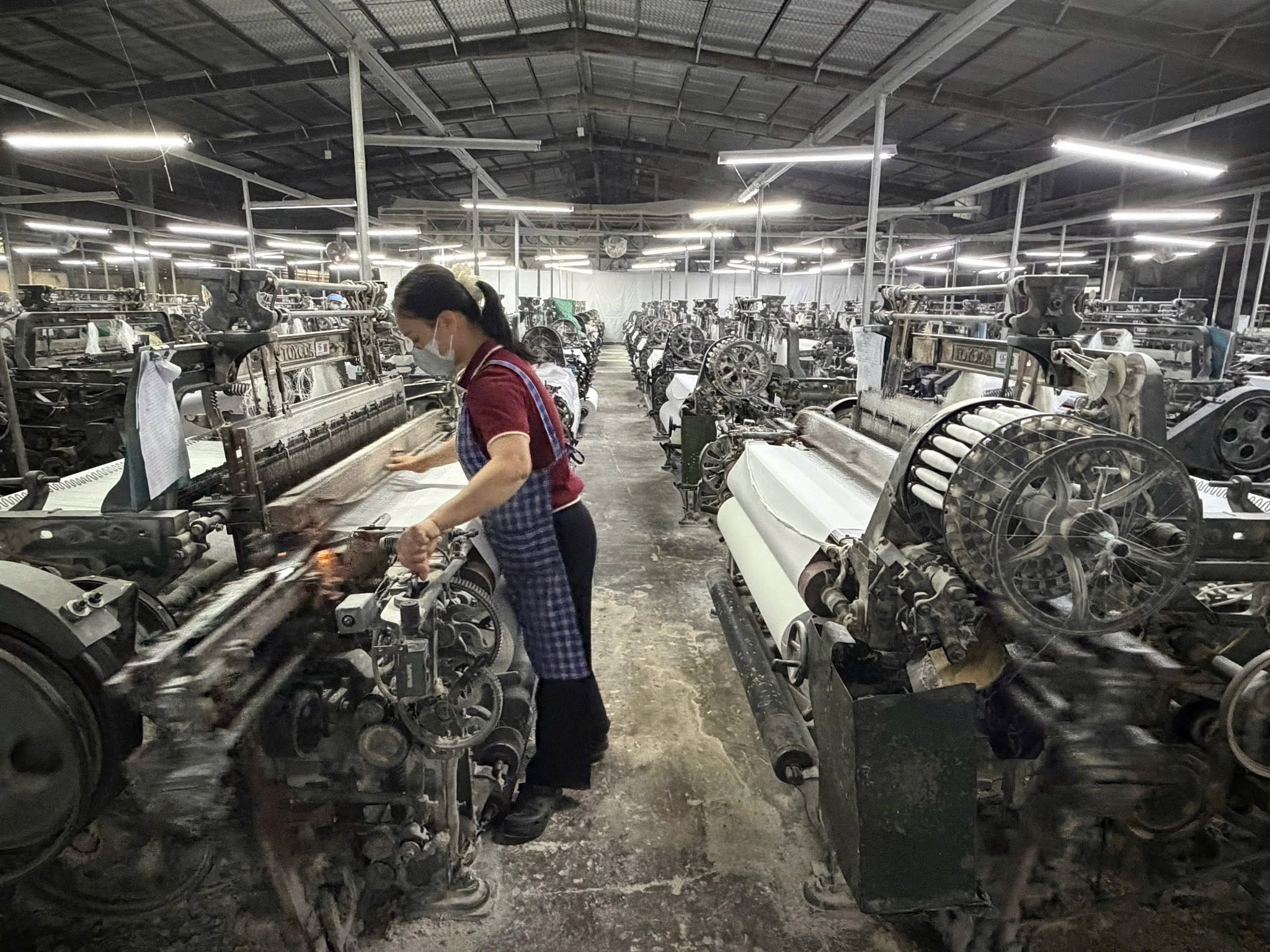
Dai Hoang Weaving Village – Traditional Textile Heritage in the Homeland of Writer Nam Cao
Dai Hoang Weaving Village, situated along the peaceful Chau Giang River in present-day Ninh Binh Province, is a traditional textile-producing village deeply rooted in the cultural landscape of northern Vietnam’s Red River Delta. Formerly part of Ha Nam Province, Dai Hoang is known not only for its longstanding weaving traditions but also as the birthplace of celebrated Vietnamese writer Nam Cao (1915–1951) and the real-life inspiration for Vu Dai Village, the fictional setting of some of his most influential literary works.
For generations, the people of Dai Hoang have practiced textile weaving using traditional handlooms known locally as khung cui mo qua. These looms produced rustic fabrics, including dui cloth and coarse textiles, for everyday use. Over time, the village gradually transformed its production methods, combining inherited craftsmanship with modern weaving machinery and expanding into a wider range of products, including face towels, bath towels, twill fabrics, and textiles for the garment industry.
What makes Dai Hoang particularly appealing is the close connection between traditional craftsmanship and Vietnam’s literary heritage. Visitors can explore the village’s weaving traditions while discovering locations associated with Nam Cao’s famous short story Chi Pheo, including the historic house popularly known as Ba Kien’s House. The village is also celebrated for its traditional clay-pot braised fish, widely known as Vu Dai Village Braised Fish, and its distinctive chuoi ngu bananas.
Together, these elements create a cultural destination where textile craftsmanship, literature, rural architecture, and traditional cuisine offer a fascinating perspective on the history and everyday life of the Vietnamese countryside.
History of Dai Hoang Weaving Village and Its Traditional Textile Craft
Dai Hoang is a historic rural community situated within the cultural landscape of the Red River Delta. The village was formerly associated with Hoa Hau Commune, Ly Nhan District, Ha Nam Province, before the administrative reorganization of 2025 placed the area within Ninh Binh Province. Located near the Chau Giang River, its history has long been shaped by agriculture, local trade, and traditional handicraft production.
Among the village’s traditional occupations, textile weaving has played an important role in supporting household livelihoods and shaping the community’s identity. According to local craft traditions, generations of Dai Hoang residents have used wooden handlooms to produce cloth for clothing, domestic use, and trade. Weaving was commonly practiced within family homes, allowing households to supplement agricultural income during periods when farming activities were less demanding.
One of the most recognizable features of Dai Hoang’s weaving heritage was the traditional mo qua handloom, a wooden loom associated with the village’s early textile production. Operating these looms required considerable coordination and experience. Weavers had to control the movement of warp and weft threads, guide the shuttle, and maintain appropriate tension to produce consistent fabric. The rhythmic sounds of wooden looms once formed a familiar part of daily village life, reflecting the patience and skill of local craftspeople.
Traditional products included dui fabric, a rustic silk-related textile, and various types of coarse cloth used for everyday clothing and household purposes. Although these fabrics were generally less elaborate than embroidered textiles or brocade, their production required careful preparation of materials and an understanding of thread density, fabric structure, and finishing techniques. The quality of each woven piece depended heavily on the weaver’s ability to maintain a stable and even fabric structure throughout the process.
Traditional weaving knowledge was primarily transmitted through direct instruction and everyday work. Younger family members learned to recognize different types of yarn, prepare the loom, arrange warp threads, and operate the shuttle. As their skills improved, they gradually became capable of producing more complex fabrics and handling difficulties such as broken or tangled threads. This family-based transmission of knowledge helped preserve the village’s textile traditions across generations, even as its economic circumstances changed.
Throughout its history, Dai Hoang weaving adapted to shifting consumer demands and production conditions. What began as small-scale household manufacturing gradually expanded to include workshops, specialized production facilities, and businesses using modern equipment. The introduction of machinery allowed producers to increase output, improve consistency, and manufacture textiles for a wider market. Nevertheless, the traditional understanding of yarn preparation, weaving structures, and fabric quality remained an important foundation for the village’s continued development.
Dai Hoang’s weaving heritage therefore represents more than a memory of rural life. It reflects the ability of a traditional craft community to adapt to economic and technological change while maintaining a connection to the skills and knowledge inherited from earlier generations.
From Traditional Handlooms to Modern Textile Production
One of the most significant characteristics of Dai Hoang Weaving Village is its gradual transition from hand-operated weaving to a production system combining traditional knowledge with modern textile technology. While earlier generations primarily produced rustic fabrics for local consumption, contemporary workshops have diversified into practical textile products such as face towels, bath towels, twill fabrics, and materials used in garment manufacturing.
In traditional weaving, preparing the raw materials is a crucial stage that directly influences the quality of the finished cloth. Weavers must select yarn appropriate to the intended product, examine its strength and consistency, and arrange the threads before weaving begins. The warp threads are positioned lengthwise on the loom, while the weft threads are passed across them to create the fabric structure. The texture, strength, flexibility, and thickness of the finished textile depend on the type of yarn, thread density, and weaving technique.
Using a mo qua handloom, the weaver coordinates several movements to guide the shuttle and secure each row of weft threads. Every movement contributes to the fabric’s overall consistency. Although the process may appear repetitive, it demands concentration and experience, particularly when dealing with broken yarn, uneven tension, or other weaving difficulties. These skills formed the technical foundation of Dai Hoang’s traditional textile craft and continue to provide an important historical reference for the village’s modern production activities.
As demand for textiles increased, mechanization became an important part of the village’s development. Modern weaving machines can perform repetitive operations more efficiently, shorten production time, and create fabrics with relatively consistent dimensions and structures. However, mechanized production still requires workers who understand textile materials, machine operation, quality inspection, and production management. The transformation of Dai Hoang’s weaving industry has therefore involved not only new equipment but also the development of new technical skills.
Among the village’s contemporary products, face towels and bath towels are practical items used in households, accommodation establishments, and various service industries. Depending on their intended purpose, these products must meet requirements relating to absorbency, softness, durability, and performance after repeated washing. Material selection and finishing processes are particularly important in maintaining consistent product quality. The ability to produce textiles that meet different customer specifications has helped local manufacturers broaden their markets.
Twill fabrics and other woven materials for garment production also form part of the village’s diversified product range. These textiles vary in weave structure, weight, durability, and intended use. Expanding into different product categories enables local producers to respond to changing market demand and participate in broader textile supply chains.
According to previously published descriptions of the craft village, Dai Hoang has had more than 1,200 households and dozens of businesses involved in textile-related production. These figures reflect the scale reported at the time of those descriptions and should not be treated as verified statistics for 2026 without updated official information. Nevertheless, the presence of household producers and textile enterprises demonstrates the continuing economic importance of weaving in the local community. Textile production contributes to employment opportunities, household income, and the development of supporting services.
As Vietnam’s textile industry becomes increasingly competitive, Dai Hoang’s long-term development depends on improvements in product quality, technology, workforce skills, and production management. Responsible material sourcing, safe working conditions, energy efficiency, and appropriate wastewater and waste management are also important considerations, particularly where fabric processing or finishing activities are involved.
By combining traditional weaving knowledge with modern production methods, Dai Hoang has the potential to maintain its identity as a historic craft village while remaining relevant to contemporary textile markets.
Dai Hoang – The Homeland of Nam Cao and the Literary Landscape of Vu Dai Village
Beyond its weaving heritage, Dai Hoang occupies a distinctive place in Vietnamese literary history as the birthplace of Nam Cao (1915–1951), one of the most influential writers of twentieth-century Vietnamese literature. His works are particularly celebrated for their realistic portrayals of rural society, social inequality, human dignity, and the struggles of ordinary people before the August Revolution of 1945.
The rural environment of Dai Hoang, including its village lanes, traditional houses, agricultural landscapes, community relationships, and everyday experiences, provided an important source of inspiration for Nam Cao’s literary imagination. His fictional world drew on the social conditions and human experiences of northern Vietnamese villages, transforming familiar rural settings into powerful literary representations of life under colonial-era social structures.
In the short story Chi Pheo, Nam Cao created Vu Dai Village, a fictional setting that exposes the social conflicts and personal tragedies experienced by marginalized rural people. Dai Hoang is widely recognized as the real-life village associated with this literary landscape. As a result, the name Vu Dai has become closely connected with the cultural identity of Dai Hoang and is frequently used in local tourism and food branding.
One of the best-known attractions is the historic house popularly referred to as Ba Kien’s House. The building is associated in local cultural memory with Ba Kien, an influential village notable portrayed in Chi Pheo. The house also offers visitors an opportunity to appreciate aspects of traditional rural architecture and the living environment of relatively prosperous households in northern Vietnam during earlier periods.
It is important to distinguish the literary character from historical reality. Ba Kien is a fictional figure created by Nam Cao, and the modern name of the house reflects its association with local literary heritage. It does not mean that every event described in the story occurred within the building.
For literature enthusiasts, visiting Dai Hoang provides an opportunity to explore the life and creative legacy of Nam Cao while gaining a deeper understanding of the rural world portrayed in his works. Characters such as Chi Pheo, Thi No, Ba Kien, and Lao Hac have become enduring figures in Vietnamese literature, representing complex questions about poverty, social exclusion, compassion, and human dignity. The village landscape adds an important cultural dimension to these literary experiences, helping visitors imagine the social and historical environment that influenced the writer.
Dai Hoang is also famous for Vu Dai Village Braised Fish, known in Vietnamese as ca kho lang Vu Dai. This traditional dish is commonly prepared by slowly braising fish in clay pots with a carefully balanced mixture of seasonings. The cooking process typically requires several hours of controlled heat, allowing the fish to absorb the flavors and develop a firm, richly seasoned texture. The dish reflects the culinary knowledge of the Red River Delta and has become one of the area’s most recognizable specialties.
Another celebrated local agricultural product is Dai Hoang’s chuoi ngu banana, a traditional banana variety associated with the village’s farming heritage. Known for its relatively small fruit, attractive appearance, and distinctive flavor, it has long formed part of the area’s agricultural and culinary identity. Banana gardens also contribute to the rural landscape, preserving a visible connection between the village’s agricultural traditions and everyday life.
The combination of weaving, literary history, traditional architecture, and local cuisine gives Dai Hoang a cultural character that is difficult to separate into individual attractions. Rather than being defined by a single monument or product, the village offers a broader experience of northern Vietnamese rural heritage, where literature, craftsmanship, agriculture, and food traditions remain closely intertwined.
Preserving Dai Hoang’s Weaving Heritage and Developing Literary and Craft Village Tourism
As Vietnam continues to industrialize and modernize, Dai Hoang Weaving Village faces both opportunities and challenges. Modern machinery has helped improve productivity and expand textile production, but it has also reduced the everyday visibility of traditional handlooms that once formed an essential part of the village’s cultural landscape. Preserving the village’s weaving heritage therefore requires more than maintaining commercial production. It also involves protecting traditional knowledge, documenting historical techniques, and preserving the memories of generations of local craftspeople.
An important priority is the documentation and interpretation of weaving techniques associated with the traditional mo qua handloom. Activities such as preparing yarn, arranging warp threads, operating the shuttle, and finishing woven cloth reflect technical knowledge developed through long periods of practical experience. Photographs, historical tools, fabric samples, recorded demonstrations, and interviews with experienced weavers could provide valuable resources for cultural research, heritage education, and tourism interpretation.
At the same time, the village’s economic future depends on its ability to produce textiles that meet contemporary consumer needs. Product diversification, quality improvements, appropriate technology, and transparent information about materials and manufacturing can help local businesses strengthen their competitiveness. Communicating the history of the weaving craft and the skills involved in production can also add cultural value to locally manufactured textiles, distinguishing them from anonymous mass-produced goods.
Craft village tourism combined with literary heritage tourism represents a particularly promising direction for Dai Hoang. Its connection with Nam Cao and the fictional world of Vu Dai provides an identity that few other traditional weaving villages possess. Visitors can potentially combine textile-related experiences with visits to literary landmarks, historic buildings, and local food producers, creating an itinerary that explores several aspects of rural Vietnamese culture.
A cultural journey through Dai Hoang might begin with an introduction to traditional weaving, including the history of wooden handlooms and the transformation of textile production over time. At facilities equipped to receive visitors, travelers may be able to observe modern weaving processes and learn how yarn is transformed into finished fabric. The experience can then continue with an exploration of locations associated with Nam Cao’s life and literary works, including the historic house popularly known as Ba Kien’s House.
These visits offer opportunities to discuss the relationship between fictional literature and real rural communities, as well as the social conditions that influenced Vietnamese realist writing. Traditional cuisine can provide another memorable part of the journey. Visitors may enjoy locally prepared clay-pot braised fish, learn about the cooking methods associated with Vu Dai Village, and discover the agricultural traditions behind Dai Hoang’s chuoi ngu bananas. Such experiences are particularly suitable for cultural tourism, educational trips, literary heritage tours, and rural tourism programs.
However, not all weaving workshops are regularly open to tourists. Travelers interested in visiting production facilities should contact local businesses or relevant hosts in advance to confirm whether visits can be arranged. Safety instructions should be followed carefully in areas containing industrial weaving machines, electrical equipment, moving mechanical parts, or textile-processing materials.
In the longer term, preserving Dai Hoang’s heritage will require cooperation among local producers, cultural organizations, tourism businesses, and the wider community. Educational programs, demonstrations of traditional weaving, documentation of local craft history, and responsible promotion of village products can help strengthen awareness of the village’s cultural significance. Environmental protection, safe production practices, and respect for the community’s traditional way of life are equally important to ensuring that economic development and cultural preservation remain compatible.
Dai Hoang’s distinctive combination of craftsmanship and literature creates opportunities for tourism experiences that go beyond conventional sightseeing. By connecting the stories of textile workers with the literary legacy of Nam Cao, the village can offer visitors a richer understanding of the history, creativity, and resilience of rural Vietnamese communities.
Dai Hoang Weaving Village is a remarkable expression of the cultural heritage of northern Vietnam’s Red River Delta, where traditional textile craftsmanship, the literary legacy of Nam Cao, and rural community life continue to intersect. From the rhythmic movements of the old mo qua handlooms to modern weaving workshops, and from the fictional world of Vu Dai Village to the flavors of traditional braised fish and locally grown bananas, Dai Hoang preserves a distinctive cultural identity. More than a place where textiles are produced, it is a living destination where visitors can discover the enduring relationship between craftsmanship, literature, agriculture, and Vietnamese village traditions.
Quick Information
| Item | Details |
|---|---|
| Village name | Dai Hoang Weaving Village |
| Vietnamese name | Làng dệt Đại Hoàng |
| Current province | Ninh Binh Province, Vietnam |
| Former administrative location | Hoa Hau Commune, Ly Nhan District, Ha Nam Province |
| Geographical setting | Near the Chau Giang River, Red River Delta |
| Heritage type | Traditional weaving and textile craft village |
| Main craft | Textile weaving and textile manufacturing |
| Traditional weaving equipment | Mo qua handloom (khung cui mo qua) |
| Traditional products | Dui fabric and coarse woven cloth |
| Contemporary products | Face towels, bath towels, twill fabrics, and textiles for garment production |
| Production methods | Traditional weaving knowledge combined with modern machinery |
| Reported production scale | Earlier descriptions mention more than 1,200 households and dozens of textile-related businesses; figures require current verification |
| Cultural significance | Traditional textile knowledge and northern Vietnamese rural heritage |
| Famous literary figure | Nam Cao (1915–1951) |
| Literary connection | Real-life inspiration associated with the fictional Vu Dai Village |
| Notable literary work | Chi Pheo |
| Cultural attraction | Historic house popularly known as Ba Kien’s House |
| Local culinary specialty | Vu Dai Village Braised Fish |
| Famous agricultural product | Dai Hoang chuoi ngu bananas |
| Potential visitor experiences | Learning about weaving, exploring literary heritage, discovering local cuisine |
| Tourism themes | Traditional craft tourism, literary heritage tourism, rural cultural tourism |
| Visitor advice | Arrange workshop visits in advance and observe safety instructions |







