


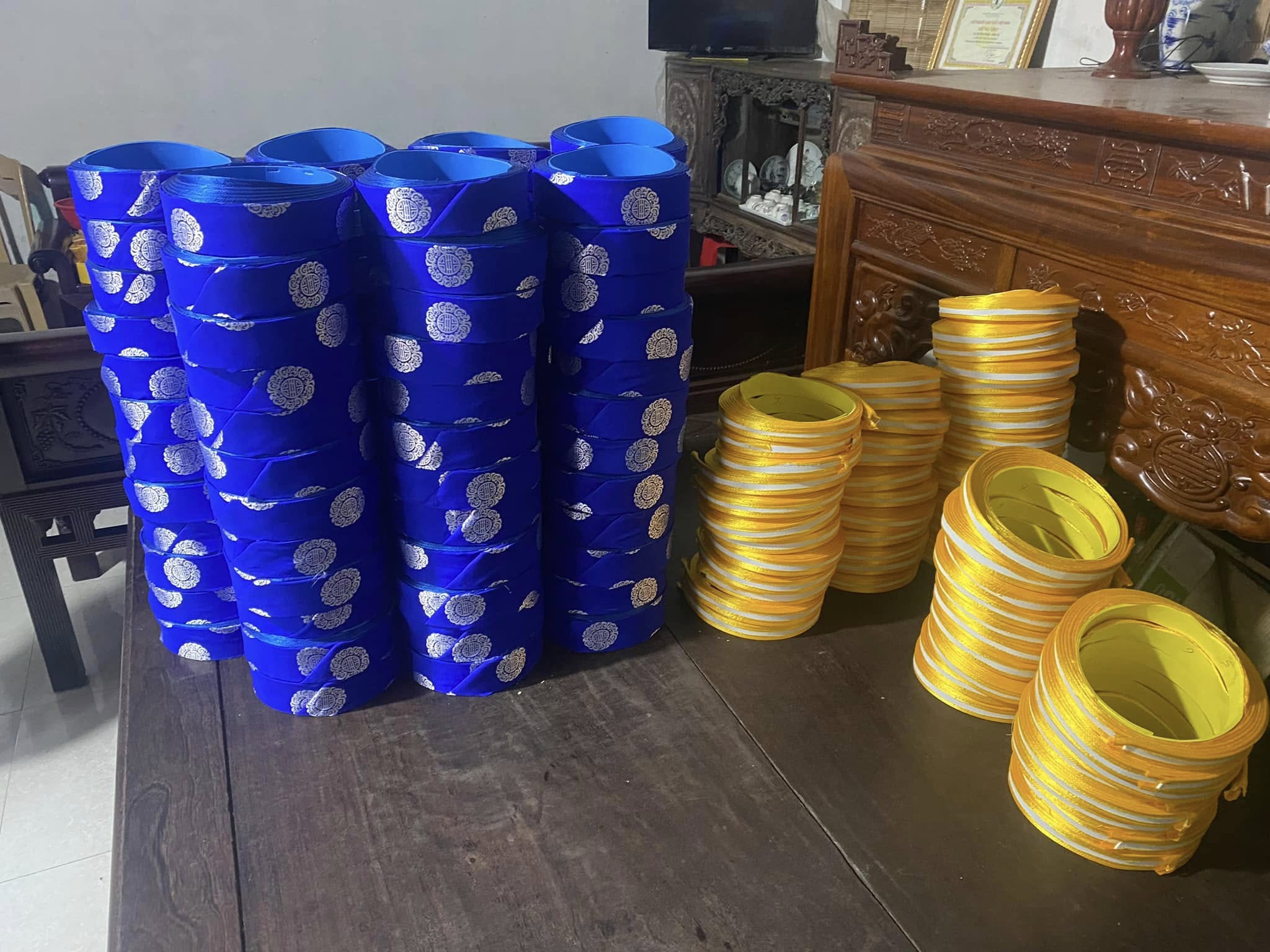
Giap Nhat Traditional Turban Village, located in Nam Truc Commune, Ninh Binh Province, is one of the few communities in northern Vietnam that continue to preserve the traditional craft of making khan xep, Vietnam’s distinctive pre-folded ceremonial headwear. Passed down through generations, this craft reflects the skill, patience, and cultural pride of local artisans.
Traditionally worn with the ao the, a formal Vietnamese tunic, or the Vietnamese ao dai, the khan xep has long been associated with festivals, religious ceremonies, weddings, longevity celebrations, and important cultural events. Beyond its decorative function, this traditional headwear symbolizes elegance, dignity, and respect for cultural customs.
According to local tradition, turban-making in Giap Nhat has a history of approximately 400 years. Although surviving historical records do not clearly identify when the craft began or who founded it, the techniques have been preserved through family-based apprenticeship and the transmission of skills between generations.
Today, alongside traditional black turbans, Giap Nhat artisans produce a wide variety of designs, colors, and sizes for cultural performances, ceremonial occasions, weddings, and modern celebrations.
The village offers a fascinating insight into Vietnam’s traditional clothing heritage and the continuing importance of handicrafts in contemporary cultural life.
History of Giap Nhat Turban Village and the Cultural Significance of Khan Xep
Giap Nhat is situated in the former Nam Truc area, a region with a long history of traditional handicrafts and cultural practices in the Red River Delta.
Before administrative restructuring, Giap Nhat Hamlet belonged to Nam Giang Town, Nam Truc District, Nam Dinh Province. Under the current administrative arrangement, the village is part of Nam Truc Commune, Ninh Binh Province.
In Vietnamese clothing traditions, khan xep refers to a type of structured headwear made from carefully arranged layers of fabric.
It is commonly worn with traditional tunics or formal Vietnamese clothing, creating a dignified appearance suitable for ceremonies and special occasions.
The khan xep is closely associated with older Vietnamese customs of wrapping and wearing cloth around the head.
Over time, traditional hand-wrapped headwear evolved into ready-made designs with fixed folds, making the accessory easier to wear while maintaining its characteristic appearance.
These structured turbans allowed wearers to achieve a neat and consistent style, particularly for ceremonial activities and theatrical performances.
According to local oral traditions, the craft has existed in Giap Nhat for many generations, with its history often described as extending back more than four centuries.
However, because comprehensive historical documentation is unavailable, the precise date of its establishment and the identity of the first craftsman remain uncertain.
What is particularly remarkable is that the craft has continued to survive despite major changes in clothing styles and everyday customs.
In earlier times, Giap Nhat turbans were primarily black and were commonly worn with the ao the during festivals, ceremonies, and important community gatherings.
As society changed, local craftsmen expanded their products to include different colors, shapes, and purposes.
The turbans are no longer made exclusively for men. Today, artisans also produce designs for women, older people, theatrical performers, and participants in traditional ceremonies.
During Vietnamese weddings, the combination of a traditional turban and ao dai contributes to the elegance and cultural significance of the occasion.
For longevity celebrations honoring older family members, special turbans may feature the Chinese-derived character Thọ, symbolizing longevity, good health, and blessings.
In traditional performing arts, turbans also play an important role in identifying characters, historical settings, and the social or ceremonial significance of costumes.
Vietnamese theatrical and musical traditions such as cheo, tuong, and chau van may use different styles of headwear depending on the performance.
According to local craft village accounts, Giap Nhat turbans have also been used in major cultural events, including activities associated with the 2006 APEC meetings in Vietnam.
Their appearance at festivals, theatrical performances, and international cultural events demonstrates that these traditional accessories have significance beyond the boundaries of the village.
From a familiar element of Vietnamese ceremonial clothing, the khan xep has become a means of introducing the country’s cultural identity to domestic and international audiences.
The Art of Making Khan Xep and Traditional Fabric-Folding Techniques
Creating a beautiful traditional Vietnamese turban requires a combination of careful material preparation, precise construction, skilled folding, and detailed finishing.
According to local craftsmanship traditions, the production process generally involves approximately seven main stages, although the exact sequence may vary depending on the design and methods used by individual workshops.
These stages may include cutting fabric, preparing the internal structure, shaping the core, sewing or attaching components, wrapping the fabric, decorating the turban, and inspecting the finished product.
Among these activities, wrapping and forming the folds is considered the most technically demanding.
The craftsman must apply consistent tension so that the fabric wraps securely around the core without distorting its shape.
Each fold needs to be evenly spaced, with harmonious proportions and a balanced appearance from different angles.
Even a slightly misplaced fold can affect the overall shape of the turban.
For this reason, the process requires concentration, patience, and experience developed through years of practice.
Materials used in turban-making have changed considerably over time.
In the past, local craftsmen commonly used traditional woven fabrics, fine cloth, and satin, together with readily available materials for the internal structure.
According to local accounts, some older turbans were constructed using paper, including recycled newspapers, to create their supporting cores.
Today, artisans may use satin, glossy synthetic fabrics, brocade, and various lining materials depending on the product’s intended purpose.
The inner structure is often made from lightweight shaping materials, such as foam, helping the turban maintain its form while remaining comfortable to wear.
For ceremonial or theatrical products, fabric selection and decorative details can be adjusted to meet specific requirements.
The structure of a traditional khan xep varies considerably.
Local craftsmen describe several conventional designs according to the number of fabric wraps and visible folds.
Examples include four wraps with seven folds, five wraps with seven folds, and six wraps with nine folds.
The number of wraps and folds influences the turban’s height, thickness, and overall appearance.
Depending on the intended use, artisans select an appropriate construction style to complement the wearer’s clothing.
Some traditional men’s designs feature a slightly projecting front section, while the back is shaped to accommodate historical hairstyles or particular costume styles.
Other designs are adapted for women’s clothing, stage performances, or ceremonial purposes.
An interesting element of local craft tradition is the interpretation of certain fold arrangements as resembling the Chinese-derived character Nhân, associated with humanity, benevolence, and moral values.
This symbolic explanation reflects local cultural interpretations of the relationship between craftsmanship and traditional aesthetics.
Color is another important aspect of Giap Nhat’s products.
Black turbans remain among the most recognizable traditional styles and are commonly associated with formal clothing such as the ao the and ao dai.
Red and yellow turbans may be used for particular ceremonies, performances, or celebrations where their colors carry appropriate cultural meanings.
For longevity celebrations, artisans may decorate turbans with the character Thọ, using embroidery or raised ornamental details.
Modern workshops also offer products in customized colors, sizes, and designs.
Although machinery now assists with certain tasks, such as cutting, sewing, and preparing materials, shaping the folds and achieving the final appearance still depend heavily on manual skill.
This attention to detail ensures that each khan xep is not merely a functional accessory but also a product of traditional craftsmanship.
Giap Nhat Turban-Making in Modern Vietnamese Life
Changes in clothing preferences and daily lifestyles have significantly influenced the demand for traditional turbans.
Whereas the khan xep once appeared more frequently in everyday and ceremonial clothing, it is now primarily associated with festivals, weddings, longevity celebrations, theatrical performances, and cultural events.
To adapt to these changes, Giap Nhat artisans have diversified their products, improved materials, and reorganized production methods.
Alongside traditional designs, workshops now produce turbans for brides, grooms, older people, performers, and participants in cultural ceremonies.
Different sizes and construction styles are available to suit individual customers.
According to previously published local information, Giap Nhat once had approximately 1,050 households and 4,800 residents, with around 140 households involved in turban-making.
Other local reports indicated that the craft employed more than 1,000 workers, including approximately 600 to 700 regular workers.
These figures reflect the scale of the craft at the time they were recorded and should not be interpreted as verified current statistics.
Production in Giap Nhat has traditionally been organized through family workshops and small handicraft businesses.
Some households specialize in cutting fabric, sewing, preparing the internal structure, or wrapping turbans, while others focus on finishing products and distribution.
Dividing production into specialized stages can improve efficiency and allow more local workers to participate.
According to craft village accounts, Giap Nhat turbans have historically been distributed through Hang Quat Street in Hanoi, an area associated with traditional ceremonial and decorative goods.
From commercial outlets in Hanoi, products have been supplied to customers throughout Vietnam.
Some workshops also accept customized orders for particular colors, fabrics, and designs.
Prices vary according to size, materials, complexity, and order quantity.
Older local reports described basic turbans selling for several tens of thousands of Vietnamese dong to more than VND 100,000 each. These figures are historical references rather than confirmed current prices.
Although the craft provides employment opportunities, earnings remain influenced by material costs, market demand, and competition.
During certain periods, declining demand has created difficulties for artisans, especially as younger workers have gained access to other employment opportunities.
Nevertheless, for families with longstanding connections to the craft, making khan xep represents more than a source of income.
It is also a way of maintaining their community’s cultural identity.
According to local accounts, Bui Van Hung, a workshop owner in Giap Nhat, has emphasized that the cultural value of traditional turbans is a major reason why local craftsmen continue their work, even when financial returns are modest.
This commitment has helped the village preserve its craft through periods of economic and social change.
An important milestone came in 2022, when the traditional Giap Nhat turban product was reported to have received a three-star OCOP rating at the provincial level under Vietnam’s One Commune One Product program.
Participation in OCOP can help improve product recognition, encourage quality enhancement, strengthen packaging and branding, and expand market opportunities.
However, OCOP recognition applies to specific products and certification periods. The current validity of a rating should be verified separately when necessary.
Preserving Giap Nhat’s Turban-Making Heritage and Developing Cultural Tourism
As modern clothing becomes increasingly dominant, preserving traditional turban-making has gained greater cultural significance.
The craft represents more than the continued production of a traditional accessory.
It also preserves specialized knowledge of fabric folding, material selection, shaping, and ceremonial costume construction.
These skills support the preservation and presentation of Vietnamese traditional clothing during festivals, theatrical performances, and cultural activities.
The continued development of folk arts programs, heritage events, and cultural exhibitions may create new opportunities for Giap Nhat artisans.
Traditional turbans can be used in cheo, tuong, and chau van performances, as well as cultural productions that recreate historical settings and traditional Vietnamese lifestyles.
The growing popularity of ao dai at weddings, commemorative photo sessions, and cultural celebrations may also help sustain demand for complementary traditional headwear.
For the craft to remain viable, passing skills to younger generations is particularly important.
Experienced artisans can play a valuable role in teaching traditional techniques, documenting production methods, and preserving historical designs.
Recording and digitizing the craft process, together with collecting information about different turban styles and their cultural meanings, could further support long-term preservation.
Beyond its manufacturing activities, Giap Nhat also has potential for cultural tourism focused on traditional Vietnamese clothing.
At workshops equipped to welcome visitors, travelers may learn about the history of khan xep, observe the preparation of materials, and watch craftsmen form the carefully arranged fabric folds.
Processes that appear simple, such as controlling fabric tension, aligning each wrap, and shaping the finished turban, reveal the considerable skill involved.
Where appropriate programs are available, visitors may also have opportunities to try basic techniques under the guidance of local artisans.
Demonstrations showing how turbans are worn with the ao the, ao dai, or traditional performance costumes can provide additional insight into Vietnamese clothing customs.
Activities such as traditional costume photography, craft demonstrations, and meetings with artisans should be arranged in advance.
Not every household workshop has the facilities or capacity to receive visitors regularly.
Tourism development should also respect the daily lives of local residents and avoid disrupting production activities.
In the longer term, Giap Nhat could be connected with other cultural attractions, traditional craft villages, and historical sites in the former Nam Truc area, contributing to the diversification of tourism experiences in Ninh Binh Province.
Through exhibitions, product promotion, and hands-on craft experiences, traditional Vietnamese turbans may reach new audiences, particularly younger generations and international travelers.
After centuries of cultural change, Giap Nhat continues to preserve a remarkable tradition through the careful folds of its handmade turbans. Each piece of fabric, shaped by experienced hands, becomes part of a distinctive accessory closely associated with Vietnamese ceremonial clothing. In modern Vietnam, the village remains an important example of how traditional craftsmanship can preserve cultural identity while adapting to contemporary life.
Quick Information
| Item | Details |
|---|---|
| Craft village | Giap Nhat Traditional Turban Village |
| Vietnamese name | Làng nghề khăn xếp Giáp Nhất |
| Current location | Giap Nhat Hamlet, Nam Truc Commune, Ninh Binh Province, Vietnam |
| Former administrative location | Nam Giang Town, Nam Truc District, Nam Dinh Province |
| Craft type | Traditional handicraft village |
| Main specialty | Making traditional Vietnamese pre-folded turbans |
| Traditional history | Approximately 400 years, according to local tradition |
| Representative products | Men’s turbans, women’s turbans, wedding turbans, longevity celebration turbans, theatrical headwear |
| Common colors | Black, red, yellow, and customized colors |
| Materials | Satin, glossy fabrics, brocade, lining materials, and shaping cores |
| Traditional techniques | Fabric cutting, core preparation, sewing, wrapping, shaping, and decoration |
| Traditional structures | Four wraps and seven folds; five wraps and seven folds; six wraps and nine folds |
| Production process | Approximately seven main stages, depending on design |
| Historical household participation | Around 140 households, according to previously published local information |
| Historical employment | More than 1,000 workers, including approximately 600–700 regular workers |
| OCOP recognition | Traditional turban product reportedly received a three-star rating in 2022 |
| Cultural significance | Preservation of traditional Vietnamese headwear and handicraft techniques |
| Main uses | Festivals, ceremonies, weddings, longevity celebrations, traditional theater, and cultural events |
| Tourism potential | Workshop visits, craft demonstrations, and traditional costume experiences |







