


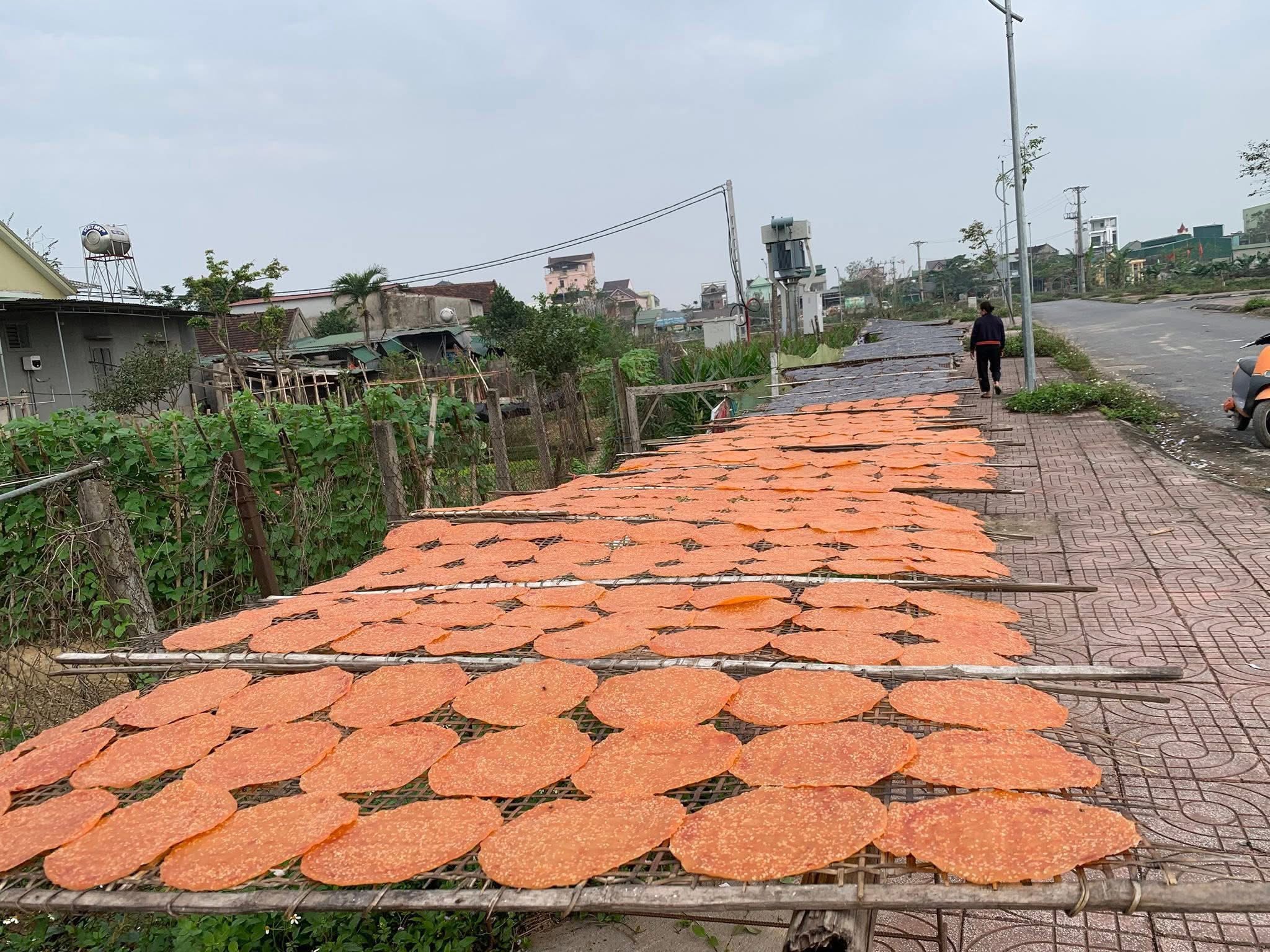
Khanh Thien Traditional Food Craft Village, located in Khanh Thien Commune, Ninh Binh Province, is a traditional Vietnamese food-making village renowned for its wide variety of rice-based cakes and snacks. Situated in the fertile lowlands along the Day River, the village has preserved its culinary traditions for generations, transforming locally grown rice and familiar agricultural ingredients into distinctive regional specialties.
Among its best-known products are sesame rice crackers (banh da vung), gac fruit rice crackers, sticky rice cakes, mugwort rice cakes, steamed rice cakes, and many other traditional treats. Each reflects the skills, experience, and creativity of local families who have passed down their recipes and techniques over many generations.
In December 2014, Khanh Thien was officially recognized as a traditional craft village by the Ninh Binh Provincial People’s Committee, acknowledging the cultural and economic significance of its longstanding food-making traditions.
Today, Khanh Thien continues to preserve its culinary heritage while improving production methods, developing local specialties, and exploring opportunities for community-based tourism and traditional food experiences.
History and Cultural Identity of Khanh Thien Food Craft Village
Khanh Thien lies in the fertile lowlands along the lower reaches of the Day River, an area with a longstanding agricultural tradition and abundant rice production.
Before administrative restructuring, the commune belonged to Yen Khanh District, Ninh Binh Province. Its favorable conditions for rice cultivation provided local residents with the ingredients needed to develop a diverse range of traditional foods.
According to local tradition, rice cake making in Khanh Thien dates back hundreds of years.
Initially, families prepared these foods mainly for household consumption, traditional festivals, Lunar New Year celebrations, weddings, ancestral commemorations, and other community occasions.
Over time, popular varieties became products for sale at local markets and neighboring communities.
The craft was traditionally passed down within families. Younger generations learned directly from parents and grandparents, gradually mastering techniques such as selecting rice, soaking grains, grinding flour, preparing fillings, steaming, drying, and roasting.
One of Khanh Thien’s most distinctive features is the diversity of its traditional food products.
Unlike craft villages specializing in a single type of cake or snack, Khanh Thien is known for producing a broad selection of rice-based specialties for breakfast, everyday snacks, family celebrations, and festive occasions.
A particularly important part of local culinary life is Cho Xanh Market, commonly known as Khanh Thien’s Xanh Market.
Every morning, the market comes alive with vendors selling freshly prepared traditional foods.
Stalls offer sesame rice crackers, steamed rice cakes, sticky rice cakes, fried cakes, sweet rice treats, and other familiar specialties.
The aromas of freshly cooked rice, toasted sesame seeds, and warm cakes create a lively atmosphere that reflects the rhythms of rural life in northern Vietnam.
For local residents, these foods are more than everyday meals. They evoke childhood memories, early morning market visits, family gatherings, and celebrations.
For visitors, the market provides an opportunity to explore authentic regional flavors while observing the daily life and food traditions of the local community.
The village’s official recognition in 2014 marked an important milestone, encouraging the continued preservation and development of its culinary heritage.
Sesame Rice Crackers and Other Traditional Specialties of Khanh Thien
Among the many products made in Khanh Thien, sesame rice crackers (banh da vung) are one of the village’s most recognizable specialties, particularly associated with the traditional food-making community of Phong An.
Although the ingredients are simple, producing high-quality sesame rice crackers requires patience, experience, and careful attention to every stage of preparation.
The basic ingredients include ordinary rice, sesame seeds, and salt.
The rice must have suitable characteristics to ensure that the finished crackers retain their shape during drying and become crisp when roasted.
After selection, the rice is soaked in water for approximately two hours, washed thoroughly, and ground into a smooth batter.
For gac fruit rice crackers (banh da gac), the red-orange flesh of the gac fruit is mixed with the rice before grinding, giving the crackers their distinctive natural color.
Once the batter has been prepared, it needs to be used within an appropriate period to prevent fermentation from affecting the flavor and quality.
During the steaming process, sesame seeds and salt are mixed into the batter in carefully balanced proportions.
One distinctive feature of Khanh Thien sesame rice crackers is the technique of spreading the batter in two layers, creating a cracker with a suitable thickness and texture for roasting.
After steaming, the crackers are transferred to drying surfaces and exposed to sunlight.
Drying is one of the most demanding stages because the quality of the finished product depends heavily on weather conditions.
The crackers must be dried sufficiently to preserve their structure without becoming so brittle that they break during handling.
If they remain too moist, they may become chewy rather than crisp when roasted.
Once the crackers reach the desired level of dryness, they are collected, sorted, and packaged for storage.
Traditionally, sesame rice crackers are roasted over charcoal.
The person roasting them must turn each cracker frequently to distribute the heat evenly.
As the crackers cook, they expand slightly, developing a light, airy texture and releasing the rich aroma of toasted sesame seeds and rice.
Freshly roasted sesame rice crackers are especially enjoyable because of their crisp texture and nutty flavor.
They can be eaten on their own or accompanied by boiled peanuts, roasted peanuts, coconut, and other simple local foods.
Their affordability, satisfying taste, and convenient preparation have made them a familiar countryside snack.
Another distinctive product is gac fruit rice crackers, which incorporate the naturally red-orange flesh of gac fruit into the traditional recipe.
The addition of gac gives the crackers an attractive appearance and a slightly different flavor, demonstrating the creativity of local food makers.
Beyond rice crackers, Khanh Thien is known for numerous other traditional rice-based foods.
Banh khuc, a savory sticky rice cake traditionally made with cudweed leaves, combines glutinous rice flour with finely prepared herbs. Its filling commonly includes mung beans, pork, and seasonings.
When cooked, the cake has a soft, chewy texture and a distinctive herbal aroma.
Banh duc, a traditional steamed rice cake, is another familiar specialty of northern Vietnam. Depending on the recipe, it may include peanuts and be served with a suitable dipping sauce.
Banh mat, a sweet traditional cake, is associated with local family gatherings and countryside food traditions.
Banh nep, or sticky rice cakes, are appreciated for their soft, chewy texture, while banh ran, or fried rice cakes, are known for their golden exterior and various sweet or savory fillings.
Other local products include sweet potato cakes, banh chung (square sticky rice cakes), banh gio (steamed rice dumplings), and a variety of traditional snacks.
According to local introductory materials, Khanh Thien has produced approximately 17 different types of traditional cakes and snacks.
This figure reflects the diversity recorded during a particular period and should not necessarily be interpreted as the exact number currently available.
Although the recipes and cooking methods vary, these products share a common heritage rooted in local agricultural ingredients and skills passed down through generations.
Traditional Cake-Making Techniques and the Cultural Value of Khanh Thien Cuisine
The cultural significance of Khanh Thien Food Craft Village lies not only in the variety of its products but also in the traditional skills and knowledge involved in their preparation.
Rice quality is one of the most important factors influencing the texture and flavor of traditional Vietnamese cakes.
Depending on the recipe, artisans select either ordinary rice or glutinous rice with characteristics suited to the intended product.
The grains are then soaked, washed, ground, kneaded, or mixed with other ingredients.
The fineness of the flour, the amount of water, and the timing of each preparation stage all influence the final result.
For sesame rice crackers, artisans must carefully control the consistency of the batter, the thickness of each layer, and the drying process.
For sticky rice cakes, mugwort rice cakes, and sweet cakes, the preparation of the dough and fillings is particularly important.
Traditional recipes also make use of plant-based ingredients such as gac fruit, cudweed leaves, and pandan leaves to create distinctive colors and fragrances.
These ingredients demonstrate how local communities have creatively incorporated familiar agricultural products into their cuisine.
In the past, almost every stage of production was completed by hand.
Families ground rice, prepared dough, steamed cakes, dried crackers, and roasted finished products using traditional tools and methods.
Today, some producers have introduced rice-grinding machines and other equipment to reduce manual labor, increase productivity, and improve consistency.
Nevertheless, the skills that determine flavor, texture, and product quality continue to depend heavily on the experience of individual artisans.
Traditional food production is also closely connected with family life.
Different family members may participate in preparing ingredients, making cakes, packaging products, and selling them at local markets.
Through these everyday activities, practical knowledge is passed naturally from one generation to the next.
The foods of Khanh Thien also carry cultural meaning because they are enjoyed on different occasions.
Some are popular breakfast dishes, while others are eaten as afternoon snacks or prepared for Lunar New Year, weddings, ancestral ceremonies, and family celebrations.
Their continued presence helps preserve the culinary traditions of the Red River Delta region.
As production develops, maintaining food safety, ingredient traceability, hygienic working conditions, and consistent product quality remains essential.
Any claims regarding OCOP certification, collective trademarks, or specific production standards should be verified against the records of individual products and producers.
Preserving Khanh Thien’s traditional food-making craft therefore means more than protecting old recipes. It also means safeguarding the memories, customs, and cultural identity of the local community.
Preserving Khanh Thien’s Culinary Heritage through Rural Tourism
Traditional cake making has contributed to employment, household income, and the livelihoods of many families in Khanh Thien.
The craft is particularly valuable because it can provide additional income alongside agricultural work, including during periods when farming activities are less demanding.
What began as small-scale household production has gradually developed into a local economic activity, with products sold at markets, shops, and neighboring communities.
The continued demand for traditional foods provides opportunities for families to maintain their businesses and encourages younger generations to learn inherited techniques.
Beyond its economic contribution, Khanh Thien also has considerable potential for rural tourism and culinary experiences.
The village’s agricultural surroundings, traditional markets, rural roads, and community spaces provide a setting in which visitors can explore everyday life in the Vietnamese countryside.
One of the most appealing experiences is visiting Cho Xanh Market in the morning.
Visitors can discover local specialties, observe the interactions between vendors and customers, and enjoy freshly prepared traditional foods.
Warm mugwort rice cakes, fried rice cakes, sticky rice treats, and freshly roasted sesame crackers offer an introduction to the flavors of Khanh Thien.
For travelers interested in traditional craftsmanship, visiting a local cake-making household or workshop can provide a deeper understanding of the production process.
At facilities that welcome visitors, it may be possible to observe how rice is selected, soaked, ground, steamed, dried, and roasted.
Where suitable programs are organized, visitors may also have opportunities to participate in simple cake-making activities under the guidance of local artisans.
Such visits should be arranged in advance to ensure that producers can accommodate guests without disrupting their work or compromising food safety.
In addition to enjoying local specialties on-site, travelers can purchase packaged sesame rice crackers, gac fruit rice crackers, and other suitable products as gifts.
Improving packaging, strengthening local branding, and developing distinctive regional products can help producers reach wider markets while introducing Khanh Thien’s culinary heritage to more visitors.
As rural tourism continues to develop in Ninh Binh, Khanh Thien has the potential to become part of broader itineraries connecting traditional craft villages with cultural, historical, and natural attractions across the province.
Long-term development will require continued efforts to preserve traditional recipes, improve product quality, maintain food safety standards, and encourage appropriate forms of community participation in tourism.
From rice grown in the fertile fields along the Day River, the people of Khanh Thien have created a remarkable variety of traditional cakes and snacks. Preserved across generations, this culinary craft continues to support local livelihoods while keeping alive the flavors, memories, and cultural traditions of rural Ninh Binh.
Quick Information
| Item | Details |
|---|---|
| Craft village | Khanh Thien Traditional Food Craft Village |
| Vietnamese name | Làng nghề ẩm thực Khánh Thiện |
| Location | Khanh Thien Commune, Ninh Binh Province, Vietnam |
| Former administrative location | Khanh Thien Commune, Yen Khanh District, Ninh Binh Province |
| Geographical setting | Fertile lowlands along the lower Day River |
| Craft type | Traditional rice cake and snack production |
| History | Food-making traditions passed down through generations |
| Recognition | Traditional Craft Village |
| Recognition year | 2014 |
| Recognizing authority | Ninh Binh Provincial People’s Committee |
| Signature products | Sesame rice crackers, gac fruit rice crackers, banh khuc, banh mat, banh nep, banh duc, banh ran, sweet potato cakes, and banh chung |
| Main ingredients | Ordinary rice, glutinous rice, sesame seeds, gac fruit, and other agricultural products |
| Traditional techniques | Rice soaking, flour grinding, steaming, drying, boiling, and charcoal roasting |
| Local food market | Cho Xanh Market, Khanh Thien |
| Cultural significance | Traditional food craftsmanship, rural market culture, and northern Vietnamese culinary heritage |
| Tourism potential | Culinary tourism, traditional cake-making experiences, local food tasting, and rural tourism |







