Kim Son Sedge Craft, practiced in the coastal region of Ninh Binh Province, is one of Vietnam’s distinctive traditional handicrafts, closely associated with the livelihoods and cultural identity of local communities for generations. From green sedge fields on reclaimed coastal land to finely woven mats, baskets, handbags, and decorative products, this craft reflects the diligence, creativity, and resilience of the people of Kim Son.
Kim Son is widely known for Phat Diem Stone Cathedral, one of Ninh Binh’s remarkable religious architectural landmarks. Yet the region is also home to another important cultural tradition: the cultivation, processing, and weaving of sedge, a natural material that has supported local households and developed into a handicraft industry serving both domestic and international markets.
In 2025, Vietnam’s Ministry of Culture, Sports and Tourism issued Decision No. 1150/QD-BVHTTDL, inscribing Kim Son Sedge Craft on the National List of Intangible Cultural Heritage.
This recognition highlights the historical significance, traditional knowledge, craftsmanship, and cultural values preserved and passed down by generations of local artisans.
Origins and Historical Development of Kim Son Sedge Craft
Kim Son is a coastal region shaped by generations of land reclamation and settlement. Its landscape has long been influenced by tides, brackish water, and the changing conditions of coastal wetlands.
Within this environment, sedge and rice became two important crops closely connected to the lives of local residents.
According to a local legend, seven fairies once visited the Kim Son coast on a beautiful autumn afternoon. Captivated by the meeting of sea and sky, the seventh and most beautiful fairy cut off her long hair and scattered it into the water.
Carried by the waves, the strands of hair drifted onto newly formed coastal mudflats, where they transformed into slender green sedge plants.
Although mythical, the story expresses the community’s affection for a plant that has supported local livelihoods for generations.
In reality, sedge thrives in suitable wetland environments, including areas influenced by brackish water. These natural conditions helped make sedge cultivation an important part of Kim Son’s agricultural landscape.
The plant also came to symbolize the determination of local communities who reclaimed coastal land, endured storms and changing tides, and gradually established settlements along the shoreline.
In earlier times, sedge was often cultivated alongside rice. As agricultural policies and economic priorities changed, some sedge-growing areas were converted to rice production or brackish-water aquaculture.
Although the cultivated area declined during certain periods, sedge processing and weaving continued to provide employment and support local economic activity.
According to local historical materials, sedge processing had existed in Kim Son for generations, initially alongside rice farming, fishing, and other traditional occupations.
By the early 20th century, mat weaving began to develop on a more organized commercial scale.
During this period, Chinese settlers and entrepreneurs contributed to the establishment of several weaving workshops, helping expand production beyond individual households.
Historical records of the craft mention establishments such as Hung Loi Workshop in Thu Trung, Kim Chinh; Xuong Loi and Quan Hoa Workshops in Tri Chinh; Minh Tin Workshop in Trung Tran; and Chu Loi Workshop in the Huong Dao area of Dong Huong.
These workshops helped transform sedge mat weaving into an organized handicraft industry.
Kim Son mats were sold throughout Vietnam and eventually reached overseas markets, including France.
Following 1954, production was reorganized through the establishment of several sedge mat enterprises, including Cong Luc, Cong Hoa, and Hoa Binh.
Smaller facilities specializing in twisted sedge fibers, such as Tran Phu, Ai Quoc, and Minh Khai, also operated in the Phat Diem area.
These enterprises were subsequently consolidated into the Dai Dong Sedge Mat Enterprise.
Over the following decades, Kim Son’s sedge products continued to reach international markets.
Before 1990, exports included shipments to the Soviet Union and other socialist countries. As trading relationships evolved, producers expanded their markets to Europe and Asian countries such as China, South Korea, and Japan.
Historical accounts of the industry’s development also mention Dai Dong Enterprise, Con Co Sedge Mat Enterprise, and businesses such as Nang Dong, Doi Moi, Quang Minh, and Xuan Hoa, together with numerous handicraft cooperatives.
During one period, the combined annual revenue of sedge-processing establishments in the area was reported to be approximately VND 250 billion.
These developments demonstrate the important role sedge production has played in Kim Son’s economy and the growth of its traditional handicraft industry.
Traditional Sedge Processing and Weaving Techniques
Creating a finished Kim Son sedge product involves a series of carefully coordinated stages, from cultivation and harvesting to processing, drying, dyeing, weaving, and final finishing.
Each stage requires practical knowledge, patience, and the skilled hands of experienced artisans.
Sedge is cultivated in areas where soil and moisture conditions support its growth. Once the plants reach the appropriate stage of maturity, they are harvested, sorted, and prepared for processing.
Depending on the intended product, the harvested sedge may be split or treated before being dried to reduce its moisture content.
Drying is an important step because the fibers must retain suitable flexibility, color, and strength for weaving.
For products featuring colorful patterns or decorative designs, the sedge fibers are dyed before being woven or braided.
Artisans carefully select and combine colors to achieve harmonious patterns that suit the intended design.
In traditional mat weaving, sedge fibers are arranged and interlaced on a loom to create a firm, even surface.
The weaver must maintain a steady working rhythm, control the tension of the fibers, and finish the edges carefully to produce a well-proportioned mat.
The production of baskets, handbags, trays, and decorative objects requires additional techniques depending on the shape and function of each item.
Artisans may construct frames, weave and braid fibers, form curved surfaces, and carefully finish individual details.
From slender strands of sedge, skilled hands create products with a wide variety of shapes, textures, and decorative patterns.
Alongside traditional techniques, creativity and product design have become increasingly important.
Contemporary products often require artisans to combine inherited weaving skills with new forms, color combinations, and practical features that meet modern consumer preferences.
This combination of local knowledge, manual skill, and continuous innovation gives Kim Son sedge products their distinctive character.
The craft is therefore more than a production process. It represents a living tradition in which knowledge is developed through experience and passed from one generation to the next.
Kim Son Sedge Products and Their National Intangible Cultural Heritage Value
Originally best known for traditional sleeping mats, Kim Son’s sedge craft has developed into a diverse handicraft industry.
In the past, sedge mats were among the most important products made by local artisans.
Traditional varieties, including plain and patterned mats, were widely used in Vietnamese households and became familiar objects in everyday domestic life.
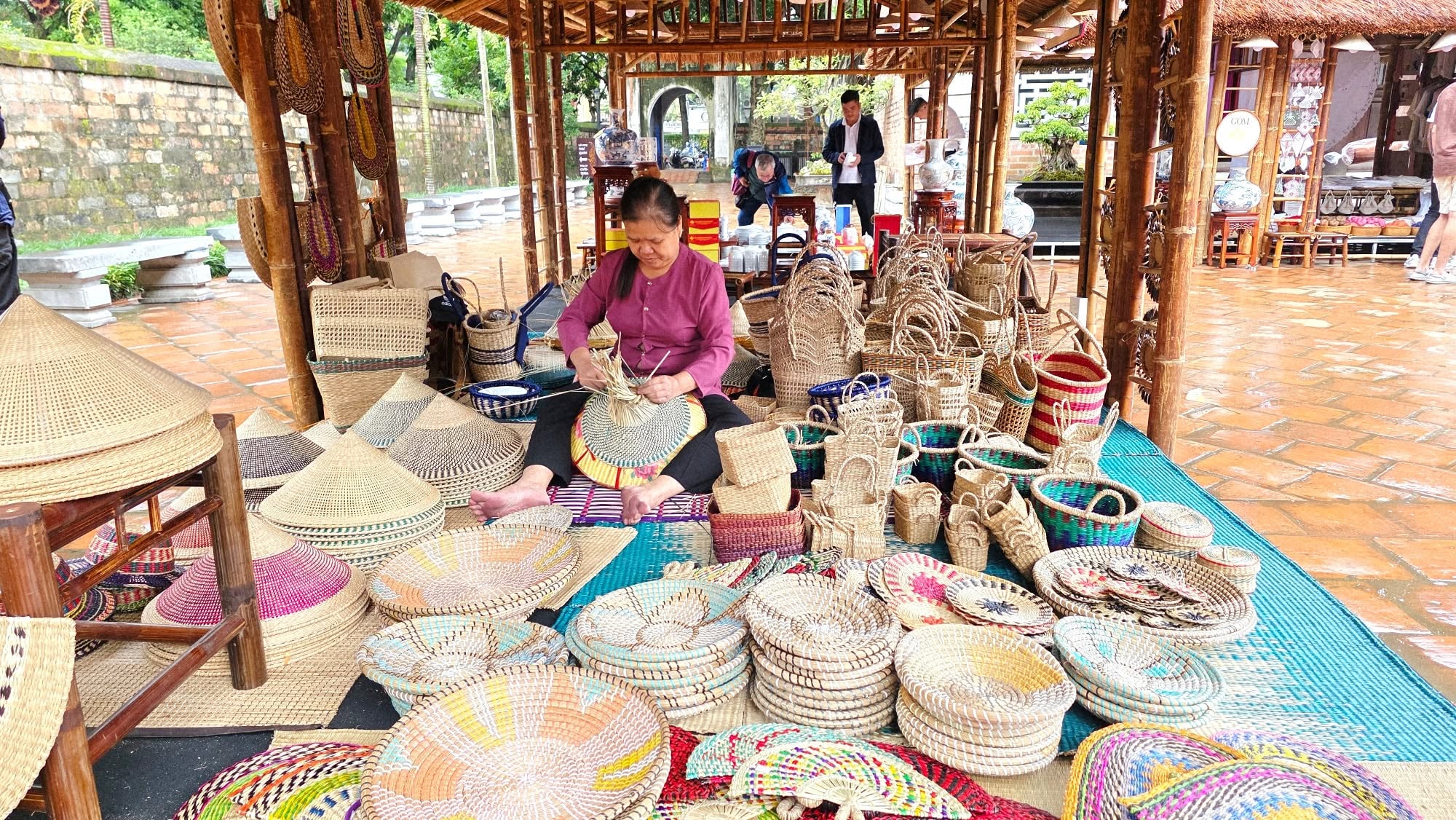
As consumer demand evolved, producers expanded their product ranges to include floor mats, shopping baskets, storage containers, trays, hats, handbags, cushions, household accessories, and interior decorations.
These products are made in different shapes, sizes, colors, and designs, combining the natural appearance of sedge with contemporary functionality.
In addition to sedge, some Kim Son handicraft producers have experimented with other plant-based materials, including water hyacinth stems and rice straw, to create decorative and household products for domestic and export markets.
With growing interest in natural materials and sustainable consumption, sedge handicrafts offer advantages in terms of their plant-based origins, versatility, and distinctive handmade appearance.
However, the environmental performance of individual products also depends on their processing methods, dyes, finishing materials, and overall production practices.
Beyond their commercial value, Kim Son sedge crafts preserve a rich body of traditional knowledge.
This includes selecting suitable raw materials, preparing fibers, combining colors, weaving mats, braiding, shaping products, and completing decorative details.
These skills have traditionally been transmitted within families, through workshops, and through direct instruction from experienced artisans to younger workers.
The craft is also closely associated with Kim Son’s history of coastal reclamation and settlement.
Each woven product reflects not only technical skill but also the working traditions, cultural memory, and identity of the local community.
A major milestone came in 2025, when Kim Son Sedge Craft was officially included on Vietnam’s National List of Intangible Cultural Heritage under Decision No. 1150/QD-BVHTTDL issued by the Ministry of Culture, Sports and Tourism.
The inscription recognizes the historical and cultural significance of the craft, the specialized skills involved in its practice, and the essential role of local communities in preserving and transmitting this heritage.
It also provides an important foundation for further efforts to safeguard traditional knowledge, train younger artisans, encourage product innovation, and promote the craft through cultural and economic development.
For Kim Son, national heritage recognition is not simply an honorary title. It highlights the importance of sustaining a living tradition that continues to support local livelihoods and express the region’s cultural identity.
Experiencing Kim Son Sedge Craft in Ninh Binh
Kim Son offers visitors more than traditional handicraft products. The region is also known for its distinctive cultural landscape, history, and architecture.
One of its most famous landmarks is Phat Diem Stone Cathedral, celebrated for its unusual architectural character, which brings together elements of traditional Vietnamese design and Catholic religious architecture.
A visit to the Kim Son area can be combined with an exploration of its sedge-making traditions, offering travelers a closer look at the everyday lives and working culture of Ninh Binh’s coastal communities.
At workshops that welcome visitors, travelers may have opportunities to observe different stages of sedge processing, including drying, dyeing, braiding, and mat weaving.
Depending on the facilities and arrangements available, some workshops may also offer simple hands-on activities under the guidance of local artisans.
Such experiences can help visitors appreciate the time, patience, and technical knowledge required to transform natural sedge fibers into a finished mat, basket, or handbag.
Visitors may also purchase locally made handicrafts as souvenirs.
Sedge handbags, woven baskets, storage trays, and decorative accessories combine practical uses with the distinctive character of Kim Son’s traditional craftsmanship.
Developing tourism around sedge production could help expand markets for local products, create additional employment opportunities, and encourage younger generations to continue practicing the craft.
For these activities to be sustainable, tourism development should respect the daily working routines of local communities and provide authentic opportunities to learn about traditional production.
Travelers interested in visiting workshops or participating in hands-on activities should make arrangements in advance to confirm availability.
As traditional handicrafts face increasing competition from mass-produced goods, preserving Kim Son sedge craft requires a combination of cultural safeguarding and economic adaptation.
Important priorities include improving product quality, developing contemporary designs, supporting artisans, maintaining access to suitable raw materials, and expanding domestic and international markets.
Documenting traditional techniques and passing them on to younger generations are equally essential to ensuring that the craft remains a living part of the community.
From the green sedge fields of Ninh Binh’s reclaimed coastal land to handcrafted products reaching markets around the world, Kim Son Sedge Craft has become an enduring symbol of local identity and creativity. Its recognition as a National Intangible Cultural Heritage in 2025 celebrates generations of craftsmanship while creating new opportunities to preserve and develop this distinctive Vietnamese tradition.
Quick Information
| Item | Details |
|---|---|
| Heritage name | Kim Son Sedge Craft |
| Vietnamese name | Nghề cói Kim Sơn |
| Alternative names | Kim Son Sedge Weaving, Kim Son Traditional Sedge Handicraft |
| Location | Kim Son area, Ninh Binh Province, Vietnam |
| Reference locality | Phat Diem Commune, Ninh Binh Province |
| Heritage category | Traditional Handicraft |
| Recognition | National Intangible Cultural Heritage |
| Recognition year | 2025 |
| Recognition decision | No. 1150/QD-BVHTTDL |
| Recognizing authority | Ministry of Culture, Sports and Tourism of Vietnam |
| Main material | Sedge |
| Typical products | Sedge mats, floor coverings, baskets, handbags, hats, trays, and decorative items |
| Traditional techniques | Cultivation, harvesting, processing, drying, dyeing, braiding, weaving, and finishing |
| Cultural significance | Traditional craftsmanship, coastal settlement history, and community identity |
| Nearby attraction | Phat Diem Stone Cathedral |
| Tourism potential | Craft village tourism, handicraft experiences, and locally made souvenirs |