

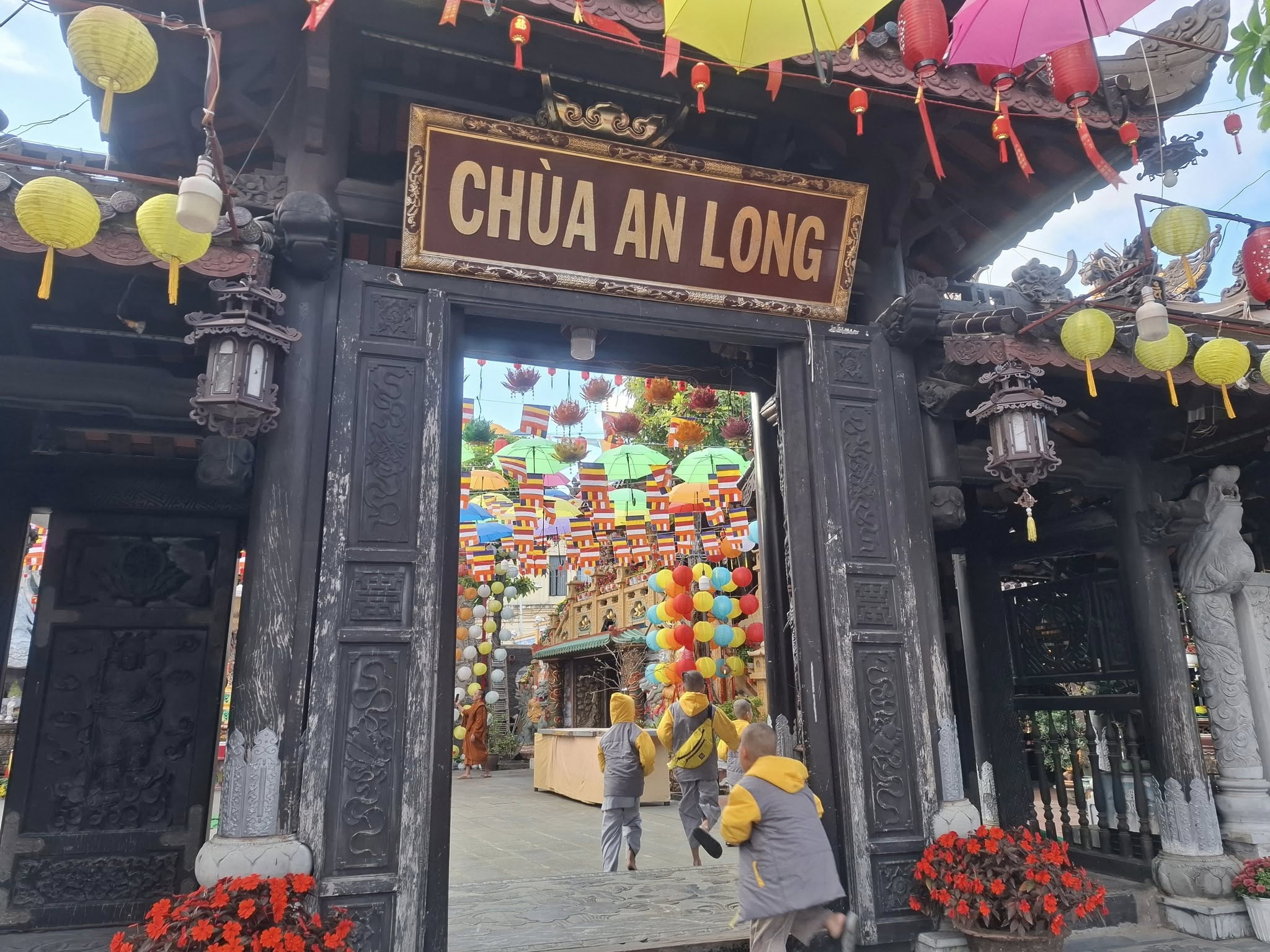
The Long Thu Pagoda Stele is a historical monument closely associated with the establishment and development of an ancient Buddhist temple in Da Nang, Vietnam. Erected in 1658 during the reign of Emperor Le Than Tong, the stone inscription records the origins of the pagoda’s name, its construction, and the individuals who donated money and land to establish this place of Buddhist worship.
Although the original pagoda has not survived in its original form, the stele remains an important historical artifact, providing valuable insights into the development of Buddhism and community life in Da Nang during the seventeenth century.
Location and Historical Origins
The Long Thu Pagoda Stele was originally erected within the grounds of Long Thu Pagoda, which was later renamed An Long Pagoda. The monument is located in Hai Chau Ward, Da Nang City, in the area behind the Museum of Cham Sculpture.
The stele was erected in 1658, the fifth year of the Thinh Duc era under Emperor Le Than Tong. Its inscription was composed by Le Gia Phuoc, whose Buddhist name was Phap Giam, a resident of Hai Chau Village.
The inscription explains the reasons for establishing the pagoda, the origins of the name Long Thu, the names of those who contributed money and land, and details of the properties donated for religious purposes.
According to the inscription, the Buddha was believed to have manifested in the Nai Hien area to help people facing hardship, appearing in a form associated with a dragon’s head. As a result, Buddhist followers frequently visited the area to pray.
A local resident named Tran Huu Le donated his garden as the site for constructing a Buddhist temple. Other villagers and Buddhist devotees contributed funds, farmland, and resources to complete the pagoda.
In 1653, a temple bell was cast and Buddhist statues were created as part of the development of the religious complex.
These records not only document the pagoda’s origins but also demonstrate the collective efforts of the local community in establishing and maintaining a place of worship.
Changes to the Pagoda Over Time
According to accounts passed down by elderly residents, Long Thu Pagoda once housed two large bells and several beautifully crafted Buddhist statues.
Unfortunately, these artifacts were eventually lost.
The original pagoda was also destroyed during the conflicts between the Tay Son Dynasty and the forces of Nguyen Anh in the late eighteenth and early nineteenth centuries.
Following the destruction, the ancient stone stele became buried underground.
It was not rediscovered until 1903, when it was recovered and re-erected near the pagoda entrance.
In 1961, the Buddhist community and local devotees rebuilt the pagoda, creating the structure that became familiar in later decades.
The reconstructed temple featured architectural characteristics similar to contemporary pagodas in southern Vietnam.
Although the building itself was relatively simple, its traditional three-entrance gate, reportedly dating from 1903, remained a notable architectural feature.
Despite the many changes experienced by the pagoda, the rediscovery and preservation of the stele helped safeguard an important part of Da Nang’s religious and cultural history.
Architecture and Stone Carving Features
The Long Thu Pagoda Stele is carved from gray sandstone and measures approximately 1.25 meters high, 1.20 meters wide, and 0.21 meters thick.
The stone has an isosceles trapezoidal shape with a rounded top and decorative carvings on both sides.
Front of the Stele
The front contains a Chinese-character inscription surrounded by ornamental patterns.
At the top, a sun motif occupies the center, surrounded by stylized clouds. Floral vines extend along both sides, while a decorative lotus band appears near the bottom.
Two mythical Vietnamese guardian creatures known as nghê are carved at the lower corners, completing the ornamental composition.
The front inscription consists of 368 Chinese characters.
Six large characters are arranged horizontally across the upper section, each enclosed within an individual frame. Together, they form the inscription:
“Lập Thạch Bi Thủ Long Tự”
Two smaller Buddhist swastika symbols, known as van characters, appear on either side.
The main inscription contains 360 smaller characters arranged in 18 vertical columns, traditionally read from right to left.
Back of the Stele
The reverse side features a decorative border similar to that on the front but contains no written inscription.
Instead of the lotus band used on the front, the lower section is decorated with a chrysanthemum vine pattern.
The two mythical guardian creatures found on the front are absent from the reverse.
These decorative details illustrate the combination of historical documentation and traditional artistic craftsmanship.
Beyond its written content, the stele is a valuable artifact for studying seventeenth-century stone carving techniques and Buddhist decorative art in Da Nang.
Historical and Cultural Significance
Although the original Long Thu Pagoda no longer exists in its initial architectural form, the stele provides important physical evidence of the temple’s historical existence.
Its inscription offers valuable information about the establishment of Buddhist places of worship, local religious beliefs, community contributions, and the donation of land for religious purposes.
These details make the stele an important historical source for understanding the cultural and religious life of Hai Chau and the wider Da Nang region during the seventeenth century.
The Long Thu Pagoda Stele is also considered one of the area’s notable early dated stone inscriptions.
Its references to the construction period, the author, donors, and donated properties contribute to the historical documentation of Da Nang’s urban development and religious traditions.
The monument is therefore significant not only as a Buddhist artifact but also as evidence of the relationships between religion, land ownership, and community organization in early local society.
Recognition as a Historical Monument
The Long Thu Pagoda Stele was officially classified as a historical monument by the Governor-General of French Indochina under a decree dated May 16, 1925.
On December 2, 1992, Vietnam’s Ministry of Culture and Information recognized the stele as a National Historical Monument.
This designation acknowledges its historical, cultural, and artistic importance and provides a foundation for the protection and preservation of the artifact.
Importance to Da Nang’s Cultural Heritage
The Long Thu Pagoda Stele is a meaningful historical site for visitors interested in Buddhism, traditional art, and the cultural heritage of Da Nang.
Through its ancient Chinese characters and carefully carved decorative patterns, visitors can learn about a Buddhist temple established in the seventeenth century and the collective efforts of local residents who supported its construction.
The stele also demonstrates that cultural heritage is not preserved solely through surviving buildings.
Sometimes, a single historical artifact can provide essential evidence for reconstructing the memory of a place that has undergone centuries of transformation.
With its historical documentation, religious significance, and artistic craftsmanship, the Long Thu Pagoda Stele contributes to a deeper understanding of Da Nang’s development and the spiritual traditions of its communities.
Quick Facts About the Long Thu Pagoda Stele
| Information | Details |
|---|---|
| Monument name | Long Thu Pagoda Stele |
| Vietnamese name | Bia chùa Long Thủ |
| Associated pagoda | Long Thu Pagoda, later renamed An Long Pagoda |
| Location | Hai Chau Ward, Da Nang, behind the Museum of Cham Sculpture |
| Date of inscription | 1658, fifth year of the Thinh Duc era |
| Historical reign | Emperor Le Than Tong |
| Inscription author | Le Gia Phuoc, Buddhist name Phap Giam |
| Material | Gray sandstone |
| Dimensions | 1.25 m × 1.20 m × 0.21 m |
| Main inscription | Origins of the pagoda, donors, construction history, and donated land |
| Rediscovered | 1903 |
| Pagoda reconstructed | 1961 |
| Colonial-era monument classification | May 16, 1925 |
| National historical monument recognition | December 2, 1992 |
| Historical significance | Buddhist history, community heritage, and traditional stone carving art |