


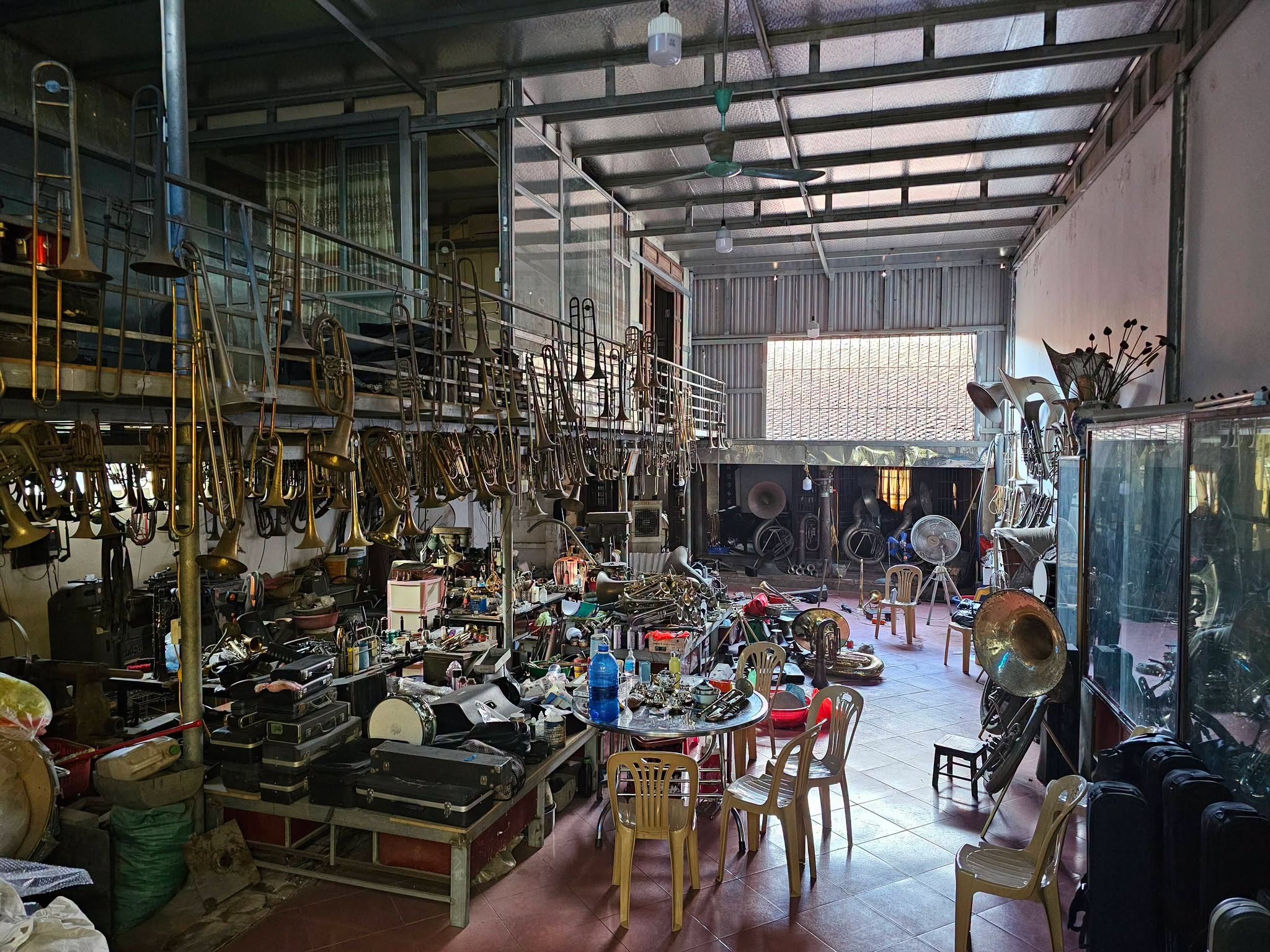
Pham Phao Brass Instrument Village, located in Hai Anh Commune, Ninh Binh Province, is a distinctive traditional craft village renowned for its expertise in making, repairing, and restoring brass and other wind instruments. Set amid the peaceful countryside of northern Vietnam, the village is a remarkable place where skilled metalworking, musical traditions, and Catholic community life have developed together over generations.
Unlike villages specializing in pottery, woodcarving, or textiles, Pham Phao is known for producing and maintaining musical instruments originally introduced from the West. Using sheets of brass, metal tubing, and intricate mechanical components, local craftsmen are capable of repairing, restoring, and manufacturing a variety of instruments that require considerable technical precision.
What makes Pham Phao particularly fascinating is that many of its instrument makers come from ordinary rural backgrounds. Farming, craftsmanship, and music have long existed side by side in the community.
During the day, residents may work in their fields or family workshops. On religious holidays and special occasions, many become musicians, performing together in the village’s brass bands.
For the people of Pham Phao, brass instruments are more than tools for making music. They symbolize community identity, religious traditions, artistic expression, and the skills passed down through generations.
Today, Pham Phao offers a distinctive cultural perspective for travelers interested in traditional Vietnamese craftsmanship, musical heritage, and the Catholic communities of the Red River Delta.
History and Origins of Pham Phao Brass Instrument Village
Pham Phao is located in the former Hai Hau area, a region known for its agricultural traditions and longstanding Catholic communities.
Before administrative restructuring, the village belonged to Hai Minh Commune, Hai Hau District, Nam Dinh Province. Under the current administrative arrangement, it is part of Hai Anh Commune, Ninh Binh Province.
The history of brass instrument craftsmanship in Pham Phao is closely connected with the development of Catholic parish life in the region.
According to local accounts, Catholicism has been present in this area for several centuries. As religious communities developed, musical activities gradually became an important part of worship and communal celebrations.
Brass bands, commonly referred to by local residents as ken Tay, meaning Western-style wind bands, became particularly prominent.
The name reflects the European origins of many of the instruments traditionally used by these ensembles.
According to local historical accounts, a substantial church was built in Pham Phao in 1908. Around the same period, the parish began organizing brass bands, establishing a musical tradition that would become deeply rooted in village life.
Initially, most instruments were imported from overseas.
Purchasing them was expensive, and repairing damaged instruments could be difficult because replacement parts and specialized technicians were not readily available.
As instruments aged or developed mechanical problems, local musicians began searching for ways to repair them independently.
Some villagers with mechanical aptitude and musical knowledge started dismantling instruments to understand their internal structures.
They examined how valves, pistons, tubing, bells, and other components worked together to produce sound.
Through repeated experimentation, local craftsmen gradually acquired the skills needed to repair damaged instruments, replace components, and restore their playing condition.
Once they understood the mechanical principles involved, some artisans began attempting to manufacture instruments themselves.
According to village tradition, Nguyen Van Bien was among the pioneers of brass instrument manufacturing in Pham Phao during the 1950s.
Working at a time when materials and equipment were limited, he reportedly experimented with recycled metal, scrap brass, and other available materials to create instrument components.
These early efforts helped lay the foundations for a local instrument-making craft.
What began as a practical response to the repair needs of parish musicians gradually developed into a specialized occupation for local households.
Craftsmanship was passed from experienced workers to younger generations, creating a community of artisans who understood both instrument construction and musical performance.
Over the following decades, Pham Phao became widely recognized for its expertise in manufacturing, repairing, and restoring wind instruments.
The Art of Brass Instrument Making and the Skills of Pham Phao Craftsmen
Making a brass instrument requires a combination of precision metalworking, practical engineering knowledge, manual craftsmanship, and musical understanding.
Unlike many decorative handicrafts, a musical instrument must not only look attractive but also function accurately and produce a consistent, appropriate sound.
According to local craft village accounts, some instruments contain approximately 180 to 250 individual components, depending on their design and mechanical complexity.
These components may include metal tubing, valves, pistons, springs, keys, mouthpiece connections, and the instrument’s bell.
Each part performs a specific function, and even a small manufacturing error can affect the instrument’s performance.
The production process involves several demanding stages, including selecting materials, cutting metal, shaping tubing, bending components, soldering joints, machining mechanical parts, assembling the instrument, and adjusting its sound.
Metal shaping and tube bending are particularly important.
The craftsman must form the instrument’s tubing carefully to achieve the required shape while minimizing distortions that could interfere with airflow.
For instruments with large bells, specialized shaping and forming techniques are used to create the characteristic flared opening.
Once the components have been prepared, the joints must be securely soldered and properly sealed.
Even a small air leak can affect the instrument’s tone, response, and overall playability.
Among the most technically challenging components are valve and piston mechanisms.
These parts require precise machining so that the valves move smoothly, respond quickly, and maintain an effective air seal.
Different instruments use different mechanical systems, so the required techniques vary according to the type of instrument being manufactured or repaired.
After assembly, the craftsman must inspect the instrument’s airtightness, mechanical operation, and sound quality.
Tuning and sound adjustment are essential final stages.
An instrument is only truly complete when it produces suitable, stable notes and responds properly during performance.
This requires the craftsman to recognize differences in pitch, tone quality, and subtle changes in sound.
For this reason, many experienced Pham Phao instrument makers are also skilled musicians.
They can personally test an instrument, identify problems, and make the necessary adjustments before it is delivered to a customer.
Local accounts mention artisans such as Nguyen Van Cuong and Nguyen Van Huong, who have contributed their expertise in instrument manufacturing, repair, and the transmission of craft knowledge to younger generations.
Over time, workshops have incorporated equipment such as rolling machines, bending tools, welding and soldering devices, and other metalworking machinery.
Nevertheless, many important stages continue to depend on the craftsman’s manual skills, practical experience, and musical ear.
According to local sources, Pham Phao workshops have worked with a wide variety of wind instruments, including:
- Trumpet: A brass instrument known for its bright, powerful sound, commonly used in brass bands and orchestras.
- Trombone: A brass instrument characterized by its movable slide, which allows musicians to change pitch.
- Tuba: A large, low-pitched brass instrument that provides the bass foundation of many ensembles.
- Helicon: A low-pitched brass instrument designed to wrap around the musician’s body, making it suitable for marching performances.
- Baritone horn: A brass instrument with a warm, rounded tone, often featured in traditional brass bands.
- Saxophone: A metal-bodied wind instrument that uses a single reed and a complex key mechanism.
- Clarinet: A single-reed wind instrument requiring specialized techniques for its construction, adjustment, and repair.
Although saxophones and clarinets are often grouped with Western-style band instruments in local descriptions, they are technically classified as woodwind instruments, rather than brass instruments.
The range of instruments handled by Pham Phao craftsmen demonstrates the breadth of their practical knowledge.
In addition to manufacturing new instruments, repairing and restoring older ones remains an important part of the village’s craft tradition.
Damaged instruments may be dismantled, cleaned, fitted with replacement components, repaired, and carefully adjusted to restore their playing condition.
The close relationship between mechanical craftsmanship and musical knowledge is what makes Pham Phao’s instrument-making tradition particularly distinctive.
Brass Band Culture and the Musical Traditions of a Catholic Village
What makes Pham Phao exceptional is not only its instrument-making industry but also the community’s enduring enthusiasm for music.
Brass bands are closely associated with religious observances, festivals, and important occasions in village life.
During major Catholic celebrations such as Christmas and Easter, brass bands may perform as part of parish activities, contributing to the solemn and celebratory atmosphere.
Depending on local customs, band performances may also accompany weddings, funerals, processions, and other community gatherings.
For the people of Pham Phao, music is not merely a form of entertainment.
It is a means of expressing faith, strengthening community bonds, and maintaining traditions shared across generations.
The sound of brass instruments during church celebrations, village gatherings, and ceremonial processions has become part of the community’s collective memory.
Historical reports about the former Nam Dinh and Hai Hau areas describe a particularly strong brass band tradition, with hundreds of ensembles, including numerous all-female bands.
Within this wider musical culture, Pham Phao became especially well known because local residents could both perform on wind instruments and manufacture or repair them.
In many households, children are introduced to music through the activities of parish bands.
As they grow older, those interested in music may begin studying music theory, reading notation, breathing techniques, and instrumental performance.
Learning to play a wind instrument requires considerable practice.
Musicians must develop control over their breathing, embouchure, finger movements, and coordination with other performers.
Playing in a brass band also requires the ability to listen carefully and maintain musical balance within an ensemble.
According to previously published local figures, Pham Phao once had approximately 1,500 residents familiar with music theory and around 1,000 capable of playing Western-style wind instruments.
Some younger musicians had also received formal training at professional music institutions.
These figures illustrate the strength of the village’s musical tradition at the time they were recorded and should not be interpreted as verified current statistics.
Another notable achievement described in local accounts was a large-scale brass band performance involving more than 800 musicians.
Such gatherings demonstrate the extraordinary level of community participation in musical activities.
An especially interesting aspect of Pham Phao is that many musicians are not full-time professional performers.
In everyday life, they may be farmers, craftsmen, shopkeepers, or workers in other occupations.
Yet during religious festivals and community celebrations, they come together as accomplished musicians, performing music that requires coordination, discipline, and years of practice.
The image of farmers exchanging their everyday work clothes for performance uniforms, carrying polished brass instruments, and joining a large ensemble has become a defining feature of the village’s cultural identity.
This strong musical environment also helps sustain the demand for instrument repair, maintenance, and manufacturing.
As a result, the village’s craft tradition and musical culture continue to support one another.
Preserving Pham Phao’s Instrument-Making Heritage and Developing Cultural Tourism
Over several decades, instrument making has become an important part of Pham Phao’s local identity.
From the earliest craftsmen who learned to repair damaged imported instruments, the village gradually developed a community capable of producing, restoring, and maintaining various types of wind instruments.
The craft has provided employment opportunities, supported household incomes, and diversified economic activities in an area traditionally associated with agriculture.
More importantly, it has created a distinctive relationship between craftsmanship and musical performance.
Instrument makers understand the practical needs of musicians, while performers have opportunities to learn about the mechanical structures of the instruments they use.
This connection has helped preserve technical knowledge and encourage the transmission of skills between generations.
Today, however, traditional instrument making faces both opportunities and challenges.
Mass-produced instruments often benefit from standardized manufacturing, modern designs, and large-scale distribution.
Local craftsmen must therefore build on their strengths in specialized repairs, customized components, restoration, and individual sound adjustment.
Preserving the craft requires more than maintaining older production methods.
It also involves training younger artisans, improving technical skills, adapting to changing markets, and documenting knowledge held by experienced craftsmen.
Beyond its economic significance, Pham Phao has considerable potential for cultural tourism.
For visitors, the village offers an opportunity to discover a lesser-known aspect of traditional life in northern Vietnam.
At workshops that welcome guests, travelers may be able to observe craftsmen shaping metal components, soldering joints, assembling instruments, and testing their sound.
Processes such as forming an instrument’s bell, checking valve mechanisms, and adjusting musical tones can be particularly fascinating for visitors interested in music, engineering, and traditional handicrafts.
Where appropriate visitor programs are available, meetings with local artisans may provide opportunities to learn about different wind instruments, the principles of sound production, and the skills required to manufacture them.
Beyond the workshops, travelers can explore the village’s Catholic cultural environment and discover how brass bands have become an integral part of local community life.
Visits to churches or attendance at musical and religious events should respect parish schedules, local customs, and the guidance of organizers.
Visitors are advised to make arrangements in advance, as not all workshops or brass bands operate regular tourism programs.
Pham Phao could also be included in broader cultural itineraries featuring religious architecture, traditional craft villages, and rural landscapes in the former Hai Hau area.
The combination of instrument making, musical performance, and Catholic cultural traditions gives the village a distinctive character rarely found in other handicraft communities.
For sustainable tourism development, it is important to preserve traditional knowledge, support artisan training, improve product quality, and present the village’s cultural heritage in a respectful and accurate manner.
In the peaceful countryside of northern Vietnam, the sound of brass instruments continues to express the unique identity of Pham Phao. From carefully shaped metal components to the powerful harmonies of community brass bands, the village brings together craftsmanship, music, and religious traditions, preserving a remarkable cultural heritage in present-day Ninh Binh Province.
Quick Information
| Item | Details |
|---|---|
| Craft village | Pham Phao Brass Instrument Village |
| Vietnamese name | Làng nghề kèn đồng Phạm Pháo |
| Current location | Pham Phao Village, Hai Anh Commune, Ninh Binh Province, Vietnam |
| Former administrative location | Hai Minh Commune, Hai Hau District, Nam Dinh Province |
| Craft type | Traditional musical instrument manufacturing and repair |
| Main specialties | Making, repairing, and restoring brass and other wind instruments |
| Associated cultural tradition | Brass band music in Catholic community life |
| Local historical milestone | Parish church built in 1908, according to local accounts |
| Development of instrument making | Around the mid-20th century |
| Pioneering craftsman | Nguyen Van Bien |
| Notable artisans mentioned in local accounts | Nguyen Van Cuong, Nguyen Van Huong |
| Representative instruments | Trumpet, Trombone, Tuba, Helicon, Baritone Horn, Saxophone, Clarinet |
| Traditional techniques | Metal tube bending, bell shaping, soldering, valve machining, assembly, and sound adjustment |
| Instrument complexity | Some instruments contain approximately 180–250 components |
| Cultural activities | Brass band performances during Christmas, Easter, and community events |
| Cultural significance | Instrument-making knowledge, musical performance skills, and Catholic community traditions |
| Tourism potential | Workshop visits, instrument-making demonstrations, artisan interactions, and cultural exploration |







