The Cấm Dơi Victory was an important milestone in the history of the revolutionary struggle in Quảng Nam, associated with the summer 1972 offensive to attack and destroy the fortified defensive system of the Army of the Republic of Vietnam in the Quế Sơn area. The victory not only changed the local military situation but also expanded the liberated zone, creating conditions for residents to return to their homeland after years of living under opposing forces’ control.
Cấm Dơi was once a strategically important military base, developed into a multi-layered defensive system comprising underground bunkers, pillboxes, artillery positions, and outer strongholds. With a large garrison supported by American air power, artillery, and naval forces, it was regarded as one of the strongest defensive lines in the Quế Sơn area.
After careful preparation and coordinated operations involving main-force units, local troops, artillery, and air defense forces, revolutionary forces successively captured the outer defensive positions, defeated counterattacks, and advanced toward the center of the base. On August 19, 1972, the Cấm Dơi–Quế Sơn Victory was established, marking the growing combined-arms capabilities of the armed forces of Military Region 5.
Cấm Dơi Before the 1972 Campaign
According to historical records, the name Cấm Dơi originated from an old protected forest where large colonies of bats gathered to roost after foraging during the day. The area was located near the Quế Sơn district capital and had favorable terrain for constructing a military defensive system.
After withdrawing from the Hiệp Đức district capital, the Army of the Republic of Vietnam concentrated its forces at Cấm Dơi, established a new defensive line, and set up a military sub-sector in the Quế Sơn valley. On American military maps, the base was identified as “Ross.”
Taking advantage of large rock formations and mountainous terrain, opposing forces excavated deep into the hills to build underground bunkers, pillboxes, command posts, and fortified communications facilities. Surrounding the central base was a network of defensive positions, including Hòn Chiêng, Bàng Thùng, Hill 579, Hill 700, Đồng Mông, Đá Hàm, Đá Tịnh, and Hòn Giang. Among these, Hòn Chiêng was known as the “watchful eye” guarding the center of Cấm Dơi.
The garrison in the Cấm Dơi–Quế Sơn area included multiple infantry, armored, artillery, ranger, and local military units. Historical accounts describe the defensive system as being reinforced by numerous artillery positions nearby, air support based in Đà Nẵng and Chu Lai, and American naval gunfire from offshore.
Because it controlled routes from Hiệp Đức and western Quế Sơn toward the lowlands, Cấm Dơi served as a launching point for sweep operations, ambushes, and territorial encroachment. The presence of this network of strongholds created considerable difficulties for revolutionary forces and local residents.
The Decision to Destroy the Cấm Dơi Base
During the summer–autumn campaign of 1972, the Regional Party Committee and the Command of Military Region 5 identified the destruction of Cấm Dơi as a major objective. Breaking this defensive line was intended to expand the liberated zone in Quế Sơn, establish more favorable operational corridors, and force opposing forces to disperse their strength, thereby helping relieve pressure on the Trị–Thiên battlefield.
The campaign was meticulously prepared in terms of force organization, morale, logistics, equipment, and operational planning. The 711th Division played an important role in organizing the offensive, coordinating with infantry, artillery, special forces, and local units.
The operational plan was implemented in three main phases:
- Destroy the outer defensive positions protecting the Cấm Dơi base.
- Defeat counterattacks aimed at recapturing lost positions.
- Attack and destroy the central Cấm Dơi base, together with the military sub-sector and the Quế Sơn district capital.
In addition to infantry, artillery and air defense units were deployed to support the advancing forces, protect firing positions, and limit the opposing side’s ability to intervene with aircraft.
Capturing the Outer Defensive Positions
On the night of July 22 and into the early morning of July 23, 1972, revolutionary forces launched the campaign with attacks on the outer defensive positions surrounding Cấm Dơi.
According to historical accounts, at approximately 5:10 a.m. on July 23, the 31st Regiment opened fire on Bàng Thùng. The 38th Regiment subsequently attacked the Hòn Chiêng high ground, while the 9th Regiment advanced against the Đồng Mông–Đá Hàm positions.
The coordinated attacks plunged the battlefield into smoke and fire. Taken by surprise, opposing forces at several positions were thrown onto the defensive. Although they resisted fiercely, they were unable to maintain control of the entire defensive network.
After approximately 30 minutes of fighting, the 38th Regiment gained control of Hòn Chiêng. By 7:15 a.m. that day, the 9th Regiment had also captured the positions at Đồng Mông–Đá Hàm.
At Bàng Thùng, however, the defenders mounted strong resistance and received support from aircraft and artillery. Fighting continued until July 25, 1972. With artillery support, revolutionary forces eventually destroyed the defensive force there and took control of the position.
Within the first few days of the campaign, several key outer defensive positions surrounding Cấm Dơi had fallen. The weakening of the outer line left the central base at risk of isolation.
Defeating Counterattacks to Recapture Lost Positions
The loss of the outer strongholds forced opposing forces to deploy troops from the 5th Regiment of the 2nd Infantry Division in counterattacks intended to recover lost positions and protect the Cấm Dơi base.
The battles were intense. Opposing forces deployed reconnaissance aircraft, attack aircraft, ground artillery, and offshore naval guns to strike revolutionary formations. According to historical accounts, B-52 strategic bombers were also used in an attempt to inflict heavy casualties on the attacking forces.
In these circumstances, 37 mm anti-aircraft guns and 12.7 mm anti-aircraft machine guns worked together to protect infantry formations, artillery positions, and recently captured strongholds. In particular, air defense forces around Hòn Chiêng helped counter aerial attacks and maintain control of the battlefield.
Historical records state that the position of Battery 11, belonging to the 44th Anti-Aircraft Artillery Battalion, was attacked by A-4 attack aircraft of the U.S. Navy, causing heavy casualties. The battery’s political officer, Lê Tuấn Trang, and medic, Hồ Xuân Nghị, were wounded and later died from their injuries despite receiving emergency treatment.
Units of the 711th Division continued fighting to hold Hòn Chiêng, Đồng Mông–Đá Hàm, and Bàng Thùng, while repelling attempts by opposing forces to recapture these positions. After nearly half a month of fighting, the outer defensive network remained under revolutionary control, creating conditions for the decisive phase of the campaign.
The Final Offensive and Liberation of Cấm Dơi–Quế Sơn
On August 18, 1972, revolutionary forces launched the decisive offensive against the Cấm Dơi base. Ground artillery using 130 mm guns, B-72 missiles, 120 mm mortars, 75 mm DKZ recoilless guns, and other weapons was deployed to strike the fortified defensive structures.
Units of the 711th Division advanced toward the base, breached its barriers, and opened routes for infantry to enter. Opposing forces repeatedly deployed A-37 attack aircraft and B-52 bombers to strike the advancing formations in an attempt to reverse the situation.
On the morning of August 19, 1972, the assault on the central base became particularly fierce. Artillery concentrated its fire on fortified targets, while air defense units engaged opposing aircraft. According to historical accounts, air defense positions of the 711th Division shot down two A-37 attack aircraft during the fighting.
Under sustained pressure, opposing artillery positions, helicopter landing areas, pillboxes, underground bunkers, and command posts were successively destroyed. Infantry units advanced rapidly, using B40 and B41 rocket-propelled weapons to capture the remaining resistance positions.
By 3:00 p.m. on August 19, 1972, the victory flag was flying above the command post of the Cấm Dơi base and the Quế Sơn district capital. Another historical account records that the battle ended at 6:00 p.m. on the same day. These two times reflect differing accounts of when the campaign was fully completed.
The Cấm Dơi–Quế Sơn Victory broke an important defensive system, changed the local battlefield situation, and created conditions for residents from strategic hamlets and resettlement areas to return to their former homes.
Historical Significance of the Cấm Dơi Victory
The Cấm Dơi–Quế Sơn Victory demonstrated the growing capabilities of the armed forces of Military Region 5 in organizing an offensive against a heavily fortified military base defended by a large force and supported by substantial firepower.
The campaign highlighted the importance of coordination among infantry, artillery, air defense units, and local forces. The successive destruction of outer strongholds, defeat of counterattacks, and final assault on the central base illustrated a phased operational approach designed to weaken the defensive system before launching the decisive attack.
The victory also had a significant impact on the lives of local residents. According to historical records, more than 10,000 people in the district were able to return to their homeland after years of living in areas under control and in population-concentration zones. The expansion of the liberated area helped restore local life and strengthen the revolutionary position in the region.
More broadly, the victory contributed to the gradual weakening of the American strategy of “Vietnamization of the War” and created more favorable conditions for revolutionary military operations on the central Vietnamese battlefield.
The Cấm Dơi Victory Monument
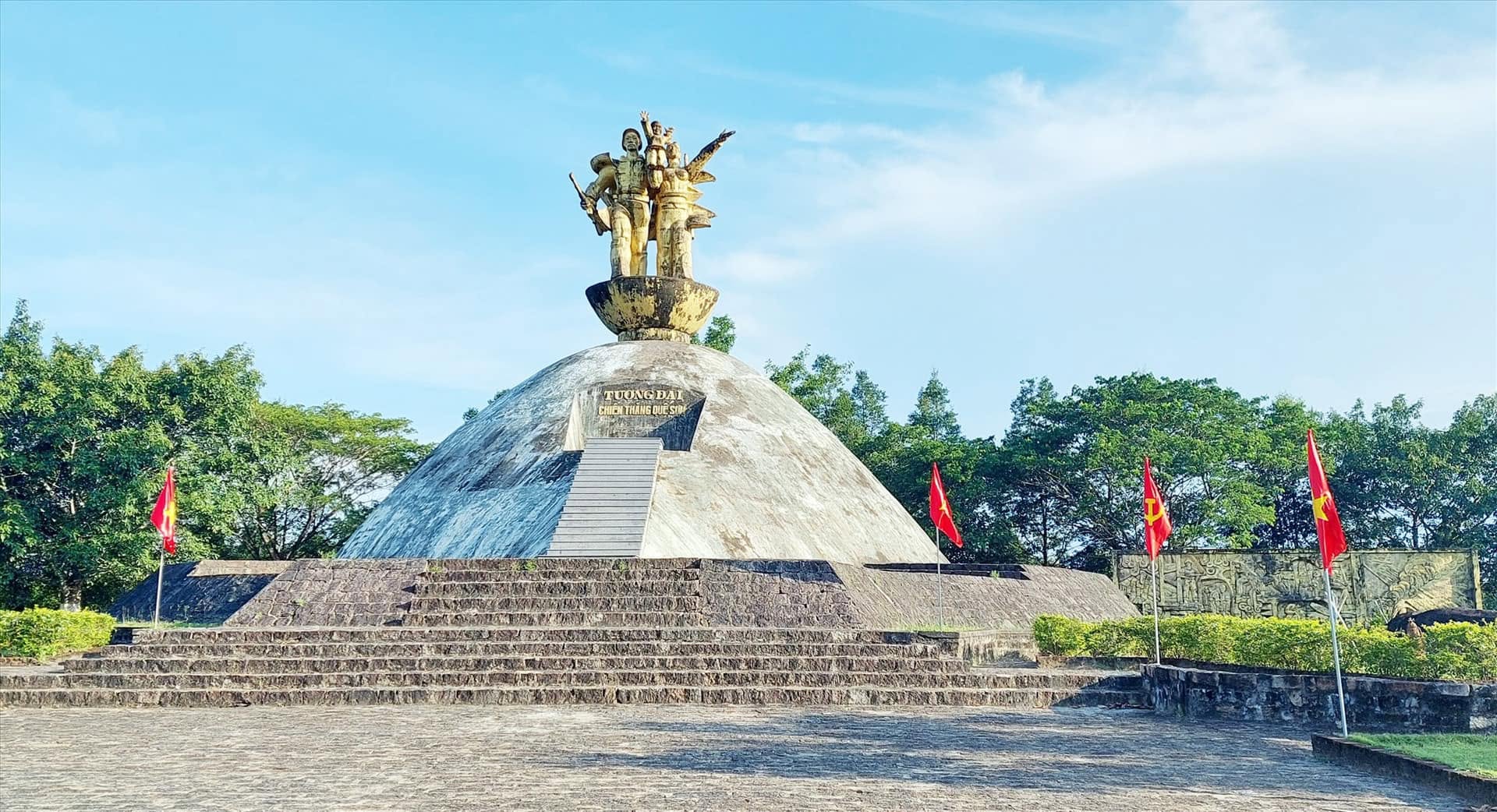
After liberation, the Cấm Dơi Victory Monument was built to commemorate those who fought and sacrificed their lives during the campaign.
The monument depicts a liberation soldier wearing a soft pith helmet standing alongside a female guerrilla. Both figures face forward and raise a child above them, evoking the struggle for life, freedom, and the future of the people. Behind them, a diagonal parachute motif creates the impression of wings.
According to the supplied historical account, the statue is approximately 7 meters high and stands on a 9-meter-high pedestal at the top of Cấm Dơi Hill. The monument commemorates the victory and serves as a reminder of the sacrifices made by officers and soldiers, as well as the contributions of local residents to the struggle for liberation.
The Site’s Value in Preserving History
The Cấm Dơi Victory Site forms part of the revolutionary historical heritage of the former Quảng Nam region. It is associated with a military campaign of considerable importance in 1972.
The site preserves memories of a strategically important defensive base, the preparation and organization of the campaign, coordination among armed forces, and the sacrifices of those who took part in the fighting. It also serves as a destination for historical education, helping younger generations learn more about their homeland’s revolutionary history and the contributions of the people of Quế Sơn.
Preserving, interpreting, and promoting the site’s historical value not only safeguards memories of the war but also highlights the importance of peace, solidarity, and the aspiration to live in independence and freedom.
Quick Information
| Item | Details |
|---|---|
| Name | Cấm Dơi Victory Site |
| Historical event | The Cấm Dơi–Quế Sơn Victory |
| Campaign period | Summer–autumn 1972 |
| Date the base was liberated | August 19, 1972 |
| Key revolutionary force | The 711th Division and supporting units |
| Historical location | Quế Sơn area, former Quảng Nam Province |
| Memorial structure | Cấm Dơi Victory Monument |
| Historical significance | Commemorates the destruction of a fortified defensive base and the expansion of the liberated zone |