The Chi Tay Village, now located in Phong Phu Ward, is an old settlement believed to have been established more than 400 years ago. According to local records, the village was founded through the efforts of early settlers and the ancestors of local family lineages who reclaimed and cultivated the land.
For generations, local residents have made their living primarily through rice cultivation and livestock farming. Alongside agriculture, however, the cultivation and shaping of ornamental plants, particularly apricot trees, gradually became an important part of village life.
Today, ornamental apricot cultivation is one of the distinctive traditional occupations of The Chi Tay. According to the source, more than 30% of the village population earns its main livelihood from growing ornamental apricot trees. Through generations of experience, local growers have developed their own techniques for cultivating, caring for and shaping the trees, making ornamental apricots a distinctive product of the village.
An Ornamental Tree Craft Rooted in Village Life
The people of The Chi Tay have long practiced agriculture and livestock raising. Over time, ornamental horticulture became another way for local families to diversify their livelihoods.
Among the many ornamental plants grown in the area, apricot trees hold a particularly important place. They are cultivated not only for the market but also as familiar ornamental trees in homes throughout the village and neighboring rural communities.
The craft has gradually developed its own local character. Growers have accumulated knowledge about selecting varieties, caring for trees, pruning branches and shaping trunks. These skills are closely associated with the traditional appreciation of ornamental trees in the Hue region.
Years of Care to Create a Beautiful Form
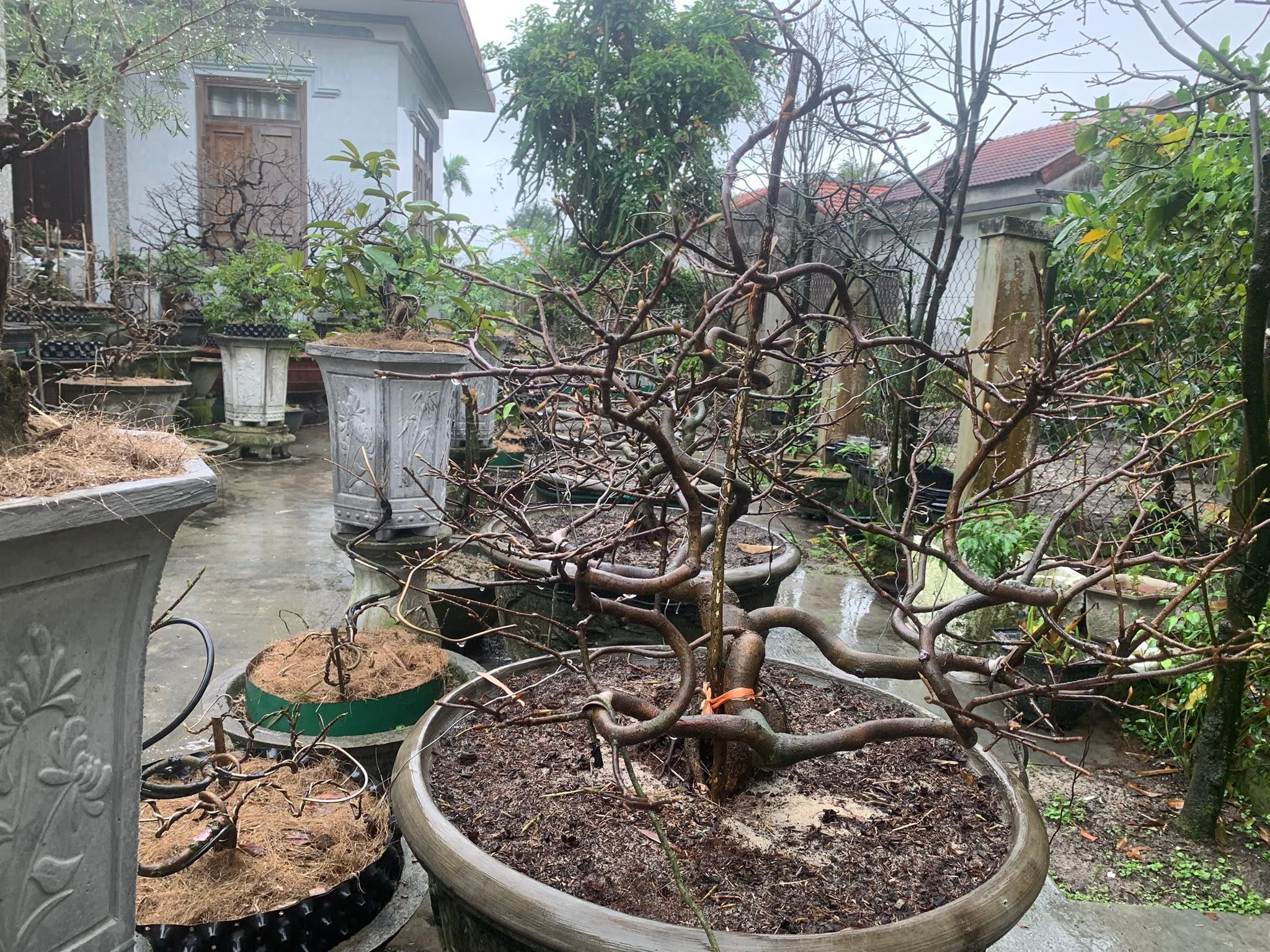
One distinctive feature of The Chi Tay ornamental apricot tradition is the largely manual approach to cultivation and shaping. According to the source, trees may be carefully tended for around three years during the initial shaping process to develop attractive, winding forms.
For older and more valuable trees, however, cultivation and shaping can continue for many years. The process requires patience because the desired form cannot be created in a single season.
Local growers traditionally pay attention to four fundamental elements, expressed in the saying “first the roots, second the trunk, third the branches, fourth the variety.” The root system provides the foundation, the trunk determines the main structure, the branches establish the composition and the variety influences the characteristics of the flowers.
A local verse associated with the area recalls the tradition:
“Remember to visit Dien Hoa,
On the twentieth day of the twelfth lunar month, home celebrates the Apricot Festival…”
The verse reflects the cultural connection between ornamental apricots, the local community and the festive atmosphere leading up to the Lunar New Year.
Distinctive Forms of The Chi Tay Apricot Trees
Local artisans know how to shape apricot trees in ways that suit the character of a traditional rural community associated with lagoon landscapes, village festivals and communal houses.
Ornamental trees are traditionally shaped into forms associated with the dragon, qilin, tortoise and phoenix. In The Chi Tay, however, the source identifies Long Van and Long Giang as two particularly characteristic forms practiced by local growers.
Creating these forms requires an understanding of the individual tree. Artisans observe the development of the roots, trunk and branches before gradually guiding their growth. The process is not simply a matter of bending branches according to a fixed pattern. Each tree has to be assessed and shaped according to its natural structure.
The resulting form depends on years of careful pruning, adjustment and cultivation.
Traditional Apricot Varieties of The Chi Tay
Several apricot varieties are grown in the village, including Hoang Truc Mai, Hoang Diep Mai and Diep Cuc Mai. Among these, Hoang Truc Mai is described in the source as the rarest variety.
According to local experience, the golden apricot trees of The Chi Tay are well suited to the area’s sandy loam soil. Their flowers are described as bright yellow, relatively large and gently fragrant, with a long-lasting bloom.
The timing of flowering is influenced by weather conditions. However, according to a well-known local artisan cited in the source, Hoang Truc Mai is known for flowering regularly around the Lunar New Year.
Local elders have also traditionally associated many large apricot trees in Hue with Dien Hoa. This is presented as part of local oral memory and tradition, reflecting the area’s longstanding connection with ornamental apricot cultivation.
Apricot Trees and the Cultural Space of the Village
The ornamental apricot craft of The Chi Tay is more than an agricultural product. It is also connected with the cultural life of the community.
During the Lunar New Year season, trees that have been carefully cultivated and shaped over many years burst into bloom and become part of family and village spaces. Caring for apricot trees is therefore both an economic activity and a form of traditional horticultural appreciation.
The knowledge involved in selecting varieties, cultivating trees and creating ornamental forms has been transmitted through generations. This continuity has helped establish a distinctive identity for the craft village.
The annual apricot season also connects the craft with local festive traditions. The sight of flowering apricot trees marks the arrival of spring and reinforces their place in the cultural landscape of the village.
A Traditional Craft Village of The Chi Tay
The Chi Tay Ornamental Apricot Craft Village was recognized by the People’s Committee of Thua Thien Hue Province as a traditional craft village under Decision No. 3078/QD-UBND dated December 28, 2018.
After more than four centuries of village history, ornamental apricot trees have become closely associated with the life of the people of The Chi Tay. From trees carefully cultivated by hand to forms shaped over many years, the craft reflects the patience, aesthetic sensibility and accumulated knowledge of local growers.
The value of the village therefore extends beyond the ornamental trees sold to the market. It also lies in a traditional appreciation of horticulture that has become part of rural life and has given The Chi Tay a distinctive cultural character within the Hue region.
Basic Information
| Item | Information |
|---|---|
| Craft village | The Chi Tay Ornamental Apricot Craft Village |
| Location | Phong Phu Ward |
| Village history | More than 400 years, according to the source |
| Traditional craft | Growing and shaping ornamental apricot trees |
| Share of residents engaged in the craft | More than 30%, according to the source |
| Notable varieties | Hoang Truc Mai, Hoang Diep Mai, Diep Cuc Mai |
| Characteristic forms | Long Van, Long Giang |
| Recognition | Traditional craft village |
| Decision | Decision No. 3078/QD-UBND, December 28, 2018 |
| Recognizing authority | People’s Committee of Thua Thien Hue Province |
Cultural Value of The Chi Tay Ornamental Apricot Craft
The Chi Tay ornamental apricot cultivation is a traditional occupation closely connected with agriculture, horticultural knowledge and the cultural life of the local community. Its value comes from knowledge of tree varieties, cultivation, pruning, shaping and long-term care.
More broadly, the craft reflects the traditional appreciation of ornamental trees in Hue. Each carefully shaped tree represents not only the natural growth of the plant but also the patience, experience and aesthetic judgment of the artisan who has cultivated it.
From one generation to the next, the people of The Chi Tay have continued to shape apricot trees into part of the village landscape, especially during the Lunar New Year season. In doing so, they have preserved a distinctive element of the cultural identity of this historic rural community.