In Hoai Nhon Bac Ward, Gia Lai Province, the traditional craft of woven sedge mats has existed for more than 300 years and has become an important part of local life. From sedge fields growing on saline and acidic soils, generations of local people have created durable, glossy and colorful mats that are distributed throughout Vietnam, particularly across the South Central Coast and the Central Highlands.
Today, alongside traditional hand weaving, local households and cooperatives have introduced mechanical looms to increase productivity and meet larger orders. The combination of traditional materials, generations-old craftsmanship and modern production methods is opening a new chapter for the Hoai Nhon sedge mat village.
| Information | Details |
|---|---|
| Village name | Hoai Nhon Woven Mat Village |
| Vietnamese name | Làng nghề dệt chiếu cói Hoài Nhơn |
| Location | Hoai Nhon Bac Ward, Gia Lai Province, Vietnam |
| History | More than 300 years |
| Type | Traditional craft village |
| Main material | Sedge, thread and dye |
| Main products | Plain sedge mats, patterned mats and sedge handicrafts |
| Main craft communities | Gia An Dong, Gia An Nam, Gia An, Quy Thuan and Chuong Hoa |
| Scale | Around 800 households primarily engaged in the craft, according to local surveys |
| Additional products | Hats, handbags, foot mats and other sedge handicrafts |
| Recognition | Recognized as a traditional craft village by the former Binh Dinh Provincial People’s Committee |
| Development direction | Combining traditional craftsmanship with mechanization, commerce and digital promotion |
From Saline Soil to Vast Sedge Fields
Sedge, also known locally as lac, is a soft, porous grass-like plant that naturally grows in wetlands or can be cultivated in acidic and saline soils. In Hoai Nhon Bac, unfavorable soil conditions once presented challenges for agriculture, but local people adapted by developing sedge cultivation.
Around 50 hectares of land in the area are mainly used for growing sedge. During the growing season, the fields create a distinctive landscape of green stalks mixed with the pale brown color of sedge flowers, stretching alongside local communities. Travelers passing through Hoai Nhon Bac along National Highway 1 can easily see these sedge fields, which provide the raw material for the traditional mat-making industry.
Local farmers generally harvest sedge twice a year. The spring crop usually takes place from March to April, while the main crop lasts from July to mid-September. In favorable weather conditions, farmers may harvest a third crop.
The journey from the sedge field to the weaving loom begins with careful harvesting. Good-quality stalks are selected, split and dried under the sun until they reach the appropriate level of dryness. Rain must be avoided during the drying process because moisture can significantly reduce the quality and durability of the sedge.
Once dried, the sedge is sorted. Some is kept in its natural color for plain mats, while other strands are prepared for dyeing and patterned mats.
From Sedge Fibers to Traditional Mats
A woven mat requires several essential materials and tools, including sedge, trân, thread, dye and either a traditional loom or a mechanical mat-weaving machine. Among these, the quality of the sedge is fundamental. Good sedge contributes to the durability of the finished mat, while its appearance and overall quality depend greatly on the skill and experience of the weaver.
Traditional Binh Dinh sedge mats can generally be divided into two main types: plain mats and patterned mats.
Plain mats are woven from undyed white sedge. The technique is relatively simple, producing a natural and understated appearance while retaining an elegant character. White mats have traditionally been used during worship and ceremonial occasions because of their natural color.
Patterned mats require considerably more work. Unlike methods in some other regions where a plain white mat is woven first and decorative designs are subsequently printed onto the surface, Binh Dinh mat makers traditionally dye selected bundles of sedge before weaving.
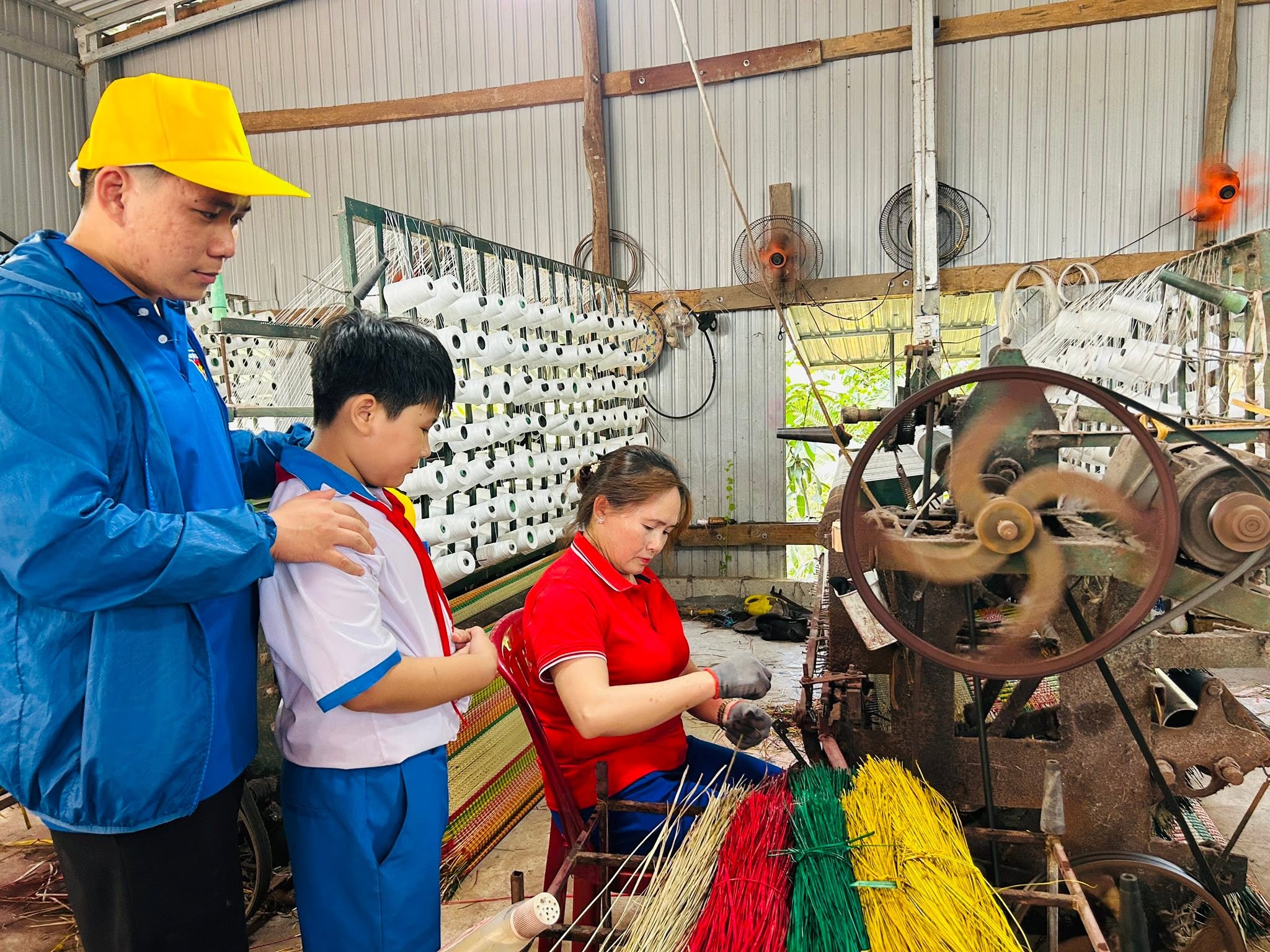
The dye is boiled, and individual bundles of sedge are dipped into the desired color before being dried. Red, blue, green and yellow are among the colors used. Once dry, the dyed strands are carefully arranged on the loom to create the decorative patterns.
Traditional patterned mats may feature auspicious characters such as Shou, symbolizing longevity, or Double Happiness, along with wishes for long-lasting happiness. The four corners can feature the Four Divine Creatures or large floral motifs, while additional decorative patterns are arranged around the edges. Red or blue borders complete the composition, creating a balanced and elegant appearance.
According to local craftswomen, producing a beautiful and durable mat begins with setting up the loom correctly. A second person traditionally assists by feeding the sedge strands into the loom, while the main weaver uses the beater to press each row tightly and evenly into place. The two workers continue this rhythm until the mat is completed.
This coordinated work was once a familiar sight in many households, where weaving knowledge was passed from one generation to another through observation and daily practice.
A Craft Closely Connected to Local Life
Over centuries, mat weaving has produced not only an essential household item but also a livelihood for many local families.
According to figures cited in local materials, among 1,525 households in villages where mat weaving takes place, nearly 700 households earn their living primarily from the craft. At the time of the application for recognition, the total number of households engaged in the craft was recorded at 780, accounting for approximately 51% of households in the villages, while 1,525 workers participated in the industry, representing around 25% of the total local workforce.
The craft also creates greater value from the region’s sedge resources. In addition to mats, local residents use sedge to make handicrafts such as hats, handbags, foot mats and other household or decorative products.
One of the notable values of the craft is its ability to transform land that is less suitable for many agricultural crops into a productive source of raw materials. Sedge is therefore more than a crop. It connects farmland, households, weaving looms and markets into a distinctive local economic system.
From Hand Looms to Modern Machines
In recent years, Hoai Nhon’s mat-making industry has undergone significant changes in its production methods. While some artisans continue to preserve traditional hand weaving, several cooperatives have invested in machinery to increase productivity and fulfill larger orders.
One example is the Hoai Chau Bac Sedge Mat Cooperative in Gia An Dong Village. Established in 2021, the cooperative works with around 20 local households that supply raw sedge. Local farmers grow, harvest and dry the sedge before delivering it to the cooperative.
At the cooperative, the sedge is dyed, dried and woven using mechanical looms. According to the cooperative’s information, six workers operate the machines while another four workers handle other production tasks. The average income is around VND 6 million per worker per month, with all employees coming from the local area.
The cooperative produces mats in various sizes, with widths ranging from 1 meter to 1.8 meters and a common length of 2 meters. With six machines operating continuously, the facility can produce an average of around 100 mats per day. Depending on size, wholesale prices range from approximately VND 70,000 to VND 220,000 per mat.
The products are generally sold as soon as they are produced, with demand particularly strong in July and August. Many primary and lower-secondary schools in the province and neighboring areas purchase the mats for boarding students at the beginning of the new school year.
The cooperative’s experience illustrates how a traditional craft can evolve without losing its connection to local materials and knowledge. Machinery can take over physically demanding work and increase productivity, while traditional designs, raw materials and local craftsmanship continue to shape the identity of the products.
Mats That Travel Beyond the Village
Hoai Nhon sedge mats are known for their glossy surface, flexibility, durability and vivid colors. They are distributed to many parts of Vietnam, particularly the South Central Coast and Central Highlands.
What was once a craft centered on household looms has gradually developed into a wider production network. Traditional mats remain part of everyday family life, schools, community spaces and ceremonial occasions, while handicrafts made from sedge provide additional opportunities for local producers.
This transformation is particularly meaningful at a time when many traditional craft villages face increasing competition and changing consumer preferences. For Hoai Nhon, maintaining the sedge-growing areas, improving product quality and reaching customers through new channels are becoming increasingly important to the future of the craft.
Preserving the Craft Through Tradition and Technology
With a history of more than 300 years, Hoai Nhon Sedge Mat Village has been recognized as a traditional craft village by the former Binh Dinh Provincial People’s Committee. The craft is currently concentrated in Gia An Dong, Gia An Nam, Gia An, Quy Thuan and Chuong Hoa, with around 800 households identified in local surveys as relying primarily on the profession.
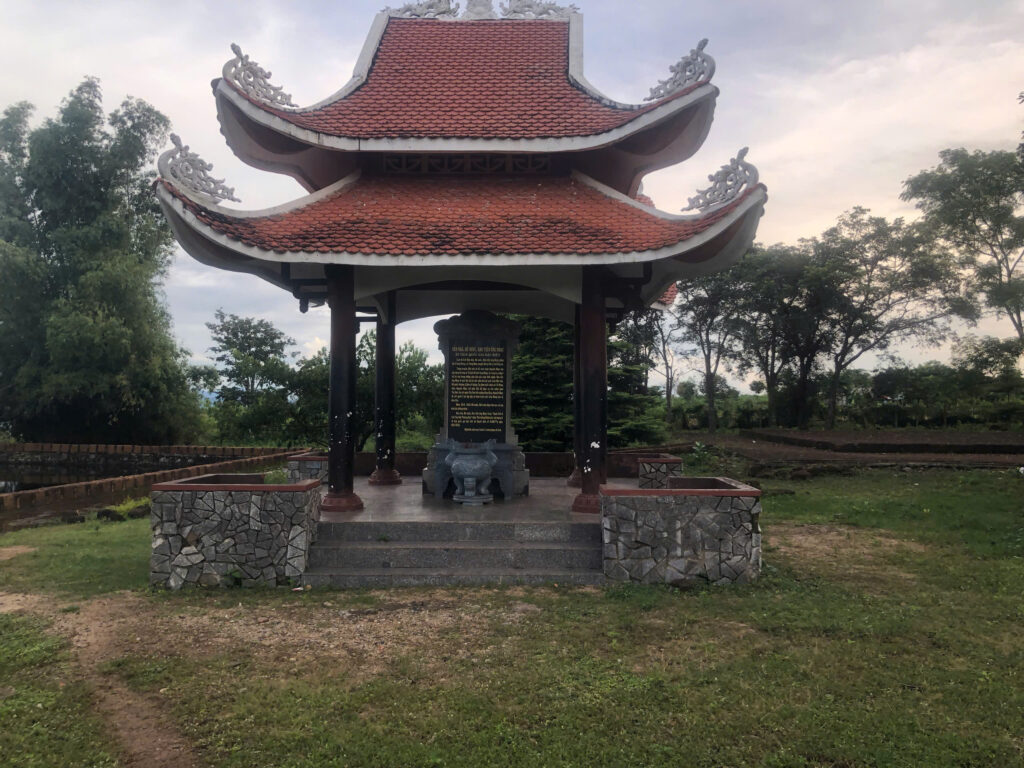
Local authorities are also paying attention to preserving the cultural spaces associated with the craft. One proposed direction is to complete documentation seeking provincial-level heritage recognition for the Temple of the Mat Craft Ancestor.
Alongside financial support for production households, the locality plans to provide training in digital sales and product promotion, including livestreaming and other commonly used online platforms. This approach reflects the changing nature of traditional craft villages. Today, a traditional product needs not only to be well made but also to have its story told and its value communicated to new generations of consumers.
Hoai Nhon’s sedge mat village now stands between two rhythms of time. On one side are the traditional looms, hand-dyed sedge and knowledge passed down through generations. On the other are mechanical looms, cooperatives, large orders and digital platforms.
The production methods may change, but the journey of the sedge remains rooted in the fields, passes through the hands of local people and emerges as a product carrying the character of its homeland. This continuity allows Hoai Nhon sedge mat making to survive not merely as a livelihood, but as a living part of the cultural memory of the region.