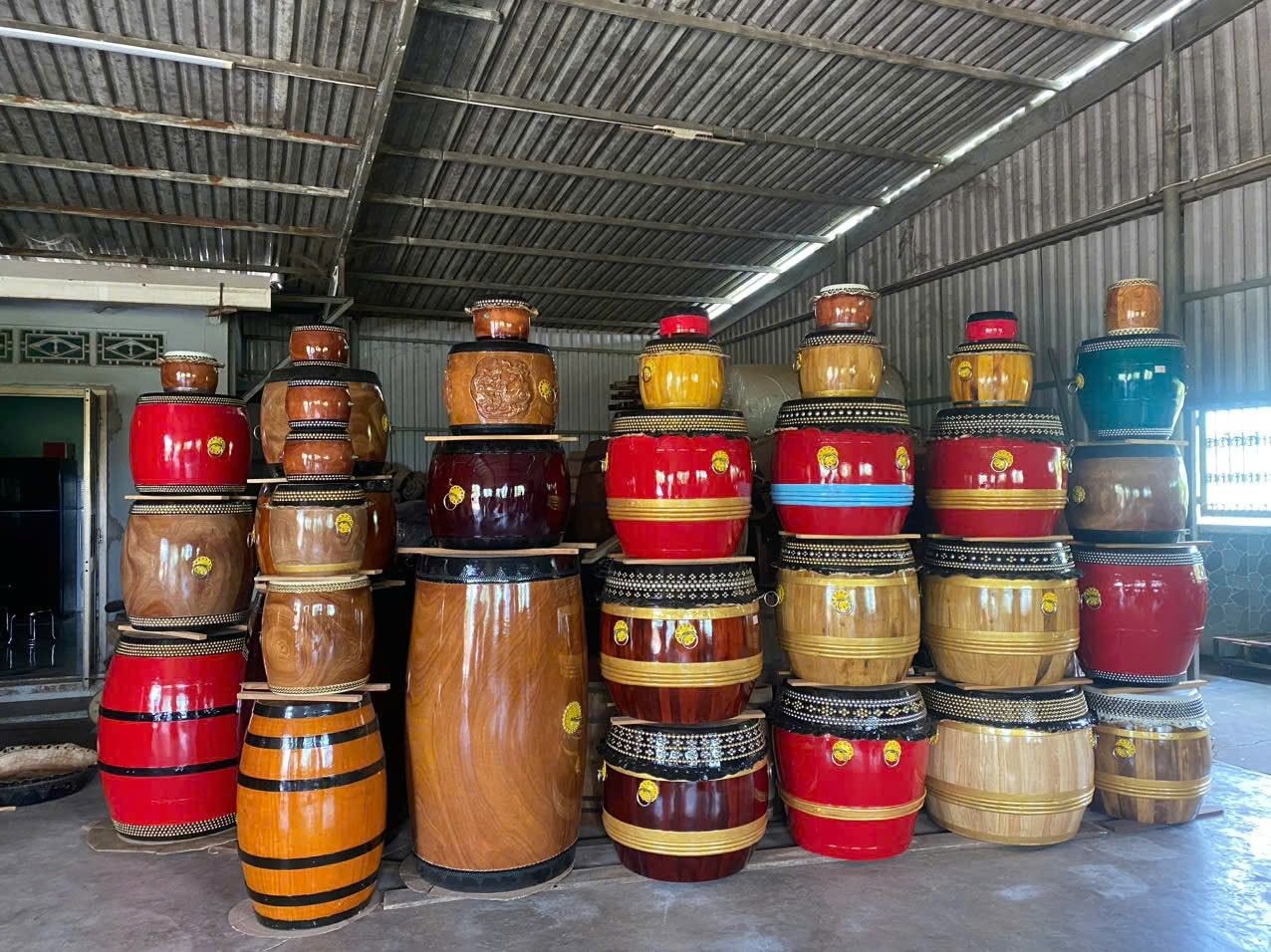
In the Mekong Delta, Binh An Drum-Making Village is a traditional craft community where the sound of drums has been passed down through generations. From carefully selected wood and buffalo hide, skilled craftspeople create drums in a wide range of sizes, shapes, and functions, serving schools, temples, communal houses, festivals, and traditional performing arts.
The craft village is located in the Binh An area, Tan Tru Commune, Tay Ninh Province, formerly part of Binh Lang Commune, Tan Tru District, Long An Province. According to the source, more than 20 drum-making establishments operate regularly in the area, creating a living craft environment where traditional techniques remain part of everyday life.
From local markets, Binh An drums have reached different parts of Vietnam and are also exported overseas. Behind each finished drum is a body of traditional knowledge that has been preserved, practiced, and passed down through generations.
A Craft Passed Down Through Generations
The community of residents in Binh An Hamlet is the custodian of the drum-making heritage. Families in the area have remained connected with the craft for generations.
For local people, drum making is more than a means of earning a living. It has become a source of family pride and an important part of the community’s identity.
Artisans play a central role in preserving the craft. They possess extensive knowledge of every stage of production, from selecting raw materials and processing wood to shaping the drum body, stretching the hide, and adjusting the sound.
Alongside experienced artisans, skilled craftspeople and younger apprentices also participate in production. This interaction between generations allows Binh An’s drum-making tradition to preserve its traditional essence while adapting to contemporary needs.
From Wooden Boards to a Finished Drum
Making a drum requires a combination of craftsmanship, knowledge of materials, and a sensitive ear for sound.
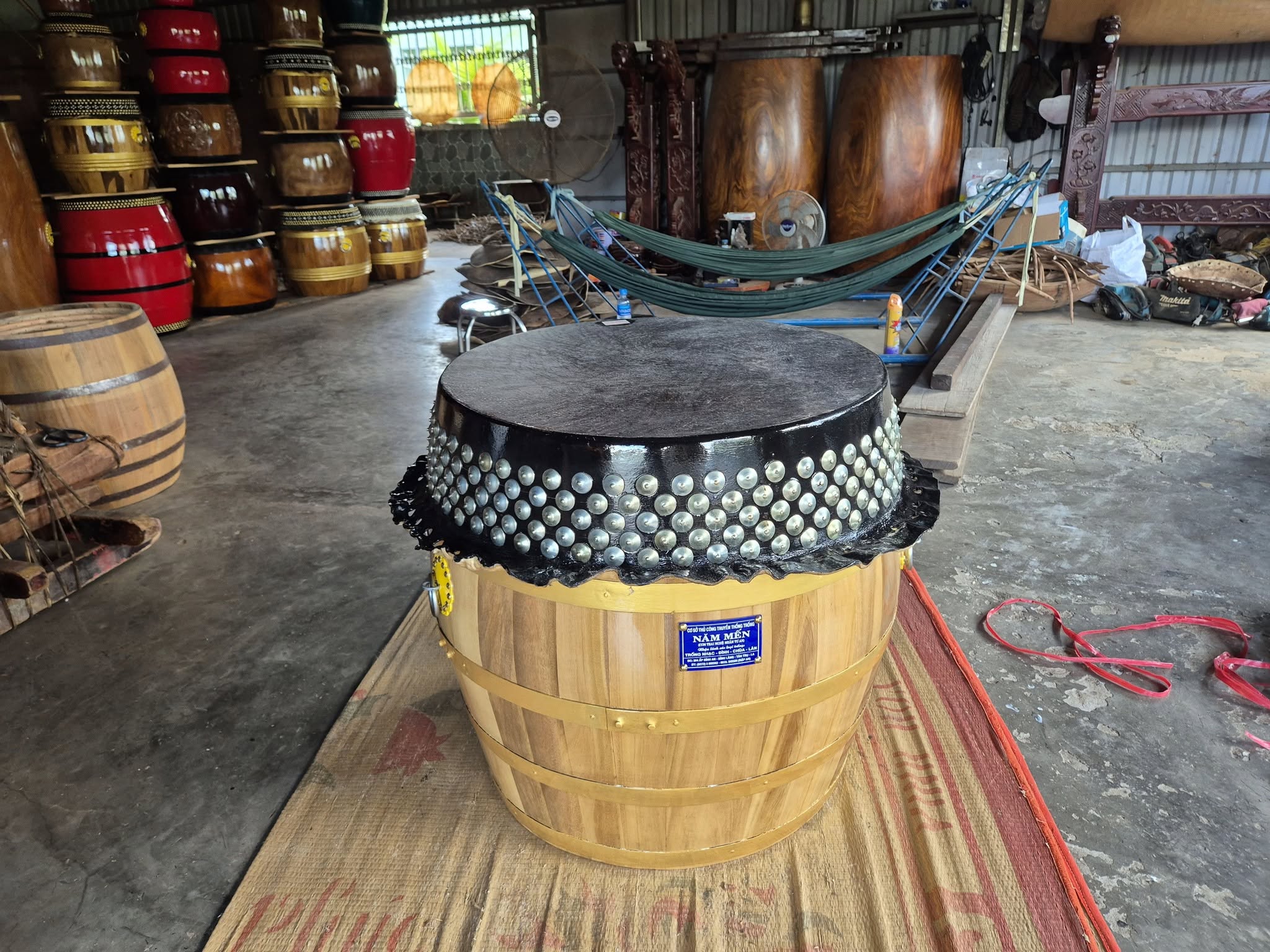
The drum body is primarily made from star wood or mature jackfruit wood, selected for its durability, relatively light weight, and ability to produce a resonant sound. Other materials, including chò wood, còng or sea almond oil, and rubber, are also used for different stages of production.
After careful selection, the wood is sawn into individual boards, dried, and smoked to help protect it against termites. The boards are then assembled into the drum body, shaped into an even circular form, and carefully smoothed.
Making the drumhead is another important stage. Buffalo hide is used for the drumhead and must meet specific requirements in terms of thickness, strength, and quality. According to the source, the hide is selected from mature buffalo, kept fresh and intact before being processed.
The hide is stretched over the drum body and secured with bamboo or wooden pegs. These materials provide strength while minimizing their effect on the drum’s sound.
Once the main components are complete, the craftsman performs one of the most important stages: sound testing. The drum is struck with a drumstick at different points to check its resonance, tone, and sustain. The tension is then adjusted until the desired sound is achieved.
This skill cannot be fully conveyed through written instructions. Much of it is passed down through hands-on apprenticeship, with learners observing experienced craftspeople, practicing themselves, and gradually developing an ear for the subtle differences in sound.
Different Drums for Different Purposes
Binh An produces a wide variety of drums for different aspects of social and cultural life.
These include school drums used to signal class times; festival drums used during ceremonies and processions; temple and communal-house drums used in religious and traditional rituals; and lion, unicorn, and dragon dance drums used by traditional performance groups.
The village also produces drums for tuong and cheo, two forms of traditional Vietnamese theater, as well as various sizes of drums used in traditional musical ensembles and for export markets.
Each type of drum has its own requirements in terms of size, shape, materials, and especially sound. Craftspeople therefore need to understand not only how to construct a drum but also the setting in which it will be used and the type of sound it needs to produce.
After the technical work is completed, drums are often painted and decorated with traditional motifs, enhancing their appearance while protecting the surface.
A Repository of Traditional Knowledge
The value of Binh An’s drum-making heritage lies not only in the physical products themselves. Each drum embodies a body of traditional knowledge accumulated by the community over generations.
This includes knowledge of selecting wood, drying and treating materials, assembling the drum body, shaping, selecting and processing hide, stretching the drumhead, securing it, and adjusting the final sound.
Many of these techniques have not been reduced to fixed written formulas. Instead, they are transmitted from one generation to the next through practice. Apprentices learn by doing, observing the hands of experienced artisans and gradually understanding the difference between a well-made drum and one that still needs adjustment.
For this reason, drum making is more than a manual skill. It represents a form of intangible cultural knowledge closely connected with community life, customs, beliefs, and traditional cultural practices.
The Sound of Drums in Vietnamese Culture
Drums occupy an important place in many forms of Vietnamese traditional culture and performing arts.
During festivals, ceremonies at communal houses and temples, and community gatherings, drums can serve as signals that bring people together, mark the beginning of ceremonies, or accompany traditional activities. In performing arts, drums create rhythm, atmosphere, and dramatic expression.
From tuong and cheo to hau dong and lion, unicorn, and dragon dances, drums serve different musical functions. Each art form requires particular characteristics of sound, making the craftsperson’s ability to construct and tune the instrument especially important.
For the people of Binh An, making drums therefore means contributing to the cultural soundscape of communities far beyond their own village.
A Craft That Connects the Binh An Community
A finished drum is the result of numerous interconnected stages. From preparing materials and processing wood to assembling the body, making the drumhead, stretching the hide, tuning the sound, and applying the final finish, production requires coordination among different people.
Within families, older generations pass their experience to younger members. Experienced craftspeople guide apprentices, while younger workers gradually learn the patience, precision, creativity, and responsibility required by the craft.
This process makes drum making a link between generations. Young people do not simply learn how to manufacture a product. They also inherit stories about the craft, the work of previous generations, and the community’s pride in its traditional occupation.
For visitors, observing or experiencing the process of making a drum offers an opportunity to approach traditional Vietnamese culture through a living craft. A piece of wood and a sheet of buffalo hide are gradually transformed by skilled hands into an instrument with its own distinctive voice.
The Resonance of Binh An Along the Mekong Delta
Binh An Drum-Making Village is a place where traditional craftsmanship, community life, and cultural heritage continue to meet.
From familiar school drums to temple and communal-house drums, festival drums, theatrical drums, and instruments used in traditional performances, Binh An’s products have found their way into many different cultural spaces.
The value of the craft village therefore extends beyond the physical process of making drums. It lies also in the preservation of traditional knowledge, technical skills, community memories, and cultural practices.
With its historical traditions, craftsmanship, traditional knowledge, and role in cultural life, Binh An Drum-Making Village was included in the National Intangible Cultural Heritage List by the Minister of Culture, Sports and Tourism under Decision No. 2202/QD-BVHTTDL dated June 27, 2025.
The recognition acknowledges a traditional craft that has been maintained by the Binh An community across generations. As the sound of drums continues to resonate from workshops throughout the village, so too does a part of the region’s cultural memory and craftsmanship continue to be passed on.
Basic Information
| Information | Details |
|---|---|
| Heritage name | Binh An Drum-Making Craft |
| Common name | Binh An Drum-Making Village |
| Current location | Binh An area, Tan Tru Commune, Tay Ninh Province |
| Former location | Binh Lang Commune, Tan Tru District, Long An Province |
| History | Hundreds of years, according to the source |
| Community custodians | Residents of Binh An Hamlet |
| Production establishments | More than 20, according to the source |
| Main materials | Star wood, mature jackfruit wood, buffalo hide, and other materials |
| Products | School drums, festival drums, communal-house drums, temple drums, lion-unicorn-dragon dance drums, tuong drums, cheo drums, and other drums |
| Transmission method | Oral transmission, hands-on practice, and apprenticeship |
| Key values | Traditional craftsmanship, folk knowledge, community culture, music, and religious practices |
| Heritage status | National Intangible Cultural Heritage |
| Recognition | Decision No. 2202/QD-BVHTTDL dated June 27, 2025 |