Address: Western and eastern banks of the Han River, connecting Hai Chau with Son Tra and Ngu Hanh Son, Da Nang, Vietnam.
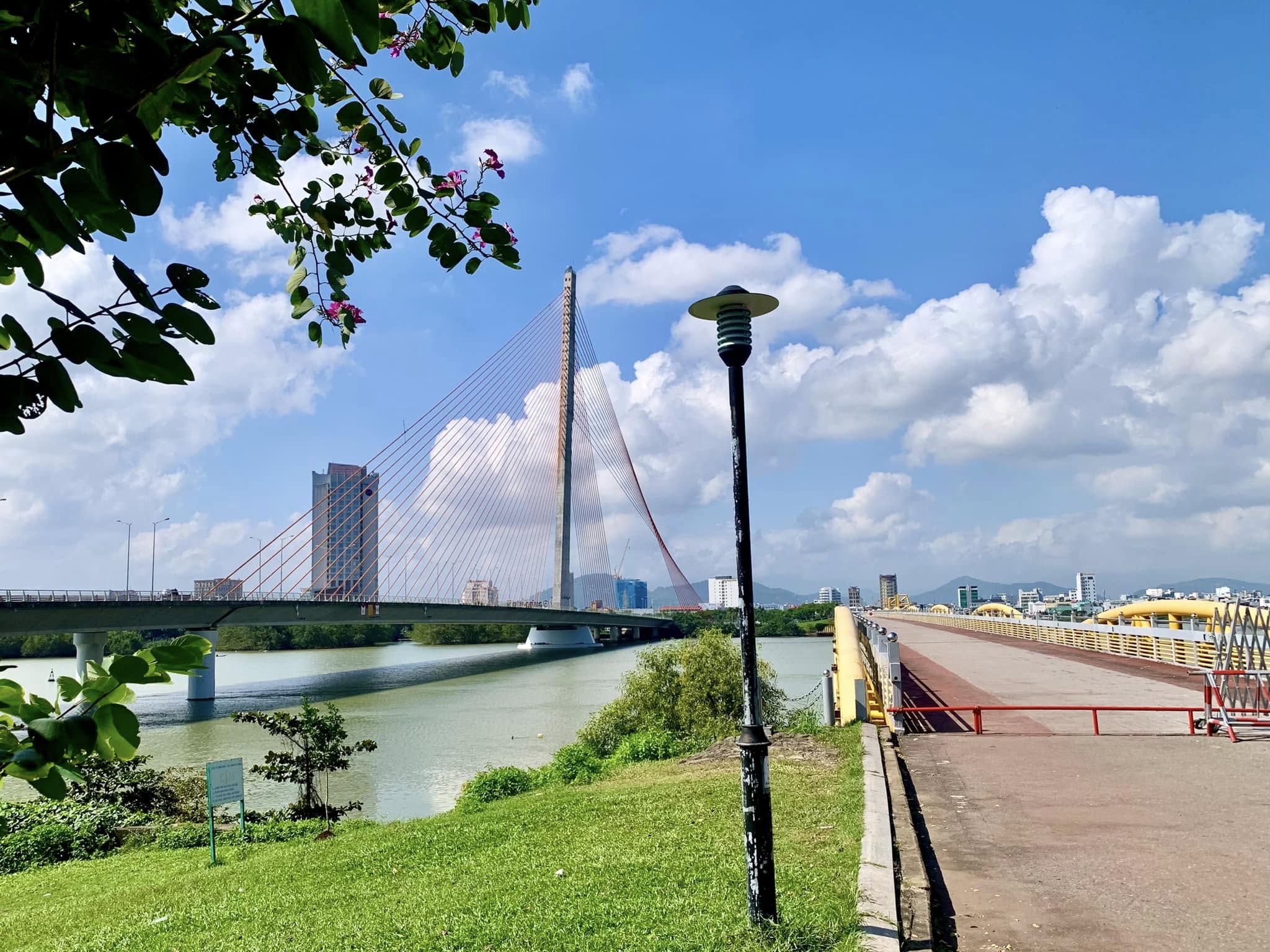
Together with Dragon Bridge, Han River Bridge and Nguyen Van Troi Bridge, Tran Thi Ly Bridge is one of the transportation structures that has helped shape the distinctive appearance of modern Da Nang. Its 145-meter inclined tower, three-plane cable-stayed system and sail-like silhouette make it one of the most recognizable architectural landmarks along the Han River.
Tran Thi Ly Bridge is more than a transportation link. It also carries a layer of history dating back to the French colonial period, when the site was occupied by a railway bridge connecting the two banks of the Han River.
From a French-Era Railway Bridge to Tran Thi Ly Bridge
The predecessor of today’s Tran Thi Ly Bridge was a railway bridge built during the French colonial period, originally named De Lattre de Tassigny, commonly referred to by local residents as Cau De Lat. The bridge stood approximately 20 meters upstream from the present Nguyen Van Troi Bridge.
It was later renamed Trinh Minh The Bridge and continued to serve as an important transportation connection across the Han River.
After 1975, the bridge was renamed Tran Thi Ly Bridge and upgraded for road traffic. For a period, Tran Thi Ly Bridge and Nguyen Van Troi Bridge played an important role in connecting the two banks of the Han River.
The bridge is named after Tran Thi Ly (1933-1992), a Vietnamese Hero of the People’s Armed Forces from Dien Quang, Dien Ban, Quang Nam. She became known as a symbol of resilience during the resistance wars against France and the United States. Her story was also portrayed by poet To Huu in his poem The Vietnamese Girl.
In 2009, the old bridge was dismantled to make way for a completely new structure. Construction of the new Tran Thi Ly Bridge began in April 2009, with an estimated investment of around VND 1.5 trillion. On March 29, 2013, Tran Thi Ly Bridge and Dragon Bridge were officially inaugurated together, marking the arrival of two major modern landmarks on the Han River.
A Distinctive Cable-Stayed Design
As early as 2007, Da Nang organized an architectural design competition for the new Tran Thi Ly Bridge. Numerous domestic and international consulting firms participated, including companies from Japan, the United States, France, Germany, China and Finland, alongside Vietnamese transportation design organizations.
The winning proposal came from WSP Finland. The Finnish company was responsible for investment project preparation and technical design, while much of the project management, construction drawings, supervision and construction work was carried out by Vietnamese engineers, technicians and workers.
The most striking feature is the main tower, approximately 145 meters high and inclined 12 degrees toward the west. Its stay cables are arranged in three planes, creating a three-dimensional structure that differs significantly from many conventional cable-stayed bridges.
On the eastern side, cables extend from the tower toward the bridge deck. On the western side, the cables twist and spread into two branches, creating the visual impression of a sail catching the wind and pointing toward the East Sea.
According to the source information, the bridge is approximately 34.5 to 35.5 meters wide, with six lanes for motor vehicles and two pedestrian lanes. A central median of around 5 meters separates the traffic directions. The main cable-stayed span is approximately 230 meters long.
The Inclined Tower and Its Unusual Structure
One of the most distinctive engineering features of Tran Thi Ly Bridge is the way its tower is connected to the bridge deck.
Rather than using a conventional rigid connection, the single tower, inclined at 12 degrees, is connected to the deck and supported by spherical bridge bearings. These bearings are designed to withstand extremely large loads, helping reduce the size of the foundation and optimize construction materials.
The inclined tower and three-plane cable arrangement give the bridge a completely different appearance when viewed from either bank of the Han River. During the day, the tower stands prominently against the Da Nang skyline. At night, architectural lighting emphasizes the tower and the sweeping lines of the stay cables.
Modern Construction Technologies
The construction of Tran Thi Ly Bridge incorporated a range of modern engineering techniques.
These included incremental launching and sliding formwork for the box girder, climbing formwork for constructing the inclined tower, installation of extremely high-capacity bridge bearings, and specialized techniques for installing and tensioning the stay cables.
Engineers also used monitoring systems to measure internal forces and structural movement during construction.
The combination of an ambitious architectural concept and complex structural solutions helped make Tran Thi Ly Bridge one of Da Nang’s most distinctive modern bridge projects.
Viewed from a distance, the inclined tower and its cable system form an image resembling a fully stretched sail heading toward the open sea. This image has often been associated with Da Nang’s dynamic character, its relationship with the ocean and its aspirations for future development.
Tran Thi Ly Bridge in the Han River Landscape
Tran Thi Ly Bridge stands close to Nguyen Van Troi Bridge, forming part of a distinctive cluster of bridges and public spaces in the southern part of central Da Nang.
From Nguyen Van Troi Bridge, visitors can enjoy a particularly clear view of Tran Thi Ly’s inclined tower and cable system. This is also one of the most effective perspectives for appreciating the bridge’s sail-like form.
The roads, parks and riverside spaces on the eastern bank offer additional viewpoints, especially around sunset and after the bridge’s architectural lighting comes on at night.
The bridge also provides an important transportation connection between Hai Chau, Son Tra and Ngu Hanh Son, strengthening traffic capacity on the eastern gateway of the city.
A Landmark on the Da Nang Discovery Route
Tran Thi Ly Bridge lies along the transportation network connecting Da Nang International Airport with the city center and the coastal routes. From central Da Nang, visitors can easily reach the Han River waterfront, Nguyen Van Troi Bridge and Dragon Bridge before continuing toward My Khe Beach, Son Tra Peninsula or Marble Mountains.
One of Da Nang’s distinctive characteristics is the way its bridges have become part of the city’s urban landscape rather than functioning solely as transportation infrastructure.
Tran Thi Ly Bridge has a character different from Dragon Bridge and Han River Bridge. Dragon Bridge is defined by its dragon-shaped form, while Han River Bridge is famous for its rotating structure. Tran Thi Ly Bridge stands out through its inclined tower and sweeping stay cables, creating the image of a sail suspended between the sky and the river.
When the city lights come on, this silhouette becomes even more striking against the Han River.
From its origins as a French-era railway bridge to its transformation into a contemporary cable-stayed landmark, the structure continues the story of connecting the two banks of the river while reflecting the architectural ambitions of modern Da Nang.
Tran Thi Ly Bridge is therefore more than a transportation project. It is part of the visual identity of the city along the Han River, where history, engineering and contemporary architecture come together in a landscape shaped by Da Nang’s enduring relationship with the sea.