Van Thanh – Confucius Temple is an important architectural, artistic, and cultural heritage complex located in Ban Thach Ward, Da Nang City, Central Vietnam. Originally established in 1840 during the Nguyen Dynasty, the monument is dedicated to Confucius and distinguished Confucian scholars, preserving the region’s longstanding traditions of education, scholarship, and respect for teachers.
Situated on Phan Boi Chau Street, the complex covers approximately 6,200 square meters and features traditional Vietnamese architecture, including a ceremonial entrance, a semicircular pond, a stone bridge, a spacious courtyard, a main worship hall, a rear sanctuary, and symmetrical bell and drum towers.
Beyond its historical and architectural significance, Van Thanh – Confucius Temple continues to serve as a cultural venue associated with educational recognition, traditional festivals, and community activities.
Recognized as a National Monument, the complex is a meaningful destination for travelers interested in exploring the cultural heritage and scholarly traditions of southern Da Nang, formerly part of Quang Nam Province.
History and Origins of Van Thanh – Confucius Temple
Van Thanh – Confucius Temple was originally established in 1840, during the reign of Emperor Minh Mang of the Nguyen Dynasty.
Its foundation was closely associated with the development of Confucian education and scholarly traditions in the historic Quang Nam region, an area renowned for producing distinguished scholars, intellectuals, and influential figures in Vietnamese history.
In traditional Vietnamese society, Confucian temples served as important cultural and educational institutions.
They were established to honor Confucius, revered Confucian scholars, and the ethical principles associated with Confucian learning.
These temples were not merely religious or ceremonial spaces. They also symbolized the importance of education, moral cultivation, intellectual achievement, and respect for teachers.
Van Thanh – Confucius Temple was founded within this historical context, becoming a symbol of the local community’s commitment to learning and traditional values.
Despite historical changes and urban development, the complex has continued to preserve its cultural identity and its association with generations of scholars and students.
Traditional Architecture of Van Thanh – Confucius Temple
Van Thanh – Confucius Temple occupies an area of approximately 6,200 square meters and was designed according to traditional Vietnamese architectural principles.
The complex features a symmetrical layout, carefully arranged structures, and a harmonious relationship between architecture and landscape.
Its main components are organized along a central axis, connecting the entrance, ornamental pond, ceremonial courtyard, and principal worship buildings.
Visitors entering the complex encounter a sequence of architectural spaces that gradually lead toward the sacred sanctuary.
Ceremonial Entrance and the Symbolism of Scholar’s Brushes
The ceremonial entrance is one of the most distinctive architectural features of the complex.
It consists of four brick pillars decorated with ornamental reliefs and ceramic mosaics.
The two central pillars rise prominently above the entrance, crowned with lotus blossoms.
Their tall, slender forms resemble traditional calligraphy brushes reaching toward the sky.
This architectural symbolism is particularly appropriate for a Confucian temple, where scholarship, literature, and intellectual achievement are central values.
The pillars are reflected in the semicircular pond nearby, creating a picturesque and meaningful architectural composition.
Semicircular Pond and Stone Bridge
Beyond the entrance lies a semicircular pond, a feature commonly associated with traditional Confucian temples and scholarly architectural complexes.
An arched bridge constructed from stone and brick crosses the pond.
Its balustrades are decorated with geometric patterns, demonstrating the craftsmanship of traditional builders.
The combination of water, bridge, and ceremonial entrance creates a graceful transition from the surrounding urban environment into the temple grounds.
The pond also reflects traditional architectural concepts emphasizing harmony between built structures and the natural landscape.
Spacious Brick-Paved Courtyard
After crossing the bridge, visitors enter a spacious courtyard paved with bricks arranged in a grid-like pattern.
The courtyard provides an open area in front of the main worship hall and serves as a venue for ceremonies and community cultural activities.
From this position, visitors can appreciate the symmetrical organization of the complex, with the principal buildings aligned along the central axis and supporting structures arranged on either side.
Main Worship Hall and Rear Sanctuary
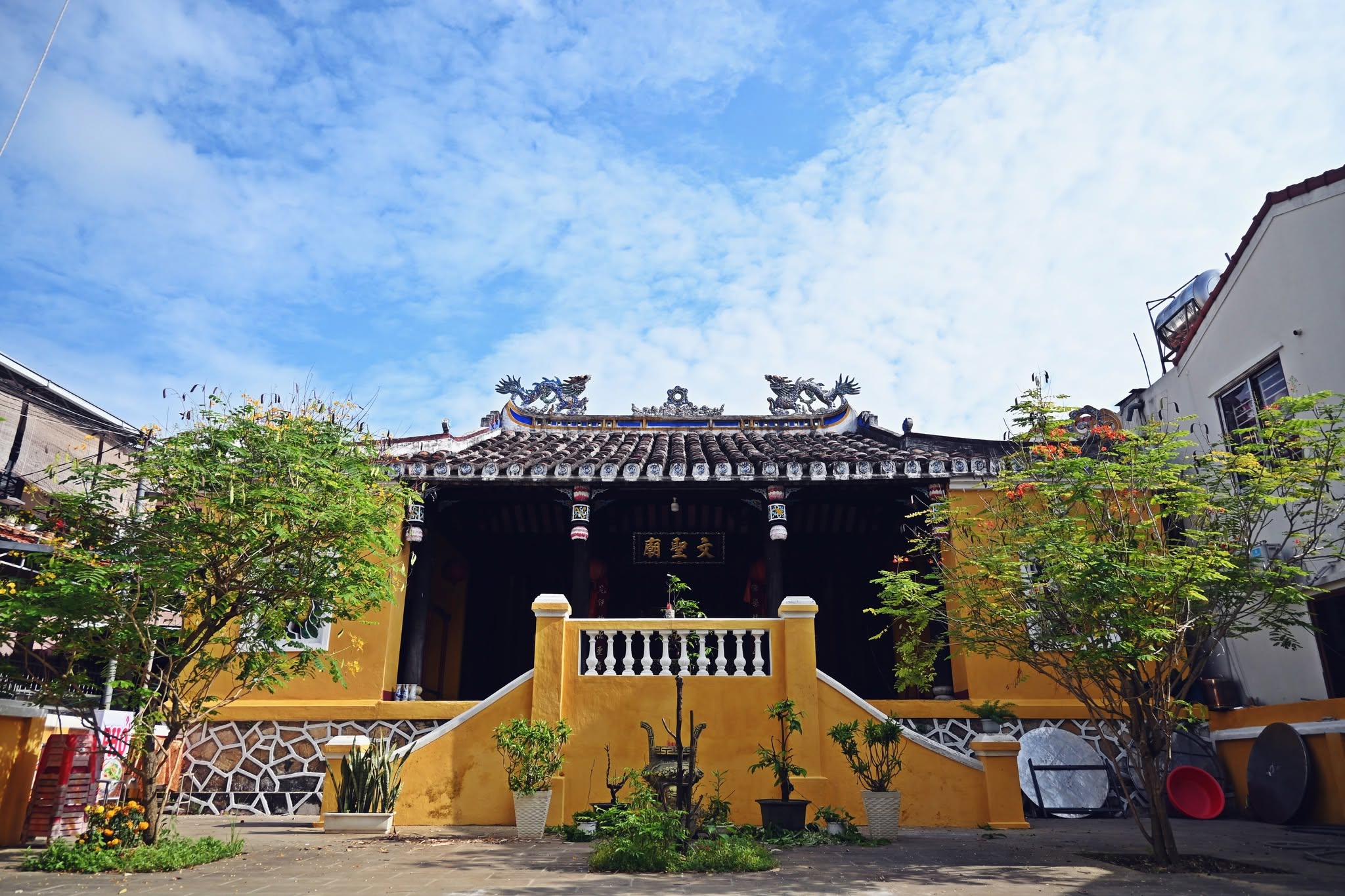
The main worship hall is the most important architectural structure within Van Thanh – Confucius Temple.
It follows the traditional three-bay, two-wing design, a common architectural arrangement in historic Vietnamese communal and religious buildings.
The roof is covered with yin-yang tiles, while its ridge features the decorative motif of two dragons competing for a pearl, known in Vietnamese as luong long tranh chau.
The four roof corners curve gracefully upward and are decorated with stylized cloud patterns.
Dragon motifs also appear on the roof finials, veranda columns, and other architectural elements.
These decorative features create a dignified yet elegant appearance, reflecting the artistic traditions of the Nguyen Dynasty.
Rear Sanctuary
Behind the main worship hall stands the rear sanctuary, constructed in a similar three-bay, two-wing architectural style.
The two structures are connected through a traditional system of timber beams and structural supports.
The rear sanctuary houses sacred altars dedicated to Confucius and revered Confucian scholars.
The arrangement of the main hall and rear sanctuary reflects traditional Vietnamese religious architecture, where different spaces are organized according to their ceremonial functions and degrees of sacredness.
Bell and Drum Towers
Two towers stand symmetrically on either side of the main worship hall.
One houses the ceremonial bell, while the other is associated with the drum.
Together, they reinforce the balanced architectural composition and contribute to the solemn atmosphere of the complex.
Their presence also distinguishes the temple from ordinary residential buildings, emphasizing its ceremonial and cultural functions.
Woodcarving and the Craftsmanship of Kim Bong Village
One of the most remarkable artistic features of Van Thanh – Confucius Temple is its elaborate architectural decoration.
The complex preserves carved timber components, lacquered horizontal boards, classical parallel couplets, and decorative reliefs.
According to local heritage descriptions, some of these architectural details were created by artisans associated with Kim Bong Carpentry Village, a traditional woodworking center historically renowned in the Quang Nam region.
The craftsmen employed various decorative techniques, including woodcarving, molded relief work, and ceramic mosaic decoration.
Notable motifs include classical inscriptions on pillars, ornamental books, deer, mythical creatures, flowers, and other symbolic subjects.
The image of a book is especially meaningful within a Confucian temple, representing knowledge, education, and scholarly achievement.
Other motifs express traditional aspirations for moral integrity, prosperity, harmony, and good fortune.
The combination of architecture, sculpture, and decorative craftsmanship contributes to the artistic significance of Van Thanh – Confucius Temple within Central Vietnam’s Confucian heritage.
Van Thanh – Confucius Temple and Quang Nam’s Scholarly Traditions
The significance of Van Thanh – Confucius Temple extends beyond its architectural beauty.
The complex represents the longstanding traditions of education, scholarship, and respect for teachers in the historic Quang Nam region.
In imperial Vietnam, Confucian learning played a central role in the education system and civil service examinations.
It helped prepare scholars and officials who contributed to state administration, literature, philosophy, and cultural development.
Historic Quang Nam became known for its strong scholarly traditions and for producing numerous prominent intellectuals and reformers.
Van Thanh – Confucius Temple serves as a cultural symbol of this heritage.
By maintaining educational and cultural activities, the complex connects traditional values with contemporary society, encouraging younger generations to pursue learning, develop their abilities, and contribute to their communities.
Educational Activities and the Phan Chau Trinh Award
An important aspect of Van Thanh – Confucius Temple’s cultural role is its association with educational recognition and scholarship programs.
According to local information, the temple grounds have been used for ceremonies honoring outstanding students and university students, including events associated with the Phan Chau Trinh Award.
The award is named after Phan Chau Trinh, a prominent Vietnamese patriot and reformist thinker of the early 20th century.
He was particularly influential in advocating educational reform, intellectual development, and social progress.
Holding educational recognition ceremonies at Van Thanh – Confucius Temple carries special symbolic meaning.
The site was originally established to honor scholarship and moral learning, making it a fitting venue for celebrating academic achievement.
Such activities reinforce the monument’s continuing role as a center for promoting education and preserving the region’s intellectual traditions.
Spring Festivals and Traditional Cultural Activities
During the first lunar month, Van Thanh – Confucius Temple is associated with a variety of traditional cultural events and community gatherings.
According to local descriptions, these activities may include the First Full Moon Poetry Night, Bai Choi folk performances, and traditional games.
First Full Moon Poetry Night
The First Full Moon Poetry Night, known in Vietnamese as Dem tho Nguyen tieu, is traditionally associated with the fifteenth day of the first lunar month.
It brings together poetry enthusiasts, writers, and members of the community to share and appreciate literary works.
Hosting poetry activities within a Confucian temple is especially meaningful because of the site’s historical association with literature, education, and intellectual life.
Bai Choi Folk Art
Bai Choi is a distinctive traditional performing art of Central Vietnam, combining music, singing, storytelling, and communal games.
In 2017, UNESCO inscribed The Art of Bai Choi in Central Viet Nam on the Representative List of the Intangible Cultural Heritage of Humanity.
Bai Choi performances during spring cultural programs contribute to the festive atmosphere while introducing visitors to one of the region’s most distinctive folk traditions.
Traditional Folk Games
Alongside poetry and Bai Choi, traditional games add a lively and interactive dimension to cultural gatherings.
These activities encourage community participation and provide opportunities for younger generations to experience local customs.
Event schedules and programs may vary from year to year, so visitors interested in attending should confirm arrangements with local organizers.
Historical, Architectural, and Cultural Significance
After nearly two centuries, Van Thanh – Confucius Temple continues to preserve several important layers of heritage.
Historical significance: The monument reflects the development of Confucian education and cultural institutions during the Nguyen Dynasty in the historic Quang Nam region.
Architectural significance: The complex preserves a traditional layout featuring a ceremonial entrance, semicircular pond, stone bridge, main worship hall, rear sanctuary, and symmetrical bell and drum towers.
Artistic significance: Its woodcarvings, reliefs, classical inscriptions, and ceramic mosaics demonstrate the technical skills and aesthetic traditions of earlier generations.
Educational and cultural significance: The temple symbolizes respect for teachers, dedication to learning, and the transmission of ethical and scholarly values.
Community significance: The grounds remain associated with educational recognition, folk cultural activities, and traditional spring gatherings.
Together, these values make Van Thanh – Confucius Temple an important cultural landmark in southern Da Nang.
Visiting Van Thanh – Confucius Temple
Van Thanh – Confucius Temple is an appealing destination for travelers interested in historic architecture, traditional education, and Vietnamese cultural heritage.
At the entrance, visitors can admire the tall ceremonial pillars crowned with lotus motifs, the intricate ceramic mosaics, and the carefully balanced architectural layout.
The semicircular pond and arched bridge create a harmonious landscape, offering insights into traditional concepts of architectural beauty.
Beyond the spacious brick-paved courtyard, the main worship hall and rear sanctuary preserve decorative woodcarvings, horizontal boards, classical couplets, and symbolic motifs.
The bell and drum towers, together with the supporting buildings, add further architectural interest.
Visitors arriving during spring cultural celebrations may also have an opportunity to enjoy poetry performances, Bai Choi, and traditional folk activities.
Beyond sightseeing, the complex provides an opportunity to learn about the history of education and the scholarly traditions of the historic Quang Nam region.
Nearby Cultural and Historical Attractions
Van Thanh – Confucius Temple is conveniently located for visitors wishing to explore other cultural and historical destinations in southern Da Nang.
Several attractions can be included in a broader heritage itinerary:
- Tam Thanh Mural Village: A coastal community known for colorful murals depicting local village life and fishing traditions.
- Vietnamese Heroic Mother Monument: A major memorial honoring Vietnamese mothers who made extraordinary sacrifices during the country’s wars.
- Chien Dan Cham Towers: An ancient Cham architectural complex reflecting the artistic and religious heritage of the Champa civilization.
- Ky Anh Tunnels: A historical site associated with revolutionary activities during the war against the United States.
Combining these destinations offers a broader understanding of the region’s heritage, from Confucian education and folk art to Cham architecture and revolutionary history.
Quick Information About Van Thanh – Confucius Temple
| Category | Information |
|---|---|
| Monument name | Van Thanh – Confucius Temple |
| Current address | Phan Boi Chau Street, Ban Thach Ward, Da Nang City, Vietnam |
| Original establishment | 1840, during the Nguyen Dynasty |
| Heritage type | Architectural, artistic, and Confucian cultural monument |
| Heritage classification | National Monument |
| Site area | Approximately 6,200 m² |
| Principal figures honored | Confucius and revered Confucian scholars |
| Architectural highlights | Ceremonial entrance, semicircular pond, stone bridge, main worship hall, rear sanctuary, bell tower, and drum tower |
| Main architectural style | Three bays and two wings, with traditional yin-yang roof tiles |
| Cultural significance | Scholarly traditions, respect for teachers, and community cultural activities |
| Notable activities | Educational recognition, First Full Moon Poetry Night, Bai Choi, and spring cultural events |
| Admission | Reportedly free, according to the supplied information |
| Visitor guidelines | Dress respectfully, keep the grounds clean, and observe the sacred atmosphere |
Van Thanh – Confucius Temple: A Living Symbol of Learning and Cultural Heritage
Amid the modern development of Ban Thach Ward, Van Thanh – Confucius Temple remains an enduring reminder of the scholarly and cultural traditions of historic Quang Nam.
From its ceremonial entrance and semicircular pond to its yin-yang tiled roofs and intricate timber carvings, each architectural element reflects a period when Confucian education played an important role in Vietnamese society.
More than a place dedicated to Confucius and revered scholars, the complex continues to symbolize respect for teachers, dedication to education, and the preservation of traditional cultural values.
A visit to Van Thanh – Confucius Temple is therefore more than an exploration of a nationally recognized architectural monument. It is an opportunity to discover the intellectual heritage, educational history, and enduring scholarly spirit of the Quang Nam region within present-day Da Nang.