Van Trinh Village, now located in Phong Dinh Ward, Hue City, is also known locally as Trien Village or Rao Village. It is one of the long-established rural communities of the former Thuan Hoa region, whose formation is associated with the southward migration of Vietnamese settlers who came to expand and develop new territories under Lord Nguyen Hoang.
According to local historical accounts, the people of Van Trinh brought the traditional craft of net making with them from their original homeland. The craft served the community’s fishing needs and provided an additional livelihood alongside agricultural production. After more than 500 years, net making continues to form part of the economic and cultural life of the local community.
A Craft Carried Southward with the Settlers
Van Trinh’s net-making tradition has a history of more than 500 years according to the source. When settlers arrived in Thuan Hoa, they continued practicing the craft as a livelihood alongside farming and fishing.
In its early period, net making was entirely manual. Artisans prepared their own materials, spun and worked the fibers, tied individual mesh sections and assembled the different components of a fishing net using simple tools. The work required patience, dexterity and practical knowledge passed down through generations.
Over time, net making became closely integrated into village life. Farmers could take up the craft during periods outside the agricultural season, creating an additional source of household income.
From Natural Fibers to a Complete Fishing Net
Traditionally, fishing nets were made primarily from natural silk fibers. Artisans used knitting needles made from bamboo to create the individual meshes.
Floats and lead weights played an important role in keeping the net upright and balanced when deployed in water. Lead was flattened and attached to the lower line of the net, while floats were arranged along the upper line.
Traditional floats were made from the re tree gathered from the forest. After being collected, the material was processed and dyed using gardenia fruit, leaves or bark from other forest plants. Dyeing helped distinguish the floats by color while also contributing to their durability during use.
Using these simple materials, artisans had to complete numerous steps to produce a single fishing net. Traditionally, the entire process depended on manual techniques and the practical experience of the craftsperson.
From Hand-Made Nets to Machine Production
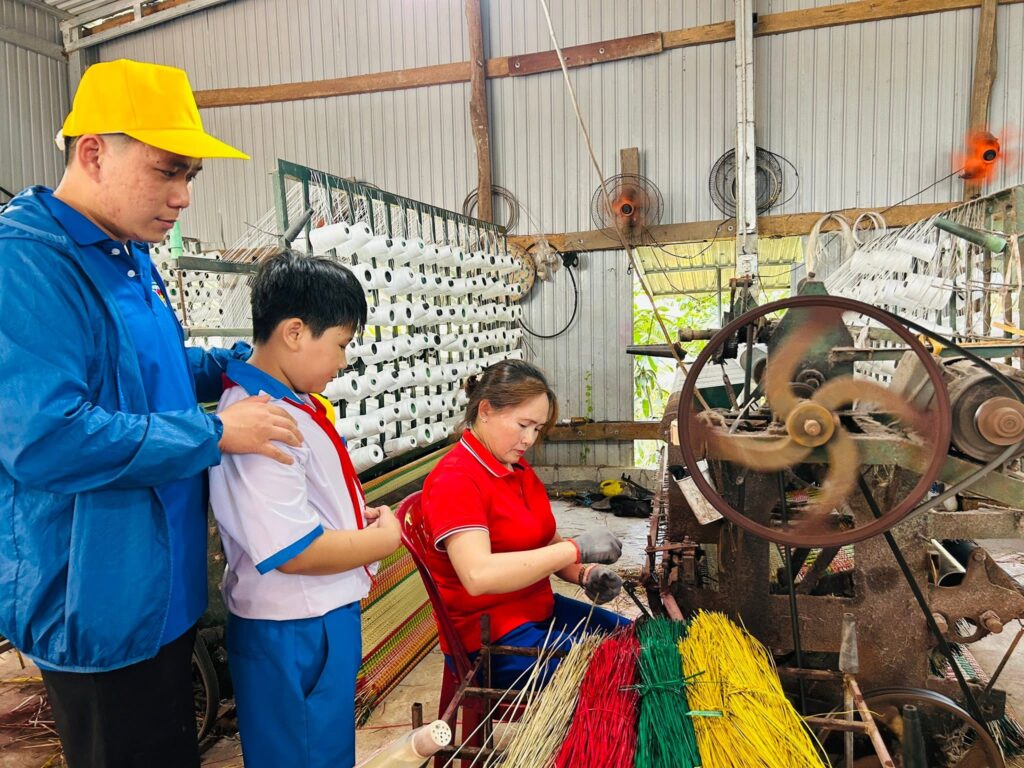
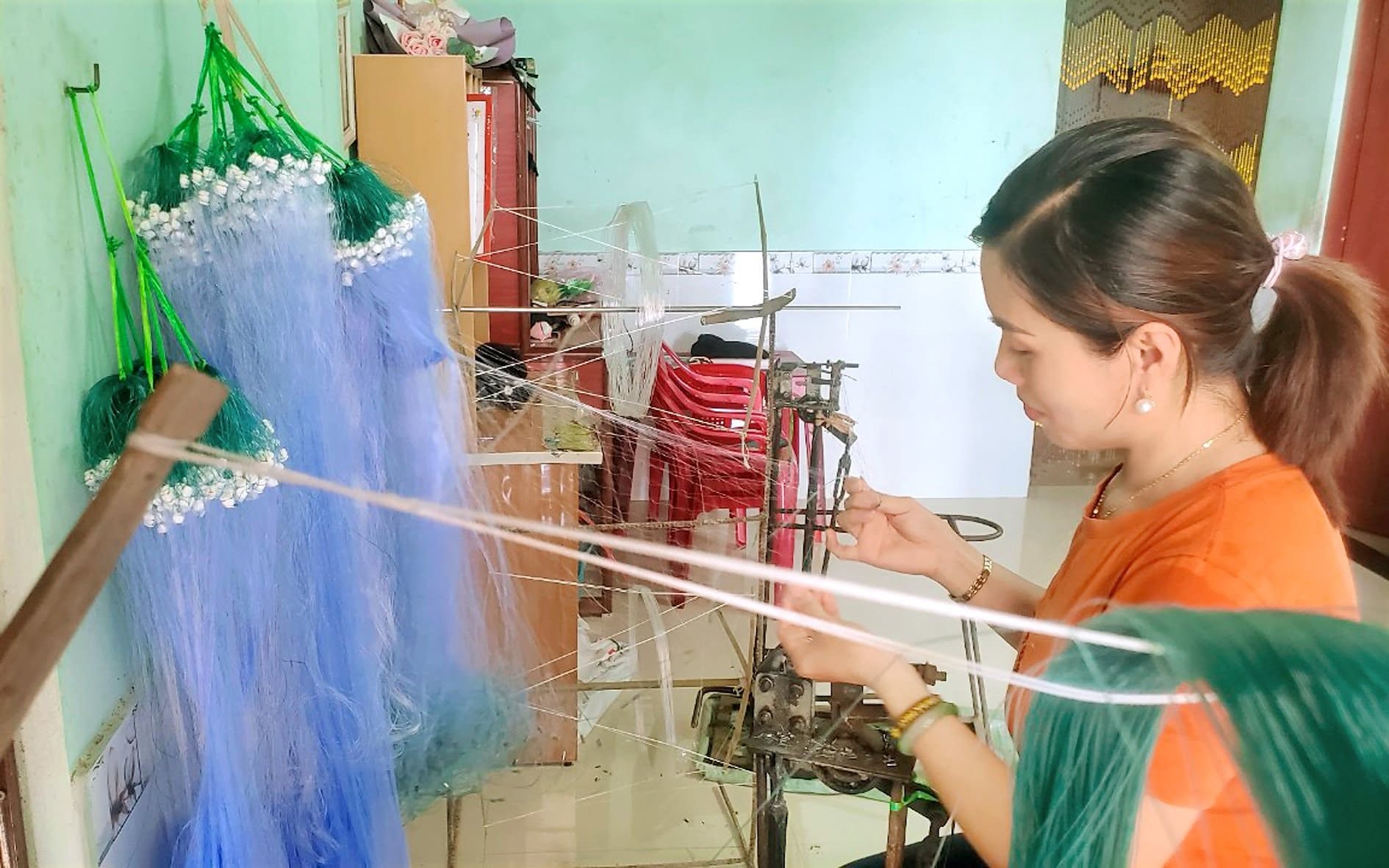
With the development of science and technology, net production in Van Trinh has changed considerably. Whereas the entire net panel was once hand-knitted, machine-made netting has now replaced most, and according to the source, all of the traditionally hand-knitted net panels.
The remaining work mainly involves finishing operations such as attaching floats, adding lead weights and carrying out other manual tasks. The combination of machinery and traditional skills has shortened production time and enabled the village to meet growing market demand.
This transformation also demonstrates the craft’s ability to adapt. Net making no longer follows entirely the traditional manual production method, but practical skills and knowledge associated with finishing the nets continue to be maintained within the community.
A Supplementary Livelihood for the Community
Today, net making remains an important supplementary occupation in Van Trinh, particularly during periods when agricultural work is less demanding after the two annual rice crops.
According to the source, the craft has attracted around 800 workers from the village and neighboring areas. Another figure in the source states that the craft provides employment and income for more than 500 local workers of different ages. The products are sold in markets both inside and outside the province.
The difference between these figures indicates that the number of people involved may vary depending on the period or the scope of the statistics. Nevertheless, both figures demonstrate the continuing role of net making as a source of employment and supplementary income for the local community.
Because the work can be carried out during agricultural off-seasons, it fits naturally into the lives of farming households. Residents can continue working in agriculture while participating in net production to supplement family income.
The Craft’s Ancestor Commemoration Day
Net making in Van Trinh is not only maintained as a livelihood but also has its own cultural dimension within the community. Every year, villagers observe the 12th day of the second lunar month as the traditional ancestor commemoration day of the craft.
The occasion provides an opportunity for the community to remember earlier generations and express respect for the craft passed down through the years. It is also part of the spiritual life of the craft village, helping maintain awareness of its origins and continuity.
Van Trinh Net Making Recognized as a Traditional Craft
Van Trinh Net-Making Village was recognized by the provincial People’s Committee as a Traditional Craft of the Province under Decision No. 971/QD-UBND dated May 12, 2016.
The recognition acknowledges the long history and continued development of Van Trinh’s net-making tradition, while providing a basis for maintaining the craft, preserving traditional skills and promoting the economic value of a handicraft that has accompanied the local community for centuries.
Basic Information
| Item | Information |
|---|---|
| Craft | Van Trinh Net Making |
| Local names | Trien Village, Rao Village |
| Current location | Phong Dinh Ward, Hue City |
| History | More than 500 years, according to the source |
| Traditional materials | Natural silk fibers, bamboo, re tree, lead, leaves and forest bark |
| Traditional techniques | Hand-knitting nets, attaching floats and adding lead weights |
| Current production | Machine-made net panels combined with manual finishing |
| Markets | Inside and outside the province |
| Ancestor commemoration day | 12th day of the second lunar month |
| Recognition | Traditional Craft of the Province |
| Decision | No. 971/QD-UBND, May 12, 2016 |