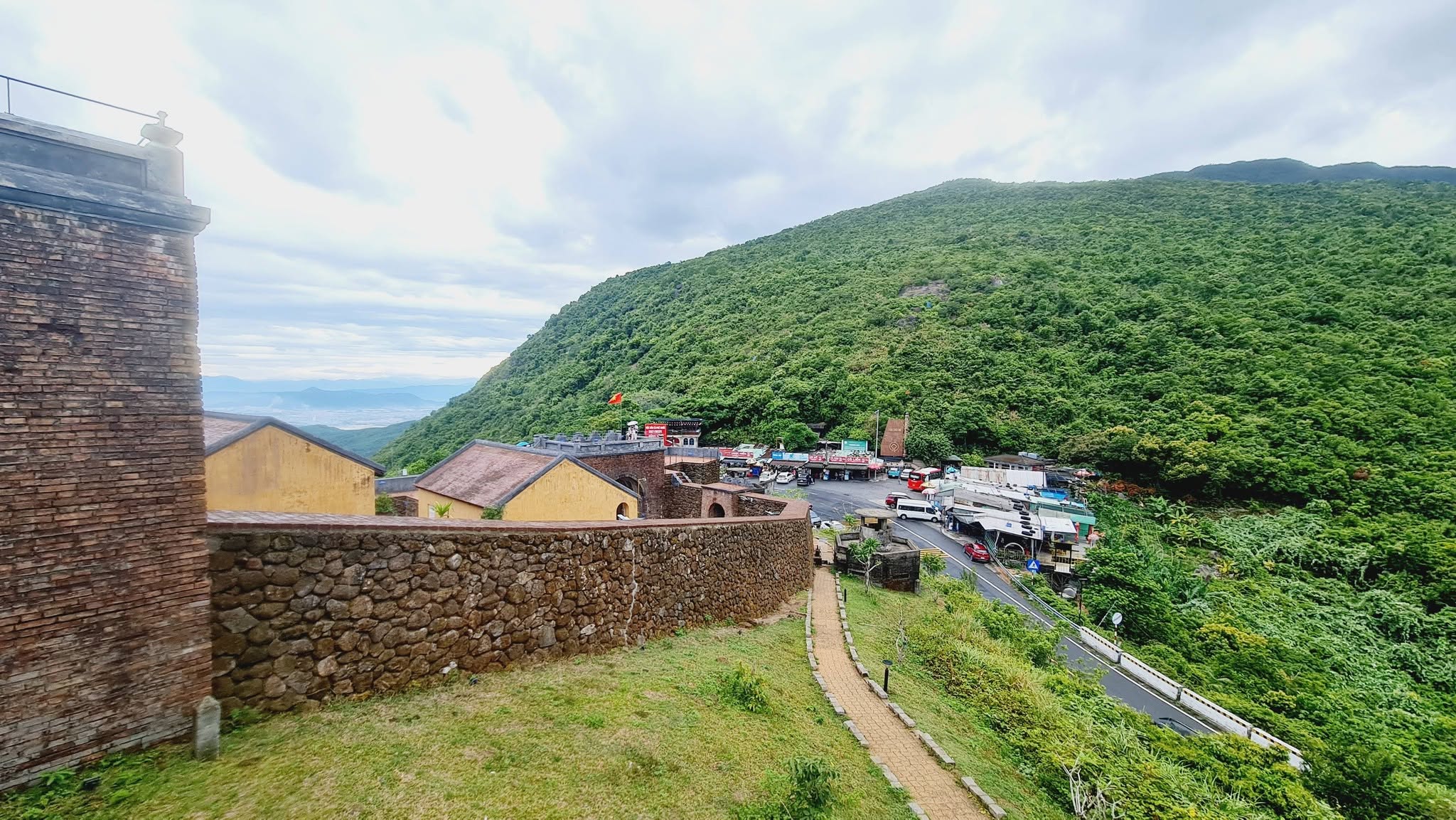
Perched atop the majestic Hai Van Pass, approximately 490–496 meters above sea level according to heritage descriptions, Hai Van Gate (Hai Van Quan) is a historic military fortification built during Vietnam’s Nguyen Dynasty. Closely associated with the defense of the imperial capital of Hue and the strategic north–south transportation route, the gateway once played an essential role in controlling movement through one of central Vietnam’s most formidable mountain passes.
Situated where towering mountains meet the sea, Hai Van Gate combines military architecture, historical significance, and spectacular natural scenery. Over nearly two centuries, the fortification experienced periods of military occupation, structural alteration, and deterioration before being conserved and restored through cooperation between Hue and Da Nang.
Today, Hai Van Gate stands as an important cultural heritage destination, offering visitors an opportunity to explore Nguyen Dynasty military architecture while enjoying the dramatic landscapes of Hai Van Pass.
Location and Overview of Hai Van Gate
Hai Van Gate is located at the summit of Hai Van Pass, on the boundary between Hue and Da Nang in central Vietnam.
According to the supplied heritage information, the site lies between Chan May – Lang Co Commune, Hue, and Hai Van Ward, Da Nang.
Hai Van Pass has long been regarded as one of the most strategically important mountain crossings along Vietnam’s historic north–south route.
With steep mountains on one side and views toward the sea on the other, the winding pass has presented significant challenges for transportation while offering considerable advantages for observation and defense.
From the position of Hai Van Gate, it is possible to observe the surrounding mountains, forests, and coastal landscape.
This commanding location made the gateway an important checkpoint on the route connecting the southern territories with the imperial capital of Hue.
Today, Hai Van Gate also serves as a cultural and tourism connection between Hue and Da Nang.
Its combination of historical architecture and mountain scenery makes it a notable stop for travelers exploring central Vietnam.
Hai Van Pass Before the Construction of the Imperial Gate
As early as the Tran Dynasty, Hai Van Pass was recognized as a strategically significant location along the north–south transportation route.
It also served as a natural boundary between the historical regions of Thuan Hoa and Quang Nam.
As the Nguyen lords expanded their control over southern Vietnam, the defensive importance of Hai Van Pass became increasingly apparent.
Nguyen Hoang (1558–1613) described the area as the strategic gateway to the Thuan Quang region, emphasizing its importance in protecting the southern territories.
In 1719, Lord Nguyen Phuc Chu (1692–1725) composed the poem Ai Linh Xuan Van, meaning Spring Clouds over the Mountain Pass, while traveling through Hai Van Pass.
The poem includes the following lines:
“Việt Nam hiểm ải thử sơn điên.
Hình thế hỗn như Thục đạo thiên.”
These verses describe the formidable terrain of the pass and compare its difficult mountain roads with the legendary routes through the ancient region of Shu in China.
After the Nguyen Dynasty was established and Hue became the imperial capital, Hai Van Pass gained even greater importance within the southern defensive system.
Its location provided opportunities to observe both overland routes and nearby coastal waters while controlling a major transportation corridor connecting the capital with the southern provinces.
During the reign of Emperor Gia Long (1802–1820), the imperial administration established four postal relay stations in Phu Loc District and carried out improvements to the road leading over Hai Van Pass.
Under Emperor Minh Mang (1820–1840), the court continued to improve transportation and encourage settlement in the mountainous region.
According to historical accounts, the administration provided financial incentives to local households and constructed stone steps along steep sections of the route to make travel easier.
These activities demonstrate that Hai Van Pass was regarded not merely as a transportation corridor but also as an area of considerable military and administrative importance.
Construction of Hai Van Gate Under Emperor Minh Mang
Recognizing the importance of Hai Van Pass in protecting the imperial capital, Emperor Minh Mang ordered the construction of a major defensive fortification at the summit in February 1826, during the Year of the Fire Dog.
Hai Van Gate was designed as a fortified military complex consisting of two principal gateways surrounded by substantial stone defensive walls.
The structure was adapted to the mountainous terrain, allowing the imperial administration to monitor movement through the pass while maintaining an advantageous defensive position.
The two gateways are the most distinctive architectural features of the site.
- Gateway facing Da Nang: Inscribed with the three Chinese characters “Hải Vân Quan”, meaning Hai Van Gate.
- Gateway facing the imperial capital of Hue: Inscribed with the six Chinese characters “Thiên hạ đệ nhất hùng quan”, commonly translated as “The Most Majestic Pass Under Heaven.”
The gateways were constructed using traditional large bricks and featured arched entrances reminiscent of the architectural style of the Hue Imperial Citadel.
Above each gateway was an elevated platform used for observation, accessible by stairways.
Unlike some larger imperial gateways, Hai Van Gate did not feature an additional watchtower above its entrance.
Within the fortified complex were several structures supporting military operations.
These included the Tru So, which served as accommodation for soldiers, and the Vu Kho, an arsenal used to store weapons and military equipment.
Defensive walls surrounded the complex, strengthening its protective capabilities and allowing the garrison to control access through the mountain pass.
According to historical records, construction was completed within several months using labor mobilized from Thua Thien Prefecture and Quang Nam Province.
Following completion, the imperial court stationed soldiers and artillery at the site and appointed officers responsible for its defense.
Administratively, Hai Van Gate formed part of the Nguyen Dynasty’s military command system.
The northern side of the gateway fell under the jurisdiction of Thua Thien, while the southern side was associated with Quang Nam.
The imperial administration also introduced policies to encourage settlement in the surrounding area and established a shrine dedicated to the mountain deity of Hai Van.
Because of its scale, location, and defensive functions, Hai Van Gate became one of the notable military fortifications constructed by the Nguyen Dynasty in central Vietnam.
Hai Van Gate Through Different Historical Periods
From an Imperial Defensive Gateway to Declining Military Use
During the nineteenth century, Hai Van Gate played an important role in controlling movement through the mountain pass.
According to historical accounts, approximately 50 soldiers were stationed at the gateway in 1876, before the establishment of the French protectorate.
Following the Treaty of Hue in 1884, the number of guards was substantially reduced.
By the early twentieth century, around 1918 according to the supplied materials, the gateway was no longer regularly guarded and gradually fell into disuse.
French and American Military Occupation
In late 1946, during the renewed French military campaign in Vietnam, Hai Van Gate was adapted into a fortified military position.
Defensive structures were reinforced around the summit, and the site was reportedly occupied by two platoons of European and African soldiers serving in the French colonial forces.
After 1954, American military forces and the South Vietnamese administration continued to use buildings, military posts, and defensive structures in the surrounding area.
These prolonged military activities significantly altered the original appearance of the Nguyen Dynasty fortification.
Several original architectural features were demolished or modified, including cannon positions, soldiers’ quarters, and the arsenal.
Some sections of the defensive walls were leveled, while the gateway bearing the inscription Thien Ha De Nhat Hung Quan was blocked with modern bricks.
According to the supplied historical materials, the area around the entrance was also buried beneath nearly two meters of accumulated earth and sand.
French and American military forces additionally constructed five concrete bunkers at strategic positions around Hai Van Gate.
These changes substantially affected the original architectural integrity of the site.
Nevertheless, the surviving structures continued to demonstrate the strategic importance of Hai Van Pass across different periods of Vietnamese history.
Conservation and Restoration of Hai Van Gate
After decades of deterioration caused by warfare, weather exposure, and structural alterations, the preservation of Hai Van Gate became an important heritage conservation priority.
In 2017, Vietnam’s Ministry of Culture, Sports and Tourism officially designated Hai Van Gate as a National Historical Relic.
This recognition established an important foundation for the site’s management, protection, and restoration.
On December 19, 2021, a major conservation and restoration project was launched through cooperation between Hue and Da Nang.
According to the supplied project information, the conservation area covered approximately 6,500 square meters, with a total investment of more than VND 42 billion.
The project focused on conserving surviving architectural elements, restoring damaged structures, recovering the historic appearance of the gateway, and improving facilities for visitors.
The restoration was particularly significant because the heritage site lies along the boundary between the two localities.
The cooperation between Hue and Da Nang demonstrated the importance of joint heritage management when a historical landmark is shared across administrative boundaries.
Following the restoration process, the site was reopened to visitors.
The conservation work not only helped preserve a valuable example of Nguyen Dynasty military architecture but also created opportunities for the public to better understand the history of this strategically important mountain pass.
Technology and Heritage Tourism Development
Following its restoration, Hai Van Gate has been promoted as a heritage destination connecting the tourism landscapes of Hue and Da Nang.
According to the supplied materials, local authorities have explored several initiatives to improve visitor experiences, including digital check-in platforms and systems for recording visitor attendance.
Other proposed or implemented improvements include:
- 3D technology: Digital interpretation tools to help visitors explore the architecture and historical significance of the gateway.
- Free Wi-Fi: Internet access to support visitor information services and online heritage resources.
- Visitor facilities: Improvements to infrastructure and services within the heritage area.
- Traffic coordination: Measures to improve traffic management along National Highway 1 near Hai Van Gate.
- Supporting infrastructure: Parking areas, public restrooms, and spaces for displaying or selling local souvenirs.
These initiatives aim to make the site more accessible while providing visitors with a richer understanding of its cultural and historical importance.
Because Hai Van Gate lies along a major transportation corridor between two of central Vietnam’s leading tourism destinations, it has considerable potential as part of broader cultural, historical, and scenic travel itineraries.
Visiting Hai Van Gate: Travel Tips
Explore the Scenery of Hai Van Pass
Hai Van Gate stands at the summit of one of Vietnam’s most celebrated mountain passes.
The surrounding landscape features winding roads, forested mountains, steep slopes, and sweeping views toward the coast.
Visitors can combine a visit to the historical gateway with sightseeing, photography, and exploration of the natural scenery along Hai Van Pass.
On clear days, the elevated location provides impressive views of the surrounding mountains and coastline.
Weather conditions, however, can change quickly, and mist or clouds may occasionally limit visibility.
Discover the Architecture and Historical Remains
Visitors should take time to examine the two historic gateways, their inscriptions, the surviving defensive walls, and the restored architectural features.
These details help illustrate how the fortification functioned as a military checkpoint during the Nguyen Dynasty.
The contrasting inscriptions on the northern and southern gateways are especially noteworthy.
They reflect both the administrative role of the pass and the importance attached to its imposing natural setting.
Exploring the preserved structures also offers insight into the changes the site experienced during later periods of military occupation.
Travel Safely on Hai Van Pass
Hai Van Pass is known for its winding roads, steep gradients, and rapidly changing weather.
Travelers should check weather and road conditions before departure, follow traffic regulations, and stop only in designated or safe areas.
Extra caution is recommended during heavy rain, strong winds, or dense fog.
Visitors should also help preserve the historical site by avoiding graffiti, respecting protected structures, and following on-site guidance.
Historical and Cultural Significance of Hai Van Gate
Hai Van Gate represents an important example of the Nguyen Dynasty’s military planning and defensive architecture.
Its construction reflected the need to control a strategically important mountain crossing, protect the southern approaches to the imperial capital, and regulate movement between different regions.
Throughout its history, the gateway experienced changing military functions, structural modifications, partial destruction, and deterioration before undergoing conservation and restoration.
Its surviving features therefore reflect not only the history of nineteenth-century military architecture but also broader changes in politics, transportation, and warfare in central Vietnam.
Today, Hai Van Gate is a shared cultural heritage asset of Hue and Da Nang.
The cooperation between the two localities in conserving the monument highlights the importance of coordinated heritage preservation.
It also creates opportunities to develop tourism experiences that combine historical interpretation, architectural heritage, and natural landscapes.
With its distinctive architecture, commanding geographical position, and nearly two centuries of history, Hai Van Gate remains one of the most meaningful historical landmarks along the Hai Van Pass.
For travelers exploring central Vietnam, the site offers a rare opportunity to experience the intersection of imperial history, military architecture, and spectacular mountain scenery.
Hai Van Gate is more than an ancient mountain checkpoint. It is a historical landmark that reflects the strategic vision of the Nguyen Dynasty, the changing military history of central Vietnam, and the enduring relationship between architecture and landscape. Restored and preserved for future generations, the gateway continues to stand as a symbol of the region’s historical heritage and natural grandeur.
Quick Information
| Item | Details |
|---|---|
| Heritage name | Hai Van Gate |
| Vietnamese name | Hải Vân Quan |
| Alternative name | Hai Van Pass Gate |
| Famous inscription | Thien Ha De Nhat Hung Quan – “The Most Majestic Pass Under Heaven” |
| Location | Summit of Hai Van Pass, between Hue and Da Nang, Vietnam |
| Administrative areas in the supplied materials | Chan May – Lang Co Commune, Hue; Hai Van Ward, Da Nang |
| Elevation | Approximately 490–496 meters above sea level |
| Construction year | 1826 |
| Reigning emperor | Emperor Minh Mang |
| Historical dynasty | Nguyen Dynasty |
| Heritage type | Military architecture and historical fortification |
| Main architectural features | Two arched gateways, stone defensive walls, observation platforms, former military quarters, and arsenal |
| National Historical Relic designation | 2017 |
| Restoration project launched | December 19, 2021 |
| Conservation project area | Approximately 6,500 m² |
| Reported investment | More than VND 42 billion |
| Outstanding values | Imperial history, military architecture, mountain scenery, and cultural heritage tourism |