Hoang Hoa Su Trinh Do (皇華使程圖), also known as The Envoys’ Journey to China, is an exceptional Vietnamese cartographic and diplomatic manuscript documenting an official mission to Qing Dynasty China in the 18th century. The work was compiled, edited, and annotated by Nguyen Huy Oanh (1713–1789), a distinguished Vietnamese scholar and diplomat, using records from earlier diplomatic missions together with observations from the embassy he personally led in 1766–1767.
Beyond illustrating the route from Thang Long, the capital of Dai Viet, to Beijing, the manuscript records postal stations, overland and waterway routes, geographical locations, fortified cities, mountains, rivers, and information concerning diplomatic ceremonies. Its hand-drawn maps, enhanced with colored ink and Chinese-language annotations, constitute a valuable source for the study of history, geography, cartography, and diplomatic relations between Dai Viet and China.
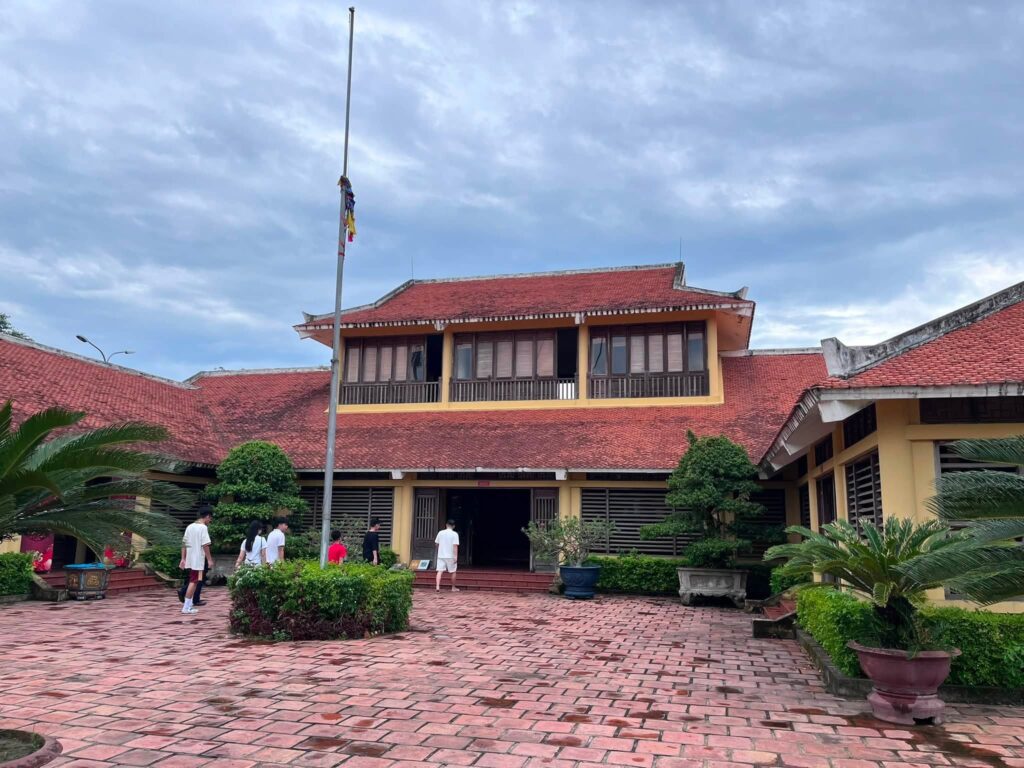
The surviving manuscript is a handwritten copy produced in 1887 by Nguyen Huy Trien (1852–1909), a fifth-generation descendant of Nguyen Huy Oanh. It has been preserved by successive generations of the Nguyen Huy family in Truong Luu Village, Ha Tinh Province.
On May 30, 2018, during the Eighth General Meeting of the Memory of the World Committee for Asia and the Pacific, held in Gwangju, South Korea, Hoang Hoa Su Trinh Do was inscribed on the UNESCO Memory of the World Asia-Pacific Regional Register (MOWCAP).
This recognition acknowledged the exceptional significance of a documentary work reflecting geographical knowledge, diplomatic practices, and Vietnamese scholarly traditions during the 18th century.
Nguyen Huy Oanh and the Historical Origins of Hoang Hoa Su Trinh Do
Hoang Hoa Su Trinh Do is closely associated with the life and career of Nguyen Huy Oanh, a distinguished official, educator, cultural scholar, and diplomat during the Later Le Dynasty.
He was born in 1713 in Truong Luu Village, a community in present-day Ha Tinh Province renowned for its longstanding literary and scholarly traditions.
Born into the intellectually prominent Nguyen Huy family, Nguyen Huy Oanh demonstrated outstanding academic ability from an early age.
In 1732, he ranked first in the provincial examination. In 1748, he achieved the prestigious title of Dinh Nguyen Tham Hoa, or Third-Ranked Doctoral Laureate, in the imperial examinations.
Throughout his official career, Nguyen Huy Oanh held several important positions, including Minister of Public Works, Minister of Rites, and senior academic offices at the Imperial Academy, or Quoc Tu Giam. He also received the noble title of Thac Linh Hau.
Alongside his political and diplomatic responsibilities, Nguyen Huy Oanh made substantial contributions to education.
He played an important role in developing Phuc Giang School and Library in Truong Luu Village, where educational materials were compiled, woodblocks were engraved, and generations of students received classical instruction.
These achievements are also reflected in the Phuc Giang School Woodblocks, another documentary heritage collection associated with the Nguyen Huy family, which was inscribed on the UNESCO Memory of the World Asia-Pacific Regional Register in 2016.
Nguyen Huy Oanh left numerous scholarly works covering subjects such as history, geography, literature, education, and diplomacy, demonstrating the breadth of his intellectual interests.
During the 18th century, diplomatic relations between Dai Viet and Qing China were maintained through official embassies, which played an important role in the political and cultural relationships of East Asia.
Preparing for these long-distance missions required extensive knowledge of geography, transportation networks, ceremonial procedures, and local customs.
As early as 1758, Nguyen Huy Oanh was considered for appointment as a deputy envoy on a diplomatic mission planned for 1760.
During this period, he began collecting and studying materials relating to earlier embassies, including records associated with the scholar and diplomat Nguyen Tong Quai.
In 1761, Nguyen Huy Oanh participated in receiving Qing diplomatic representatives, gaining additional experience in diplomatic protocol and official relations.
In 1764, he was selected to lead a mission to Yanjing, the historical name for Beijing, scheduled for 1766–1767.
The delegation led by Nguyen Huy Oanh departed from Hanoi on the ninth day of the first lunar month of 1766 and crossed the border on the twenty-ninth day of the same lunar month.
After crossing the frontier, the delegation traveled overland toward Ningming before continuing along waterways through various regions of China.
The journey combined land and river transportation, passing through important administrative, commercial, and transportation centers, including Nanjing and Jining, before reaching the Beijing area.
In the Qing capital, the delegation carried out diplomatic ceremonies and official procedures according to the conventions of the period.
After spending nearly two months in Beijing, the envoys began their return journey on February 16, 1767, reaching Hanoi on November 8, 1767, and completing a diplomatic mission lasting nearly two years.
Throughout the journey, Nguyen Huy Oanh recorded information about travel routes, geographical locations, landscapes, postal stations, and the reception of diplomatic representatives.
He also consulted Chinese geographical works, descriptions of notable landscapes, and maps, comparing these sources with records from earlier Vietnamese embassies.
Using this information, he compiled, edited, and supplemented the material that became Hoang Hoa Su Trinh Do, a work combining travel maps, geographical research, and practical diplomatic guidance.
According to information contained in the manuscript, its compilation was associated with the period 1765–1768, encompassing preparations before the mission, observations made during the journey, and revisions completed after his return.
The work was intended not merely to preserve the experiences of one diplomatic delegation but also to provide useful reference material for future envoys.
More than a century later, in 1887, Nguyen Huy Trien, a fifth-generation descendant of Nguyen Huy Oanh, copied the manuscript by hand.
This copy was preserved by the Nguyen Huy family in Truong Luu Village and became the rare surviving version known today.
Manuscript Structure, Contents, and Cartographic Art
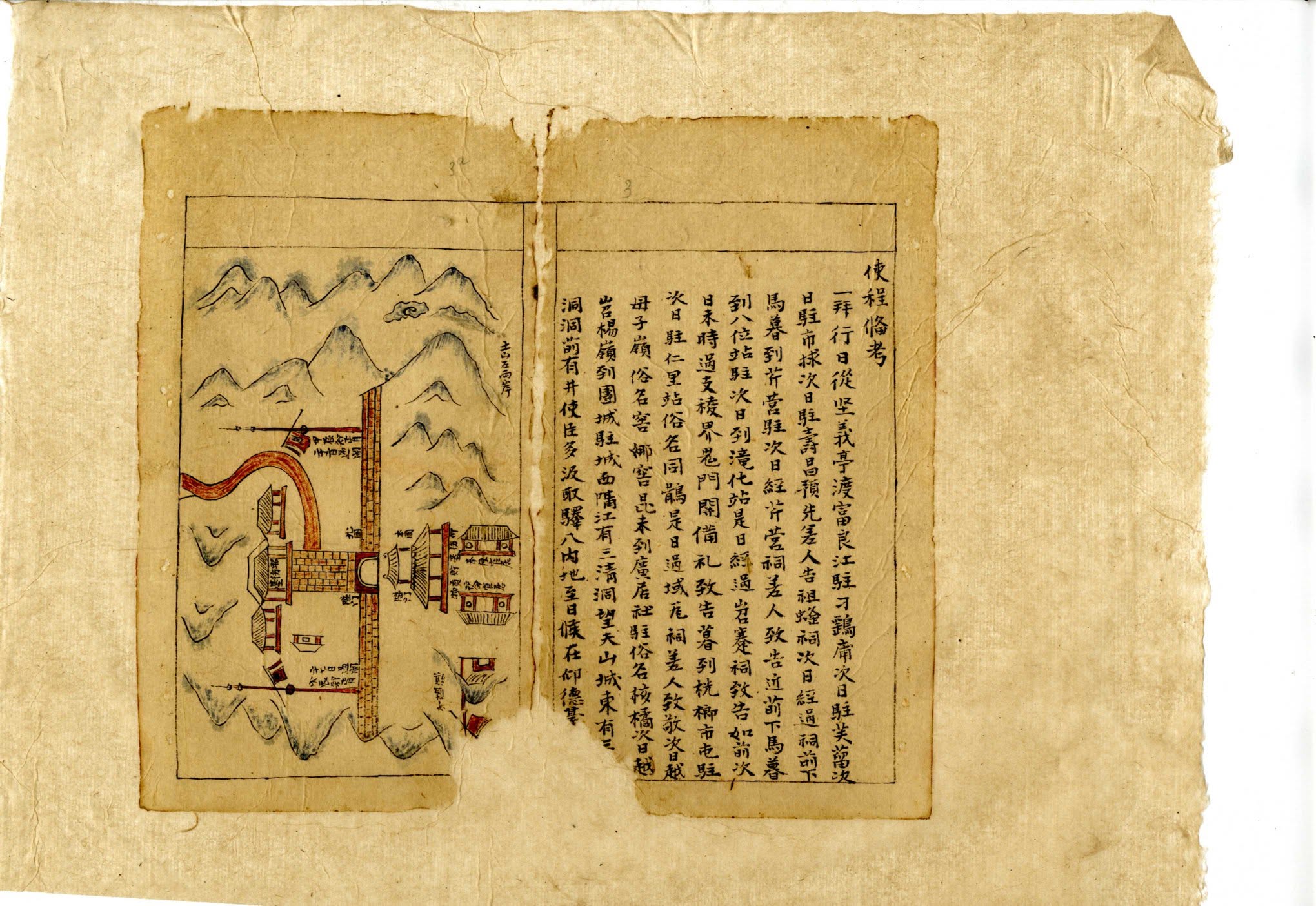
Hoang Hoa Su Trinh Do is a distinctive work that combines Chinese-language written records with an illustrated series of maps documenting a diplomatic journey.
According to the detailed heritage description, the surviving manuscript measures approximately 22 × 14 cm and consists of 119 sheets of traditional do paper, equivalent to 238 pages when both sides are counted.
The book is bound in a traditional format and written by hand in Chinese characters using black ink. Its pages feature ruled borders that organize the written content into clear sections.
The maps are illustrated in several colors, primarily black, red, and dark bluish-purple.
Black ink is used for outlines, written characters, and geographical details. Red is used to highlight roads, waterways, flags, and certain architectural features, while dark bluish-purple represents mountain ranges and natural landscapes.
Although relatively simple in style, the drawings are precise and expressive, depicting roads, rivers, fortified towns, bridges, and the terrain encountered along the diplomatic route.
One of the manuscript’s most remarkable features is the continuity of its cartographic sequence.
When viewed in order, the maps allow readers to visualize the extended journey from the capital of Dai Viet to the Qing imperial capital, following successive overland and waterway routes.
Rather than functioning as isolated geographical illustrations, the maps form a visual narrative that enables readers to trace the delegation’s movements through individual stages of the journey.
The manuscript contains extensive information about administrative locations, prefectures, districts, fortified towns, mountains, rivers, ferry crossings, bridges, postal stations, and distances between places.
These records are valuable for researching transportation networks and historical geography in Qing Dynasty China.
According to the heritage documentation, Hoang Hoa Su Trinh Do comprises seven principal sections.
Hoang Hoa Dich Lo Do Thuyet (皇華驛路圖說), or Explanation of the Diplomatic Postal Route Maps, describes the diplomatic route and provides information needed to understand the various stages of the journey.
Luong Kinh Trinh Lo Ca (兩京程路歌), or Song of the Route Between the Two Capitals, presents the journey in verse, reflecting a traditional method of memorizing and communicating geographical information.
Su Trinh Bi Khao (使程備考), or Reference Notes for the Diplomatic Journey, records preparatory information concerning the route, particularly the section within Dai Viet.
The illustrated itinerary maps form the manuscript’s most prominent component, visually documenting routes, geographical locations, and landscapes encountered by the envoys.
Ban Quoc Tu Than Kinh Tien Hanh Luc Lo (本國自神京進行陸路) describes the overland route departing from the Vietnamese capital.
Bac Su Thuy Lo Trinh Ly So (北使水陸路程里數) records the distances of overland and waterway stages along the northern diplomatic route.
Quoc So Kien Cung Dien (國初建宮殿) contains material relating to the construction of palaces during the early period of a dynasty.
The manuscript concludes with a preface by Nguyen Huy Trien, who copied the work in 1887.
Together, these sections form a relatively comprehensive documentary account of diplomatic travel, covering preparations, route identification, geographical information, historical observations, and ceremonial practices.
The manuscript’s distinctive character lies in its combination of cartography and textual scholarship.
The maps provide visual information, while the Chinese-language explanations supply additional details concerning locations, distances, terrain, and travel conditions.
This combination makes the work relevant to several fields of historical research.
For historical geography, it provides information about rivers, roads, postal stations, and the distribution of administrative centers during the 18th century.
For transportation history, the manuscript illustrates how long-distance journeys were organized across different regions using both boats and overland travel.
For diplomatic history, it demonstrates the careful preparations undertaken by Vietnamese envoys before important missions, including their study of routes, ceremonial procedures, and the conditions of the receiving country.
For art history and calligraphy, it preserves examples of Vietnamese cartographic illustration, color application, and Chinese-character manuscript presentation during the premodern period.
The maps were not designed according to modern cartographic conventions. Instead, they emphasized travel routes, landscape features, and important landmarks that helped readers recognize the itinerary.
This combination of practical purpose and artistic expression gives Hoang Hoa Su Trinh Do a distinctive place in the history of Vietnamese cartography.
Historical Significance, Diplomatic Value, and the Manuscript’s Rarity
Hoang Hoa Su Trinh Do is a rare documentary source concerning diplomatic relations between Dai Viet and China during the 18th century.
The work emerged at a time when diplomatic embassies played a central role in relations among East Asian states, particularly those sharing traditions of Chinese-character scholarship.
Diplomatic missions were not limited to formal political ceremonies. They also enabled envoys to visit important cultural, intellectual, and commercial centers.
During their travels, envoys frequently recorded observations concerning geography, history, local customs, literature, and unfamiliar aspects of the societies they encountered.
These accounts helped broaden the understanding of the outside world among Vietnamese scholars.
Hoang Hoa Su Trinh Do clearly reflects this tradition.
Rather than simply recording events from a journey, Nguyen Huy Oanh developed a systematic reference work that combined personal experience with information inherited from earlier generations of diplomats.
His decision to study previous records before departure demonstrates the careful preparation of a scholar-diplomat who understood both his official responsibilities and the importance of reliable knowledge.
After returning from China, he continued comparing, supplementing, and revising the collected information, transforming it into material that could assist future diplomatic delegations.
This approach is central to the manuscript’s historical significance.
In diplomatic history, Hoang Hoa Su Trinh Do provides evidence of the preparations and procedures associated with official embassies during Vietnam’s monarchical period.
Its descriptions of travel routes, geographical locations, and reception ceremonies offer insight into how diplomatic relations between Dai Viet and Qing China were organized.
The manuscript also illustrates the role of envoys as national representatives and scholars responsible for observing, recording, and transmitting knowledge.
In geography and cartography, the illustrated maps help researchers investigate historical transportation routes connecting Vietnam and China.
The place names, rivers, postal stations, and architectural structures depicted in the manuscript can be compared with other geographical records and historical maps to examine changes in landscapes and transportation networks over time.
In cultural history, the work provides the perspective of an 18th-century Vietnamese intellectual observing the geographical, social, and cultural environment of China.
The information selected and presented reflects the interests of Vietnamese scholars in studying, adapting, and systematically organizing knowledge about neighboring societies.
In textual scholarship, Hoang Hoa Su Trinh Do is also a notable example of a compilation based on multiple sources.
Nguyen Huy Oanh consulted records from earlier embassies, compared them with firsthand observations, and reorganized the information into a practical reference work.
This method reflects the traditions of research, synthesis, and verification within Vietnamese classical scholarship.
The historical reliability of the manuscript can be examined through comparison with contemporary and later historical and diplomatic sources.
According to the heritage documentation, relevant works include Dai Viet Su Ky Tuc Bien, Kham Dinh Viet Su Thong Giam Cuong Muc, Bac Su Thong Luc by Le Quy Don, Lich Trieu Hien Chuong Loai Chi by Phan Huy Chu, and Nghe An Ky by Bui Duong Lich.
Of particular importance is Nguyen Huy Oanh’s Phung Su Yen Dai Tong Ca, which also records aspects of his diplomatic journey and provides material for comparing dates, locations, and ceremonial activities.
These sources enable researchers to examine and clarify the information presented in Hoang Hoa Su Trinh Do.
Beyond its content, the surviving manuscript is exceptionally valuable because of its history of transmission.
According to the heritage description, Nguyen Huy Trien copied the work in February 1887, completing the process in just over 20 days.
The manuscript was reproduced on traditional do paper, with handwritten Chinese characters and colored maps.
Notes concerning the compilation and copying process appear within the manuscript itself, helping establish its provenance and historical development.
The surviving volume is regarded as the only known handwritten copy, preserved by the Nguyen Huy family in Truong Luu Village.
This makes the collection exceptionally rare.
If the manuscript were lost or seriously damaged, reconstructing its complete text and visual appearance would be extremely difficult because no equivalent surviving copy is known.
The manuscript has undergone conservation work by National Archives Center No. 1, contributing to its physical protection and continued availability for scholarly research.
In addition to its significance for Vietnam, Hoang Hoa Su Trinh Do has broader research value across East Asia.
It provides material for comparing diplomatic routes, ceremonial traditions, and travel documentation among countries with historical Chinese-character literary traditions.
Such comparative studies can deepen understanding of political, cultural, and intellectual exchange between Vietnam, China, and other societies in the region.
The combination of historical information, illustrated cartography, diplomatic knowledge, and documentary rarity gives Hoang Hoa Su Trinh Do a distinctive position within Vietnam’s documentary heritage.
UNESCO Recognition in 2018 and the Preservation of Hoang Hoa Su Trinh Do
On May 30, 2018, during the Eighth General Meeting of the Memory of the World Committee for Asia and the Pacific (MOWCAP) in Gwangju, South Korea, Hoang Hoa Su Trinh Do was inscribed on the UNESCO Memory of the World Asia-Pacific Regional Register.
This event marked an important milestone in recognizing the manuscript’s historical, cultural, and scholarly significance.
The inscription belongs to the Memory of the World Asia-Pacific Regional Register, not the International Memory of the World Register.
UNESCO recognition helped affirm the importance of historical diplomatic documents and highlighted the contributions of Vietnamese envoys to the exchange of knowledge across East Asia.
For Ha Tinh Province, the recognition was particularly meaningful because it brought further international attention to Truong Luu Village and the documentary heritage of the Nguyen Huy family.
Two years earlier, in 2016, the Phuc Giang School Woodblocks, another collection associated with the same family, had also been inscribed on the Memory of the World Asia-Pacific Regional Register.
These two collections reflect different aspects of the Nguyen Huy family’s scholarly traditions.
The Phuc Giang School Woodblocks document educational activities, textbook compilation, and traditional printing techniques.
Hoang Hoa Su Trinh Do, meanwhile, preserves geographical knowledge, diplomatic experience, and evidence of cultural exchange between Dai Viet and China.
When studied together, the two collections offer valuable insight into the role of the Nguyen Huy family and Truong Luu Village in Vietnam’s educational, cultural, and diplomatic history during the 18th century.
From a conservation perspective, Hoang Hoa Su Trinh Do requires particular attention because it is a handwritten and illustrated manuscript on traditional do paper that has survived for more than a century.
Environmental factors such as humidity, light, temperature, insects, and physical handling can affect the durability of the paper, ink, and pigments.
Conservation measures should therefore prioritize appropriate storage conditions, limited handling, and regular assessment of the manuscript’s physical condition.
Digitizing the complete work using high-resolution imaging is an important way to preserve its textual and visual information while allowing researchers to consult the material without direct access to the original volume.
Transcription, translation, geographical annotation, and comparison with other historical sources can further enhance understanding of the manuscript.
In particular, the maps in Hoang Hoa Su Trinh Do offer opportunities for research using modern cartographic methods, helping identify historical transportation routes and changes in geographical names over time.
Exhibitions and multilingual interpretation programmes can also introduce the manuscript to wider audiences.
For cultural tourism, Hoang Hoa Su Trinh Do tells a compelling story about the journeys undertaken by Vietnamese envoys in the 18th century.
Through its hand-drawn maps, visitors can imagine a diplomatic expedition lasting nearly two years, crossing frontiers, rivers, mountains, and numerous administrative centers before reaching the Qing imperial capital.
The story is not simply about geographical distance. It also reflects the intellectual curiosity, adaptability, and diplomatic abilities of Vietnamese scholars.
In Truong Luu Village, presenting Hoang Hoa Su Trinh Do alongside the Phuc Giang School Woodblocks and other cultural heritage collections could support educational visits, academic research, and specialized heritage tourism.
Exhibitions featuring facsimiles, digital maps, historical illustrations, and interpretive materials would help the public appreciate the manuscript while protecting the original artifact.
Preserved across generations, Hoang Hoa Su Trinh Do remains an important example of scholarship built upon historical knowledge, firsthand observation, and a diplomat’s sense of responsibility.
Its pages of traditional do paper, Chinese characters, and colored maps document more than the route from Thang Long to Beijing. They preserve part of the historical memory of diplomatic relations, geographical knowledge, and Vietnamese intellectual life.
From Nguyen Huy Oanh’s 18th-century diplomatic journey to the handwritten copy preserved in Truong Luu Village, Hoang Hoa Su Trinh Do has transcended its original purpose as a geographical reference work to become a precious documentary heritage, telling the story of Vietnamese scholarship and diplomatic achievement across the centuries.
Quick Information
| Item | Details |
|---|---|
| Heritage name | Hoang Hoa Su Trinh Do |
| Chinese title | 皇華使程圖 |
| English title | The Envoys’ Journey to China |
| Alternative name | Hanh Trinh Di Su Trung Hoa |
| Heritage type | Documentary heritage; diplomatic itinerary maps |
| Traditional place of preservation | Truong Luu Village, Truong Luu Commune, Ha Tinh Province, Vietnam |
| Compiler and editor | Nguyen Huy Oanh (1713–1789) |
| Copyist | Nguyen Huy Trien (1852–1909) |
| Compilation period | Approximately 1765–1768 |
| Diplomatic mission | 1766–1767 |
| Date of surviving copy | 1887 |
| Historical period | Later Le Dynasty, Le-Trinh period |
| Language and script | Classical Chinese |
| Materials | Traditional do paper, ink, and colored pigments |
| Format | Handwritten manuscript with illustrated maps |
| Extent according to heritage description | 119 sheets, equivalent to 238 pages |
| Dimensions according to heritage description | Approximately 22 × 14 cm |
| Map colors | Black, red, and dark bluish-purple |
| Main contents | Diplomatic routes, postal stations, geography, transportation, history, and ceremonial practices |
| Outstanding values | Diplomatic history, historical geography, cartography, textual scholarship, and visual arts |
| Documentary status | Only known surviving handwritten copy |
| UNESCO recognition | Memory of the World Asia-Pacific Regional Register |
| Registering body | Memory of the World Committee for Asia and the Pacific (MOWCAP) |
| Recognition date | May 30, 2018 |
| Related heritage | Phuc Giang School Woodblocks
Han-Nom Documents of Truong Luu Village | UNESCO Memory of the World Documentary Heritage in Ha Tinh |