

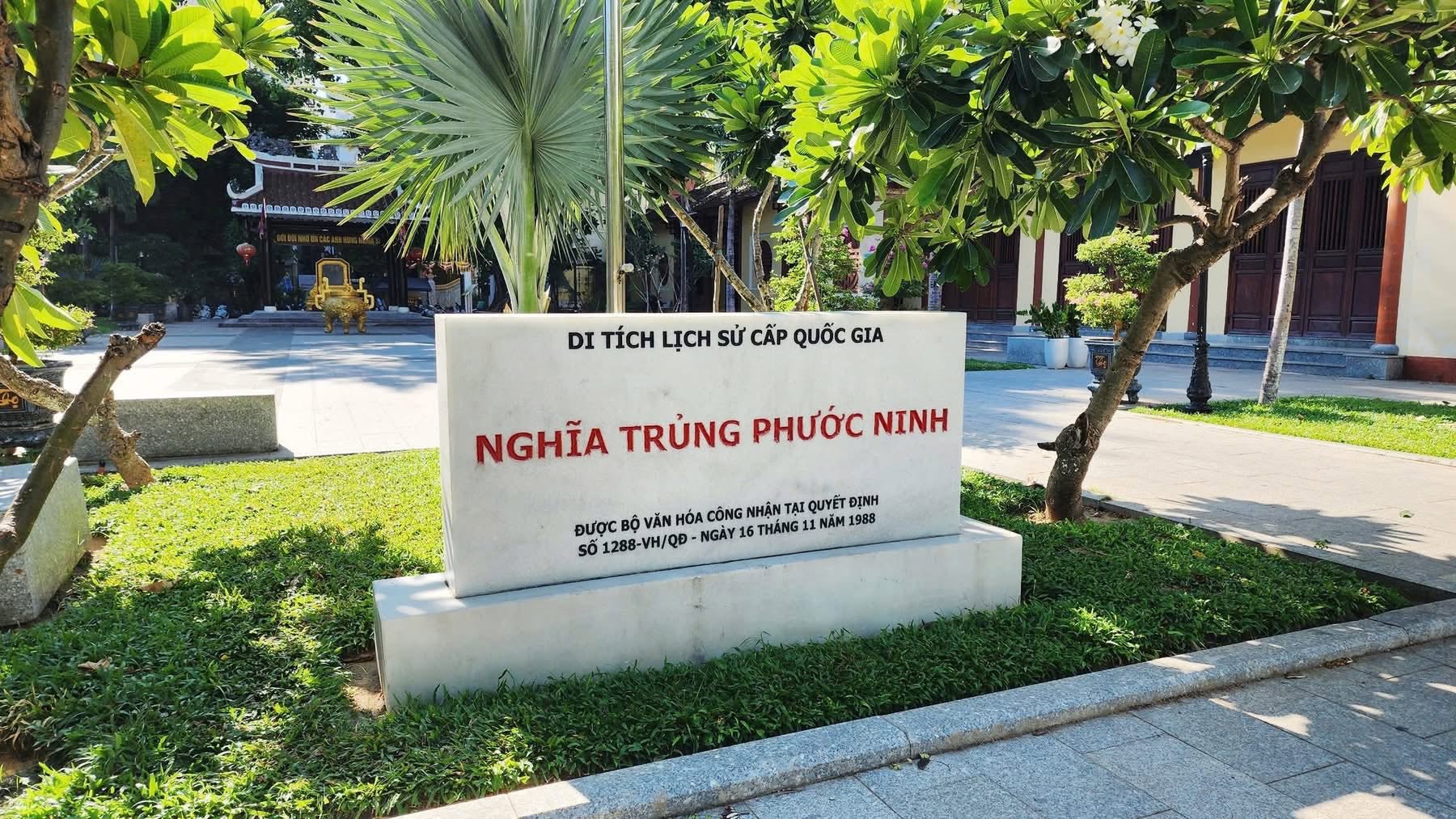
Amid the bustling streets of Da Nang, Phuoc Ninh Martyrs’ Cemetery (Nghĩa trủng Phước Ninh) is a historical and cultural site closely associated with the resistance against French and Spanish allied forces in the mid-nineteenth century.
The cemetery was established to commemorate the soldiers, local volunteers, and patriotic civilians who sacrificed their lives defending their homeland. Considered one of Vietnam’s earliest collective burial grounds dedicated to fallen patriots, it reflects the country’s long-standing tradition of honoring the deceased and remembering those who contributed to national independence.
Although most of the remains were later relocated as part of urban redevelopment, the site still preserves a historic stone stele dating from 1876. The inscription documents the cemetery’s establishment and expresses the values of patriotism, righteousness, and gratitude toward those who sacrificed their lives for their country.
History of Phuoc Ninh Martyrs’ Cemetery
In the early morning of September 1, 1858, French and Spanish allied forces under the command of French Admiral Charles Rigault de Genouilly launched an attack on Da Nang, targeting military fortifications and defensive positions, including Dien Hai and An Hai citadels.
The attack marked the beginning of the French conquest of Vietnam.
In response, Nguyen Dynasty troops, local militias, patriotic volunteers, and civilians from Quang Nam, Da Nang, and Quang Ngai organized resistance against the invading forces.
Many soldiers and volunteers lost their lives during the defense of Da Nang.
Despite possessing superior military technology and weapons, the French-Spanish coalition failed to achieve its objective of rapidly occupying and expanding control over the region.
The determined resistance of Vietnamese forces disrupted the invaders’ plans for a swift military victory.
After approximately 18 months of fighting, the allied forces withdrew from Da Nang on March 23, 1860. This became an important milestone in the resistance campaign of 1858–1860.
During the intense battles, particularly those in September and November 1858, thousands of soldiers and patriotic volunteers were reportedly killed.
Because of wartime conditions, many were buried hastily near the places where they fell.
Following the conflict, the Nguyen Dynasty authorities and local communities organized efforts to collect the remains of fallen fighters and reinter them in collective burial grounds.
Among these memorial sites, Phuoc Ninh Martyrs’ Cemetery and Khue Trung Martyrs’ Cemetery became particularly important landmarks in Da Nang’s history.
Establishment and Historical Significance
Phuoc Ninh Martyrs’ Cemetery was established in 1876, the 29th year of Emperor Tu Duc’s reign.
According to historical materials, the cemetery originally contained more than 1,500 graves.
Its establishment reflected both the imperial administration’s recognition of those who had died defending Da Nang and the community’s commitment to honoring their sacrifice.
The historical inscription identifies two important organizers: Nguyen Quy Linh, an official responsible for maritime defense affairs, and Truong Tai Phu, a deputy military commander.
They contributed personal resources, selected suitable land, and coordinated the collection and reburial of the fallen.
Military officers, soldiers, local notables, and wealthy merchants also supported the project.
The burial site was selected within the former Phuoc Ninh and Thac Gian villages.
Deputy commanders Nguyen Lan and Nguyen De were assigned to coordinate soldiers in clearing vegetation, searching for scattered remains, and preparing them for reburial.
The remains were carefully wrapped in paper and cloth, placed in coffins or burial containers, and transferred to the cemetery.
The graves were arranged in several rows along a southeast-to-northwest orientation.
An earthen wall surrounded the burial ground, with a recorded perimeter of approximately 40 truong, a traditional Vietnamese unit of length.
The work began in the fourth lunar month and was completed in the seventh lunar month of 1876.
The establishment of Phuoc Ninh Martyrs’ Cemetery was therefore much more than a burial project. It represented a collective act of remembrance, compassion, and gratitude toward those who had sacrificed their lives defending their homeland.
Khue Trung Martyrs’ Cemetery
Alongside Phuoc Ninh, Khue Trung Martyrs’ Cemetery, also known as Hoa Vang Martyrs’ Cemetery, is another important historical site associated with the resistance against French and Spanish forces.
According to historical accounts, Khue Trung Cemetery was originally established in Nghi An Village in 1866, during the 19th year of Emperor Tu Duc’s reign.
In 1962, the cemetery was relocated to its present location in the Cam Le area due to the expansion of an airfield by American military forces.
Both cemeteries represent Da Nang’s tradition of commemorating those who died defending the country.
Some historians consider these sites early examples of collective memorial cemeteries for patriotic fighters in Vietnamese history.
The Historic Phuoc Ninh Stone Stele
One of the monument’s most valuable surviving artifacts is the stone stele erected in 1876.
The stele records the establishment of the cemetery, the collection and reburial of the fallen, and the individuals who contributed to the project.
It also provides insight into the moral values of Vietnamese society during the nineteenth century.
The stele is made from dark bluish-black sandstone and measures approximately 1.2 meters in height and 0.8 meters in width.
Its inscription is carved on one side, while the stone is set within a relatively simple lime-mortar frame without elaborate decorative patterns.
Over time, natural weathering has caused some characters to become difficult to read.
The inscription explains the reasons for establishing the cemetery, describes the burial arrangements, identifies the location and scale of the site, and acknowledges those responsible for organizing the work.
According to a translated version of the inscription, its opening discusses the relationship between righteousness and personal gain.
It emphasizes that a virtuous person places moral responsibility above private interests and willingly performs good deeds, even when they appear insignificant.
In contrast, those motivated solely by personal benefit may avoid charitable acts when there is no material reward.
This moral philosophy runs throughout the inscription, expressing respect for both the fallen patriots and those who worked to provide them with a dignified resting place.
Literary and Philosophical Value of the Inscription
The Phuoc Ninh inscription is not only an important historical document but also a work of considerable literary and philosophical significance.
Its descriptions of rivers, landscapes, and the cemetery’s geographical setting convey a deep emotional connection to the homeland.
The translated inscription refers to the clear waters of Vung Thung and the winding Han River, evoking the natural beauty of Da Nang.
Selecting a peaceful and scenic location for the burial ground reflected the community’s desire to provide a dignified resting place for those who had died.
The inscription conveys a lasting humanitarian message: remembering the fallen is both a responsibility of later generations and an expression of gratitude, solidarity, and moral duty.
Changes to the Monument During Urban Development
As Da Nang expanded and modernized, the original Phuoc Ninh cemetery underwent significant changes.
According to historical materials, the remains of those originally buried there were eventually relocated and reinterred in other cemeteries.
A site covering more than 600 square meters was preserved within the former burial ground to protect the historic memorial stele.
Although the original cemetery landscape has largely disappeared, the remaining monument continues to commemorate those who died defending Da Nang.
Local accounts mention an old banyan tree and the stone stele as important surviving features associated with the area’s historical memory.
Residents have traditionally visited the site to offer incense, particularly on full-moon days, as an expression of remembrance and respect.
Preserving these surviving features is especially important in a rapidly developing city.
The monument serves not only as a physical reminder of the past but also as a place where collective memory and cultural traditions remain connected to the modern urban landscape.
Historical Value and the Vietnamese Tradition of Remembrance
Phuoc Ninh Martyrs’ Cemetery symbolizes patriotism, gratitude, and moral responsibility in Vietnamese culture.
Those originally buried here sacrificed their lives during the resistance against foreign invasion, while the people who later collected and reburied their remains demonstrated compassion and respect for the deceased.
In Vietnamese history, the term nghĩa sĩ refers to patriotic volunteers or fighters who stand up to defend their communities and country.
Establishing a shared resting place for these individuals represented public recognition of their contributions and sacrifices.
The cemetery’s significance therefore extends beyond its age and surviving artifacts.
It embodies enduring values of remembrance, solidarity, and responsibility toward previous generations.
For Da Nang residents, the site remains associated with commemorative activities, historical anniversaries, and the remembrance of those who died defending the country.
It also provides an opportunity for younger generations to learn about the determination and resilience of local communities during the nineteenth century.
Recognition as a National Historical Monument
In recognition of its historical and cultural importance, Phuoc Ninh Martyrs’ Cemetery was designated a National Historical Monument in 1988.
Khue Trung Martyrs’ Cemetery received national historical monument recognition in 1999.
These designations acknowledge the importance of both sites in the history of the resistance against French and Spanish forces in Da Nang and provide a foundation for heritage conservation, historical research, and education.
In 2014, the Da Nang People’s Committee submitted a proposal requesting that Vietnam’s Ministry of Culture, Sports and Tourism consider recognizing the Phuoc Ninh stone stele as a National Treasure.
This proposal reflected the historical importance of the artifact. However, the submission itself should not be interpreted as confirmation that National Treasure status was subsequently granted.
Visiting Phuoc Ninh Martyrs’ Cemetery
For travelers interested in Vietnamese history and cultural heritage, Phuoc Ninh Martyrs’ Cemetery offers an opportunity to learn about the defense of Da Nang between 1858 and 1860 and the country’s traditions of honoring fallen patriots.
The monument is particularly meaningful because it combines the surviving historical setting with an original nineteenth-century stone inscription.
While the remaining grounds recall the resting place of patriotic fighters, the stele provides specific information about the reburial process, the people involved, and the ethical values of the period.
Visitors are encouraged to maintain a respectful atmosphere, avoid touching or damaging the historic stone inscription, and preserve the remaining features of the monument.
Learning about the historical context before visiting can help travelers better understand this important chapter of Da Nang’s past and the Vietnamese tradition of gratitude toward previous generations.
Quick Facts About Phuoc Ninh Martyrs’ Cemetery
| Information | Details |
|---|---|
| Monument name | Phuoc Ninh Martyrs’ Cemetery |
| Vietnamese name | Nghĩa trủng Phước Ninh |
| Location | Hai Chau area, Da Nang, Vietnam |
| Established | 1876, during Emperor Tu Duc’s reign |
| Historical background | Commemorates soldiers and patriotic civilians who died resisting French-Spanish forces in Da Nang |
| Original number of graves | More than 1,500, according to historical materials |
| Main surviving artifact | Phuoc Ninh sandstone memorial stele |
| Stele material | Dark bluish-black sandstone |
| Stele dimensions | Approximately 1.2 m high and 0.8 m wide |
| Preserved site area | More than 600 m², according to historical records |
| National monument recognition | 1988 |
| Historical significance | Resistance history, remembrance traditions, cultural heritage, and classical Sino-Vietnamese literature |