


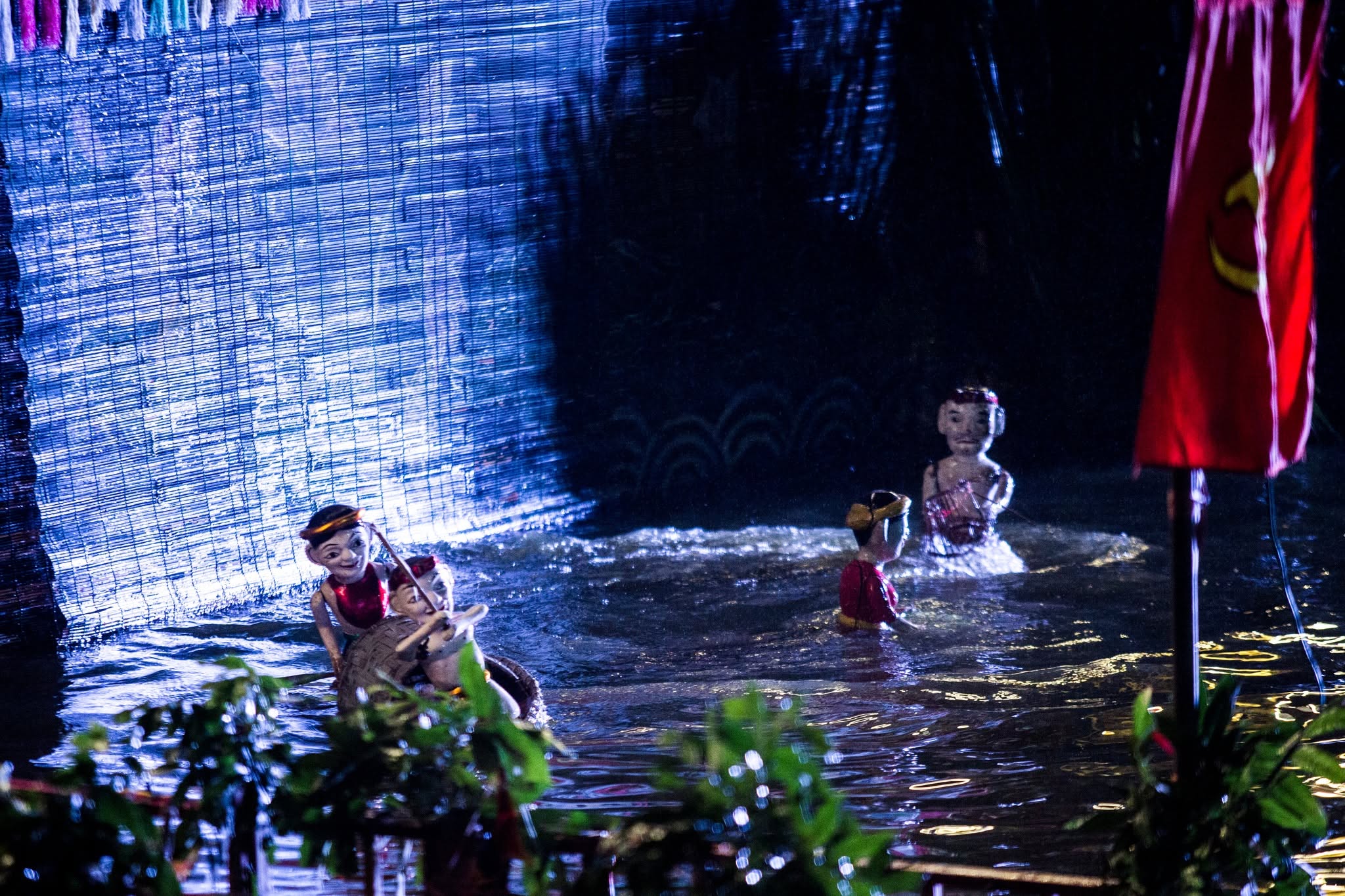
Rach Village Water Puppetry, also known as the Nam Chan Traditional Water Puppetry Troupe, is one of the distinctive folk performing traditions of Vietnam’s Red River Delta. Located in Hong Quang Ward, Ninh Binh Province, formerly part of Nam Dinh Province, Rach Village is renowned for its traditional wooden puppets, elaborate underwater control mechanisms, and performances depicting the agricultural life, customs, and spiritual beliefs of Vietnamese rural communities.
For generations, water puppetry has been an important part of Rach Village’s cultural identity. Its performances bring together traditional music, woodcarving, mechanical craftsmanship, and storytelling to create a theatrical experience unlike conventional stage performances.
The art is performed on water, where brightly decorated wooden puppets appear to move independently, guided by skilled puppeteers concealed behind a traditional pavilion. Their movements recreate familiar scenes from village life, including buffalo fighting, swinging, dragon dances, folk games, and representations of traditional beliefs.
According to local historical accounts, the Nam Chan Water Puppetry Troupe was established in 1755, traditionally attributed to the initiative of Mai Van Kha. Other accounts describe the village’s water puppetry tradition as having a history of more than 500 years. These different dates may reflect a distinction between the earlier development of puppetry within the community and the formal establishment of the troupe, although further historical research would be needed to clarify the chronology.
Despite social and cultural changes, Rach Village has preserved a rich repertoire of traditional performances and specialized techniques for creating and manipulating puppets. Local accounts indicate that the troupe has maintained more than 40 traditional acts, making it an important center for the continuation of Vietnamese folk puppetry.
Today, Rach Village Water Puppetry represents both a valuable cultural tradition and a potential attraction for visitors interested in Vietnam’s performing arts, traditional craftsmanship, and rural heritage.
History and Development of the Nam Chan Traditional Water Puppetry Troupe
Water puppetry is a traditional Vietnamese performing art closely associated with the country’s wet-rice agricultural civilization.
In the villages of the Red River Delta, ponds, lakes, and other bodies of water historically provided natural settings for community celebrations, folk games, and theatrical performances.
Water puppetry developed within this cultural environment, combining the familiar landscape of rural Vietnam with artistic storytelling and technical ingenuity.
Rach Village is among the communities known for preserving this longstanding tradition.
The art has been passed down through generations and remains closely connected to local festivals, cultural gatherings, and the collective memory of the village.
The Origins of the Nam Chan Water Puppetry Troupe
According to traditional accounts, the Nam Chan Water Puppetry Troupe was established in 1755, with its foundation attributed to Mai Van Kha.
The name Nam Chan became associated with the organized activities of the troupe and remains an important part of the identity of Rach Village’s water puppetry tradition.
Some local historical descriptions suggest that water puppetry in the village may have existed for more than 500 years.
However, it is important to distinguish between the possible origins of puppetry practices within the community and the documented or traditionally recognized date of the troupe’s establishment.
These accounts indicate the considerable historical depth of the tradition, but they do not establish a single definitive founding date for every aspect of its development.
As the troupe became more organized, water puppetry evolved into an important community activity.
Its members were responsible not only for performing but also for carving puppets, preparing the stage, maintaining equipment, and teaching specialized techniques to younger generations.
A Tradition Rooted in Rural Community Life
Unlike modern theatrical productions, traditional water puppetry originally developed as part of village cultural life.
Performances were often associated with festivals, communal celebrations, and periods when agricultural work was less demanding.
The subjects of the performances reflected the everyday experiences of rural communities.
Scenes involving buffaloes, village games, farming activities, mythical creatures, and religious imagery offered both entertainment and a way of expressing shared cultural values.
Humor, movement, music, and recognizable characters made these performances accessible to audiences of different ages.
During periods of prosperity, the Nam Chan troupe became known beyond its home village.
Local accounts describe Rach Village puppeteers traveling to perform at festivals and cultural events in various parts of northern Vietnam.
Such activities helped introduce the village’s puppetry tradition to wider audiences and strengthened its reputation as a center of traditional performing arts.
Passing Down Performance Skills
The survival of Rach Village Water Puppetry has depended heavily on the transmission of practical knowledge between generations.
Experienced puppeteers teach younger members how to operate underwater mechanisms, coordinate puppet movements, and perform individual acts.
The training process requires considerable patience because the performers must develop a precise understanding of the relationship between physical movement, mechanical controls, and the rhythm of the accompanying music.
In addition to performance skills, members of the troupe may learn how to carve wooden puppets, repair mechanical components, prepare costumes, and maintain traditional stage equipment.
This combination of artistic and technical knowledge has enabled the troupe to preserve distinctive performance methods despite changes in society.
The continued existence of the Nam Chan troupe demonstrates the essential role of local communities in maintaining traditional performing arts.
Traditional Performances, Water Stages, and Musical Accompaniment
One of the most remarkable features of Rach Village Water Puppetry is the combination of a water-based stage, concealed puppet-control mechanisms, traditional music, and stories drawn from Vietnamese folk culture.
Unlike conventional theater, where actors appear directly before the audience, water puppetry uses carved wooden figures as its principal performers.
The puppeteers remain hidden behind the stage, operating the figures through rods, strings, and other mechanical devices positioned beneath the water.
Through carefully coordinated movements, the puppets appear to walk, dance, bow, interact, and perform complex actions across the water’s surface.
The Water Pavilion and Traditional Village Pond
According to descriptions of the village’s traditional performance space, Rach Village has used a pond covering more than 2,000 square meters as a setting for water puppetry.
A traditional water pavilion, known in Vietnamese as a thuy dinh, serves as the central performance structure.
The pavilion typically incorporates architectural features associated with traditional Vietnamese communal buildings, creating a setting that is both visually distinctive and closely connected to village cultural life.
The open water in front of the pavilion functions as the performance stage.
Behind a curtain or concealed section of the structure, puppeteers operate the figures while remaining out of sight.
Water plays several essential roles in the performance.
It provides the surface on which the puppets move, conceals the mechanical controls, and creates visual effects through ripples and reflections.
As the puppets move, the water enhances their apparent liveliness and adds a dynamic element to the theatrical experience.
This unusual stage arrangement is one of the defining characteristics of Vietnamese water puppetry.
A Repertoire of More Than 40 Traditional Acts
One of the cultural strengths of the Nam Chan troupe is its extensive repertoire of traditional performances.
According to local accounts, more than 40 traditional acts have been preserved, reflecting different aspects of Vietnamese rural life, folk entertainment, and spiritual traditions.
Among the frequently mentioned performances are buffalo fighting, traditional swinging, fire-breathing dragons, and the figure of Co Doi Thuong Ngan.
Buffalo Fighting
Buffalo fighting recreates a scene involving two buffaloes confronting each other on the water.
The performance draws upon the buffalo’s longstanding significance in Vietnamese agricultural culture, where the animal has traditionally been associated with farming and rural livelihoods.
To portray the interaction convincingly, puppeteers must coordinate the movement and timing of the wooden figures.
Traditional Swinging
The swinging performance reflects a familiar village festival activity.
Puppets move back and forth in a manner that recreates the festive atmosphere of traditional folk games.
The rhythmic motion and playful subject matter make this type of performance particularly accessible to audiences.
Fire-Breathing Dragons
Dragon performances are among the visually striking elements of Vietnamese water puppetry.
The dragon is a prominent symbol in Vietnamese traditional culture, often associated with power, sacredness, and auspicious meanings.
A fire-breathing dragon act combines the mythical figure with theatrical movement and special effects, creating an energetic spectacle on the water.
Co Doi Thuong Ngan
Performances featuring Co Doi Thuong Ngan introduce elements of Vietnamese folk spirituality into the puppet theater.
The figure is associated with traditional religious beliefs, and her presence within the repertoire illustrates the relationship between water puppetry and the broader cultural and spiritual life of the community.
Alongside these representative acts, traditional water puppetry may include scenes of agricultural work, rural celebrations, animal characters, and humorous interactions.
Together, these performances create a diverse theatrical repertoire that preserves elements of everyday life and cultural memory.
Underwater Puppet Manipulation Techniques
The movements of water puppets are controlled through specialized mechanisms designed for operation beneath the water’s surface.
Depending on the puppet’s structure and intended actions, the mechanisms may include long rods, pulling strings, and articulated components.
The puppeteers generally stand in water behind the stage, using the concealed controls to move the figures.
Successful manipulation requires precise control of force, direction, speed, and timing.
Movements that are too strong or poorly coordinated can disrupt the puppet’s balance or prevent it from performing the intended action.
For scenes involving several characters, performers must work together to maintain a continuous and convincing sequence.
The coordination becomes even more demanding when the movements must correspond closely with the musical accompaniment.
Through years of practice, skilled puppeteers learn to make wooden figures appear expressive and independent, giving the audience the impression that the characters possess personalities of their own.
The Role of Traditional Music
Music is an essential component of Rach Village Water Puppetry.
Traditional instruments such as drums, gongs, bamboo flutes, and the dan nhi, a Vietnamese two-stringed bowed instrument, provide rhythm, atmosphere, and dramatic emphasis.
Drums frequently establish the pace of a performance and highlight important movements or changes in the action.
Flutes and string instruments can create contrasting moods, from playful and energetic to gentle or ceremonial.
The relationship between music and puppet movement is central to the overall performance.
When the rhythm of the instruments matches the movement of the figures, the stories become more expressive and engaging.
This combination of music, movement, and storytelling gives water puppetry its distinctive theatrical character.
Wooden Puppet Making and the Cultural Heritage of the Nam Chan Troupe
A notable feature of Rach Village’s puppetry tradition is the close relationship between performance and puppet making.
Local artisans are known not only for manipulating puppets but also for creating the wooden figures and mechanical structures used in their performances.
The craft requires knowledge of woodcarving, sculpture, painting, materials, and mechanical design.
Each puppet must satisfy two important requirements: it must represent its intended character convincingly and function reliably in water.
Fig Wood and Traditional Puppet Carving
Traditional water puppets in Rach Village are commonly made from fig wood, known locally as go sung.
This wood is relatively lightweight and suitable for carving, making it useful for puppet construction when properly prepared and treated.
The production process begins with selecting an appropriate piece of wood and determining the puppet’s overall form.
The artisan then outlines the character, establishes its dimensions, and carves the main components.
Depending on the performance, the figure may represent a human character, a domestic animal, a mythical creature, or a figure associated with folk beliefs.
For human puppets, particular attention is given to facial features, clothing, posture, and expression.
Animal puppets require recognizable shapes and carefully designed structures that allow them to perform the intended movements.
Once the carving is completed, the wooden components are dried or otherwise prepared and smoothed before decoration begins.
Painting, Decoration, and Finishing
Color plays an important role in making water puppets visually expressive.
After carving, the surface is prepared and painted using colors suited to the character and its role in the performance.
Facial details, clothing patterns, and ornamental features are emphasized so that audiences can recognize the characters from a distance.
Some puppets may incorporate traditional decorative methods, including silver leaf application or other finishing techniques.
In addition to their appearance, puppets must be prepared for repeated exposure to water.
Protective surface treatments and appropriate construction methods help maintain their condition during performances.
Puppets with complex movements also require mechanical assembly and testing.
Artisans must ensure that moving parts function correctly and that the puppet maintains an appropriate balance on the water.
Only after the artistic and mechanical requirements have been satisfied is the figure ready for use on stage.
The Relationship Between Sculpture and Performance
A water puppet is more than a carved wooden ornament.
It is a specialized theatrical object designed to move, interact, and communicate through performance.
Unlike a stationary sculpture, a puppet must be constructed with its movement in mind.
The artisan therefore needs to understand the character’s role, the sequence of actions, and the mechanical requirements of the performance.
This relationship between carving and puppetry creates a distinctive form of craftsmanship in which artistic design and practical engineering are closely connected.
According to descriptions of the village’s craft tradition, some Rach Village artisans have also produced puppets for professional puppet theaters in Vietnam.
This reflects the broader relevance of their specialized skills beyond the village itself.
The Cultural Significance of Rach Village Water Puppetry
Rach Village Water Puppetry embodies several interconnected cultural values.
First, it reflects the natural and agricultural environment of the Red River Delta.
The use of water as a stage demonstrates the close relationship between rural communities and the rivers, ponds, and flooded landscapes of Vietnam’s wet-rice civilization.
Second, its performances preserve elements of traditional social life.
Scenes of agricultural work, village celebrations, folk games, and spiritual practices provide insight into the cultural experiences of earlier generations.
Third, water puppetry combines several artistic disciplines.
Wood sculpture, decorative painting, traditional music, mechanical craftsmanship, and theatrical performance come together to create a unified artistic form.
Finally, the continuation of the Nam Chan troupe demonstrates the importance of community participation in cultural preservation.
Its members are performers, artisans, teachers, and custodians of inherited knowledge.
Their activities help ensure that the tradition remains a living practice rather than merely a subject of historical memory.
Experiencing Rach Village Water Puppetry and Preserving a Living Tradition
For travelers interested in Vietnamese culture, Rach Village Water Puppetry offers an opportunity to discover a traditional performing art closely associated with the rural heritage of northern Vietnam.
Its distinctive combination of wooden puppets, water-based staging, traditional music, and folk storytelling creates an experience different from conventional theater.
Through the performances, audiences can explore elements of Vietnamese agricultural life, traditional festivals, and community beliefs.
Watching Traditional Water Puppet Performances
During festivals or cultural events featuring the Nam Chan troupe, visitors may have opportunities to watch traditional puppet performances.
Acts involving buffaloes, village games, dragons, and other familiar characters often create a lively and engaging atmosphere.
The movements of the puppets, combined with the rhythm of traditional instruments, transform the water stage into a setting for folk stories and visual entertainment.
Beyond their entertainment value, the performances introduce audiences to traditional customs, rural activities, and symbolic imagery.
For international visitors, water puppetry is particularly interesting because much of its storytelling is communicated through movement, music, and visual expression.
Even without understanding every spoken or sung element, audiences can appreciate the artistry and technical skill involved.
Learning About Puppet Making and Manipulation
In addition to performances, demonstrations of puppet making and manipulation offer potential opportunities for cultural education and experiential tourism.
When suitable programs are organized, visitors may learn about the selection of wood, the carving of characters, decorative painting, and the construction of underwater control mechanisms.
Observing the production process helps explain how a simple piece of wood is transformed into a functioning theatrical character.
Demonstrations of puppet manipulation may also introduce visitors to the principles behind rods, strings, and articulated mechanisms.
Such activities can deepen appreciation for the technical complexity of water puppetry and the skills required to perform it.
However, performance schedules and visitor experiences depend on the troupe’s activities and the arrangements of event organizers.
Travelers should contact the relevant local organizers in advance to confirm performance dates, venues, and opportunities for participation.
Preserving Traditional Acts and Performance Techniques
An important priority for preserving Rach Village Water Puppetry is maintaining its traditional repertoire.
Each act involves more than a storyline.
It also includes particular puppet designs, movement techniques, musical arrangements, and methods of coordination among performers.
If an act is no longer performed regularly, the specialized knowledge required to present it may gradually disappear.
Documenting performances through written records, photographs, and audiovisual materials can therefore support preservation efforts.
The restoration and continued performance of traditional acts are equally important.
Training younger puppeteers is essential for maintaining the continuity of the art.
Learners need to understand not only how to operate the mechanisms but also the cultural meanings of the characters, the structure of individual performances, and the relationship between movement and music.
Puppet-making knowledge also requires preservation.
Traditional carving methods, decorative techniques, and mechanical designs are often learned through direct experience and may be difficult to reconstruct if they are no longer practiced.
Developing Cultural Tourism Responsibly
As interest in cultural tourism continues to grow, Rach Village Water Puppetry has opportunities to reach broader audiences through performances, educational activities, and carefully designed visitor experiences.
Potential programs could combine traditional acts with introductions to the history of the Nam Chan troupe, puppet-making demonstrations, and opportunities to meet local artisans.
These activities could help younger audiences and international travelers understand the cultural significance of water puppetry.
The art may also be introduced through school programs, community festivals, cultural exhibitions, and heritage events.
Such initiatives can provide additional opportunities for performance while strengthening public awareness of traditional Vietnamese arts.
However, tourism development should maintain a balance between accessibility and cultural authenticity.
Traditional acts with historical or spiritual significance should be presented with appropriate explanations and respect for their original cultural contexts.
The aim should be to support the continued practice of the art rather than reduce it to a simplified attraction.
The Future of Rach Village Water Puppetry
The long-term preservation of Rach Village Water Puppetry depends on the continued involvement of the local community.
Supporting performers, encouraging younger generations to learn the craft, and maintaining opportunities for regular performances are important for the survival of the tradition.
At the same time, preserving puppet-making skills and documenting traditional acts can help protect knowledge that has been accumulated over generations.
Cultural tourism, education, and public performances may provide additional opportunities to introduce the art to new audiences.
When developed responsibly, these activities can strengthen the connection between heritage preservation and local cultural life.
By maintaining its traditional repertoire while adapting to contemporary conditions, the Nam Chan troupe can continue to represent the creativity and cultural identity of Rach Village.
Rach Village Water Puppetry, also known as the Nam Chan Traditional Water Puppetry Troupe, is a remarkable example of Vietnam’s folk performing heritage. With its longstanding history, repertoire of more than 40 traditional acts, and specialized techniques in wooden puppet making and underwater manipulation, the tradition offers a vivid reflection of rural life, cultural customs, and spiritual beliefs in the Red River Delta. The colorful figures moving across the water are more than theatrical entertainment: they embody generations of artistic knowledge and community memory. Preserving and promoting Rach Village Water Puppetry contributes to the continuity of a distinctive Vietnamese performing art while enriching the cultural landscape and tourism appeal of Ninh Binh Province.
Quick Information
| Item | Details |
|---|---|
| Heritage name | Rach Village Water Puppetry |
| Vietnamese name | Múa rối nước làng Rạch |
| Alternative name | Nam Chan Traditional Water Puppetry Troupe |
| Current location | Hong Quang Ward, Ninh Binh Province, Vietnam |
| Province before the 2025 administrative reorganization | Nam Dinh Province |
| Heritage type | Traditional folk performing art |
| Main artistic tradition | Vietnamese water puppetry |
| Traditionally reported troupe establishment | 1755 |
| Traditionally attributed founder | Mai Van Kha |
| Historical background | Some local accounts describe a tradition exceeding 500 years; this differs from the troupe’s reported establishment date |
| Traditional repertoire | More than 40 acts, according to local accounts |
| Representative performances | Buffalo fighting, traditional swinging, fire-breathing dragons, and Co Doi Thuong Ngan |
| Traditional performance setting | Village pond and water pavilion |
| Reported pond area | More than 2,000 square meters |
| Traditional puppet material | Fig wood (go sung) |
| Puppet-making techniques | Carving, drying, smoothing, painting, decoration, and mechanical assembly |
| Puppet manipulation | Underwater rods, strings, and specialized mechanisms |
| Traditional musical instruments | Drums, gongs, bamboo flutes, and dan nhi |
| Performance themes | Agricultural life, village customs, folk games, and spiritual traditions |
| Cultural significance | Traditional performing arts, puppet-making knowledge, and community heritage |
| Potential visitor experiences | Watching performances, learning about puppet making, and exploring manipulation techniques |
| Performance schedule | Depends on festivals and actual event arrangements |
| Visitor advice | Contact local organizers in advance to confirm performances and activities |
| Preservation priorities | Skills transmission, traditional repertoire documentation, puppet-making techniques, and cultural tourism |







