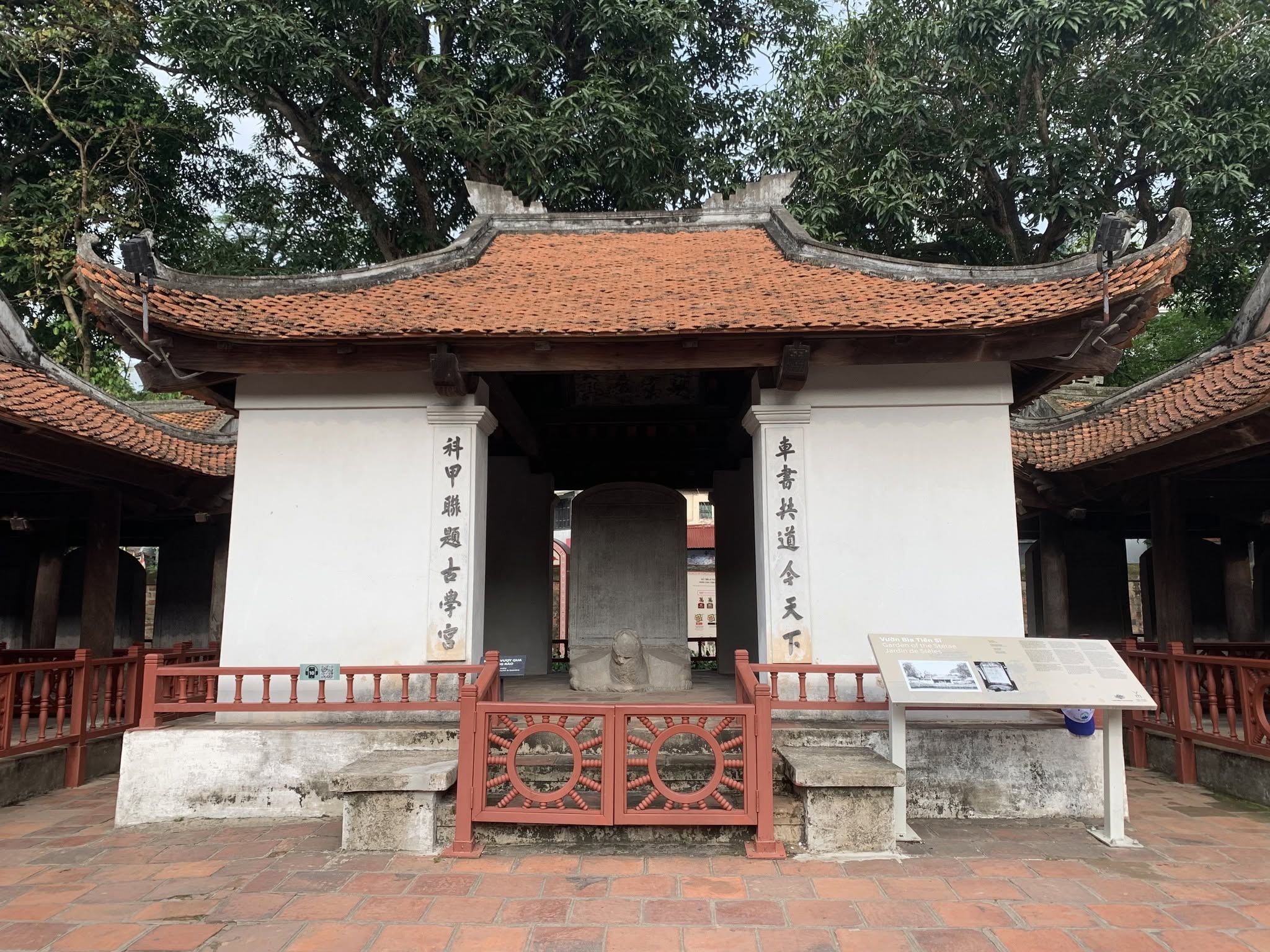
The Stone Steles of Doctoral Laureates at the Temple of Literature represent one of Vietnam’s most remarkable cultural and educational treasures. Preserving the names, hometowns, and academic achievements of scholars who passed the highest-level Confucian examinations between 1442 and 1779, the collection provides an exceptional record of Vietnam’s imperial examination system and its longstanding respect for education and intellectual achievement.
Located within the historic Temple of Literature – Imperial Academy (Van Mieu – Quoc Tu Giam) in Hanoi, the collection consists of 82 stone steles mounted on the backs of carved stone turtles. The tradition of erecting these monuments began in 1484 under Emperor Le Thanh Tong, one of the most influential rulers in the development of Vietnam’s Confucian educational system.
Each stele is an original historical document engraved in classical Chinese. In addition to recording examination results and identifying successful candidates, the inscriptions express the imperial court’s views on education, moral responsibility, good governance, and the importance of cultivating talented individuals.
The collection is particularly significant because it combines documentary heritage with exceptional stone-carving artistry. Its inscriptions preserve historical and educational philosophy, while the turtle sculptures, decorative motifs, and calligraphy reflect the evolution of Vietnamese artistic traditions over several centuries.
In 2010, the 82 doctoral steles were inscribed on the UNESCO Memory of the World Asia-Pacific Regional Register. In 2011, the collection received international recognition through inscription on the Memory of the World International Register. In 2015, the steles were also recognized as a National Treasure of Vietnam.
These distinctions acknowledge the collection’s outstanding contribution to the preservation of Vietnam’s educational history, scholarly traditions, and cultural memory.
The Temple of Literature – Imperial Academy and the Origins of Confucian Education in Vietnam
The Temple of Literature – Imperial Academy stands to the south of the former Thang Long Imperial Citadel, within Hanoi’s historic cultural landscape.
In earlier periods, the area belonged to Minh Giam Hamlet, Huu Nghiem Canton, Tho Xuong District. During the French colonial period, administrative changes associated the surrounding area with Thinh Hao Village, Yen Ha Canton, Hoan Long District, Ha Dong Province.
Today, the complex is located on Quoc Tu Giam Street in central Hanoi and remains one of Vietnam’s most important historical sites associated with education, scholarship, and Confucian traditions.
Its history dates to the Ly Dynasty, when the Vietnamese state began establishing formal institutions for Confucian learning.
In 1070, Emperor Ly Thanh Tong ordered the construction of the Temple of Literature to honor Confucius, the Duke of Zhou, the Four Correlates, and other revered Confucian scholars.
The temple also became associated with the education of the crown prince and with ceremonies demonstrating the imperial court’s respect for scholarship and moral learning.
In 1076, during the reign of Emperor Ly Nhan Tong, the Imperial Academy (Quoc Tu Giam) was established as an important educational institution of the Vietnamese monarchy.
Initially, its educational activities primarily served members of the royal family and aristocracy. Over time, opportunities expanded to include other talented students, reflecting the growing importance of education and examinations in selecting officials.
During the Tran Dynasty, the institution underwent further development. In 1253, it was reorganized under the name Quoc Tu Vien, strengthening its role in training scholars and officials.
Under the Early Le Dynasty, particularly during the reign of Emperor Le Thanh Tong, Confucian education and the imperial examination system entered a period of substantial growth.
In 1483, the court undertook construction and expansion projects associated with the academy, including facilities for scholarly instruction and educational administration.
Teaching, examinations, and the recognition of successful candidates became increasingly systematic.
For centuries, the Temple of Literature – Imperial Academy served both as a place of worship honoring Confucian sages and as an important center for educating scholars who would contribute to the administration of the country.
Its architecture, ceremonies, educational activities, and doctoral steles collectively express the Vietnamese traditions of respect for teachers, dedication to learning, and appreciation of talented individuals.
When the Nguyen Dynasty established its imperial capital in Hue, the educational role of the academy in Thang Long changed.
Nevertheless, the Temple of Literature in Hanoi continued to function as a significant cultural and ceremonial site associated with Confucian scholarship.
Despite historical changes, the complex has remained an enduring symbol of the intellectual and educational heritage of Thang Long – Hanoi.
The Establishment and Historical Scope of the 82 Doctoral Steles
The tradition of erecting doctoral steles at the Temple of Literature was initiated during the reign of Emperor Le Thanh Tong (1460–1497), a ruler widely associated with major developments in Vietnamese education and imperial examinations.
In 1484, the emperor ordered stone steles to be erected to commemorate scholars who had successfully passed the highest-level examinations, beginning retrospectively with examinations held in 1442.
The examination of 1442 took place during the reign of Emperor Le Thai Tong and marked an important stage in the organization of doctoral examinations under the Early Le Dynasty.
The decision to erect the steles was intended not merely to honor successful candidates but also to express the imperial court’s belief in the importance of education, moral integrity, and talented individuals for the prosperity of the state.
Additional steles were erected during subsequent periods under the Early Le, Mac, and Restored Le dynasties.
Today, 82 stone steles survive at the Temple of Literature – Imperial Academy, recording the results of 82 doctoral examinations conducted between 1442 and 1779.
According to commonly published figures, the inscriptions commemorate 1,304 doctoral laureates, representing different ranks within the imperial examination system.
These included scholars who achieved distinctions such as Trang Nguyen, Bang Nhan, Tham Hoa, Hoang Giap, and other doctoral ranks.
The earliest surviving stele was erected in 1484 to commemorate the examination of 1442.
This monument is especially famous for its inscription composed by the scholar Than Nhan Trung, which emphasizes the importance of talented and virtuous individuals to the strength of a nation.
The latest stele was erected in 1780, commemorating the examination of 1779, during the Restored Le period.
The collection therefore documents nearly 340 years of examination history, while the construction of the monuments themselves extended across almost three centuries.
The 82 steles are arranged symmetrically on both sides of Thien Quang Well, an important architectural feature of the Temple of Literature complex.
There are 41 steles on each side, protected within traditional stele houses that form a dignified and harmonious architectural setting.
This arrangement supports their preservation while creating a distinctive cultural landscape dedicated to scholarship and intellectual achievement.
Based on their dates of construction and artistic characteristics, the steles are generally divided into three principal groups.
The first group consists of 14 steles erected between 1484 and 1536, reflecting stone-carving traditions of the Early Le period and the early 16th century.
The second group includes 25 steles erected in 1653 during the Restored Le Dynasty. These are particularly admired for their elaborate decorative motifs and expressive turtle sculptures.
The third group comprises 43 steles erected between 1717 and 1780, illustrating the continuation and transformation of Vietnamese stone-carving traditions during the 18th century.
Although all the steles share the purpose of commemorating successful scholars, each possesses distinctive features in its dimensions, layout, turtle sculpture, calligraphy, and decorative carving.
This diversity is one of the collection’s most remarkable artistic qualities.
The Inscriptions and the Philosophy That Talent Is the Nation’s Vital Energy
One of the most important features of the doctoral steles is the content of their inscriptions, written in classical Chinese.
Unlike monuments that merely record names or commemorate isolated events, the steles at the Temple of Literature contain substantial essays combining historical documentation, political philosophy, and educational thought.
These texts were composed by respected court officials, scholars, and Confucian intellectuals, expressing the imperial court’s views on the selection, education, and responsibilities of talented individuals.
A typical inscription contains three principal sections.
The introductory section describes the historical context, the reasons for holding the examination, the educational policies of the court, and the importance of cultivating capable and virtuous scholars.
The main section records information about the examination, including the successful candidates, their academic rankings, hometowns, and relevant examination details.
The concluding section may identify the date of the stele’s erection, the author of the inscription, the calligrapher, and other individuals involved in producing the monument.
Together, these records provide valuable evidence of how imperial examinations were organized, from the selection and assessment of candidates to the announcement of results and public recognition of academic achievement.
Among the inscriptions, the most celebrated is the essay written by Than Nhan Trung in 1484 for the examination of 1442.
Its most famous statement declares:
“Talented and virtuous individuals are the vital energy of a nation. When this vital energy flourishes, the nation grows strong and prospers; when it declines, the nation weakens and falls.”
This principle reflects the profound understanding of Early Le scholars and rulers concerning the relationship between human talent and national development.
According to the philosophy expressed in the inscription, a prosperous nation must cultivate individuals possessing knowledge, moral character, and ability, while ensuring that their talents are used responsibly in public service.
The erection of doctoral steles was therefore more than a ceremonial reward.
It encouraged younger generations to pursue learning and reminded successful scholars that academic distinction carried obligations to society and the state.
Having one’s name engraved in stone brought honor to the individual, family, lineage, and hometown, but it also symbolized a lasting responsibility to uphold integrity and contribute to the common good.
Many inscriptions emphasize the relationship between intellectual ability, ethical conduct, education, and good governance.
Scholars were expected not only to excel in examinations but also to apply their knowledge to public administration, social stability, and the welfare of the population.
These principles illustrate important values in Vietnam’s educational traditions, particularly the belief that learning should be accompanied by moral cultivation.
Centuries later, the philosophy of recognizing and developing talent remains relevant to discussions of education, intellectual responsibility, and national progress.
An Exceptional Historical Source on Imperial Examinations, Scholars, and Vietnamese Society
The 82 doctoral steles constitute an exceptionally valuable collection of original documents for studying the history of Vietnamese education from the 15th to the 18th centuries.
Each stele records the results of a particular examination, providing information about dates, successful candidates, their hometowns, and aspects of the examination process.
These details can be compared with official chronicles, family genealogies, geographical records, and other Han-Nom documents.
Historical works such as Dai Viet Su Ky Toan Thu (Complete Annals of Dai Viet), Kham Dinh Viet Su Thong Giam Cuong Muc (Imperially Commissioned Annotated Text of the Complete Mirror of Vietnamese History), and Lich Trieu Hien Chuong Loai Chi (Categorized Records of the Institutions of Successive Dynasties) provide broader accounts of political, social, and educational history.
The doctoral steles, meanwhile, preserve information directly connected with individual examinations and the scholars who participated in the Confucian educational system.
Combining these sources allows researchers to develop a more comprehensive understanding of education, official recruitment, and intellectual life in imperial Vietnam.
The collection is also valuable for researching the origins, careers, and social networks of distinguished Vietnamese scholars.
Figures such as Luong The Vinh and Le Quy Don, together with many other doctoral laureates, are associated with the country’s traditions of scholarship, literature, science, and public administration.
Not every prominent historical scholar or examination figure is necessarily named on the surviving 82 steles. Identifying a particular individual requires reference to the relevant examination year and inscription.
A particularly interesting aspect of the collection is its connection with diplomatic history.
Many scholars whose names appear on the steles later served as officials or participated in diplomatic missions to China.
Some historical studies have identified approximately 225 individuals named on the steles who were associated with diplomatic missions, demonstrating the relationship between the examination system and the selection of officials for international affairs.
Scholars such as Nguyen Nhu Do and Le Quy Don illustrate the important role of educated officials in diplomatic relations and cultural exchanges between Vietnam and neighboring countries.
The steles therefore have significance beyond the history of education within Vietnam.
They also contribute to research on diplomacy, intellectual networks, and cultural interaction in East Asia.
From a social history perspective, the inscriptions provide information about the geographical distribution of successful scholars, the emergence of regional centers of learning, and the role of families and lineages with strong educational traditions.
By examining hometowns and examination dates, researchers can identify areas that produced significant numbers of scholars during different historical periods.
The essays also reveal changes in educational policies, political thought, and examination practices across successive dynasties.
This combination of biographical information, historical data, and educational philosophy gives the collection its exceptional documentary value.
Stone Turtle Sculptures, Calligraphy, and the Artistic Heritage of the Stele Garden
Beyond their historical and educational significance, the 82 doctoral steles form an outstanding collection of Vietnamese stone-carving art.
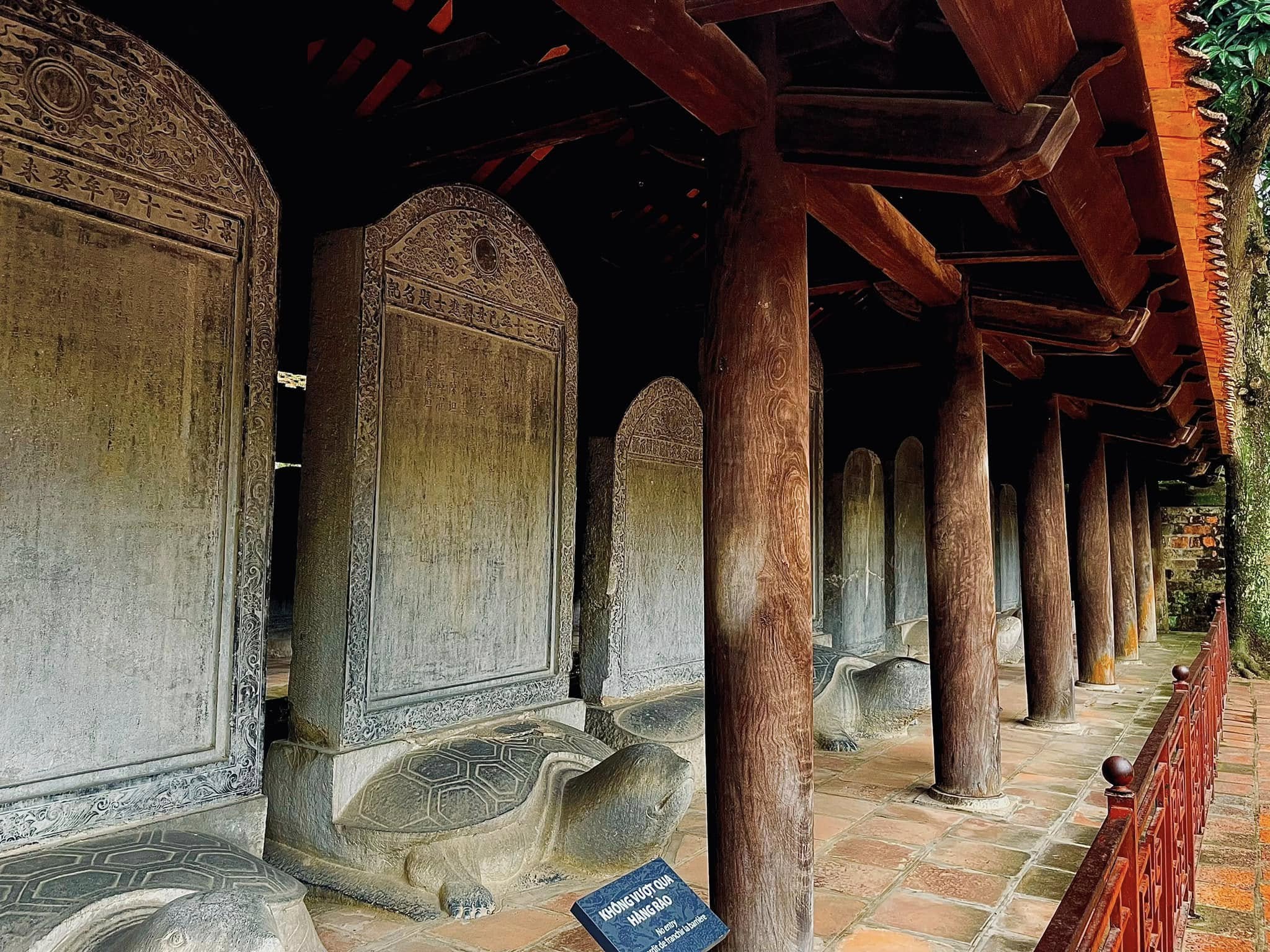
Each stele consists of an engraved stone slab supported by a carved stone turtle, creating a distinctive combination of documentary monument and symbolic sculpture.
In Vietnamese traditional culture, the turtle is associated with longevity, endurance, stability, and wisdom.
The image of a turtle supporting a stele symbolizes the enduring reputation of accomplished scholars and the lasting importance of education and intellectual achievement.
A typical doctoral stele comprises three main elements: the turtle base, the inscribed body, and the decorative upper section.
The turtle base varies in appearance across different periods.
Some turtles have broad, sturdy bodies and raised heads, while others feature softer contours and more expressive details.
Changes in their proportions, facial features, and carving techniques reflect the artistic preferences of successive generations of craftsmen.
The body of the stele contains the main inscription.
Its surface was carefully prepared to accommodate rows of classical Chinese characters, arranged with attention to clarity, balance, and proportion.
The calligraphy provides valuable evidence for studying historical writing styles and the techniques used to engrave Chinese characters on stone in Vietnam.
The upper section and borders are frequently decorated with symbolic motifs, including dragons, clouds, lotus flowers, chrysanthemums, phoenixes, and geometric patterns.
These ornaments contribute to the monuments’ visual character while reflecting the relationship between courtly artistic traditions and broader Vietnamese decorative culture.
Among the three chronological groups, the steles erected in 1653 are often particularly admired for their artistic qualities.
Their upper sections and borders display rich decorative compositions, lively carving, and considerable creativity.
The turtle sculptures in this group sometimes employ simplified forms while retaining a strong sense of balance, movement, and expression.
Variations in the shapes, proportions, and ornamentation of the steles enable art historians to trace developments in Vietnamese stone sculpture from the 15th to the 18th centuries.
The inscriptions also preserve dated examples of classical Chinese calligraphy, providing important material for research into historical writing styles and the presentation of texts on stone.
The arrangement of the 82 steles on both sides of Thien Quang Well creates a distinctive architectural ensemble.
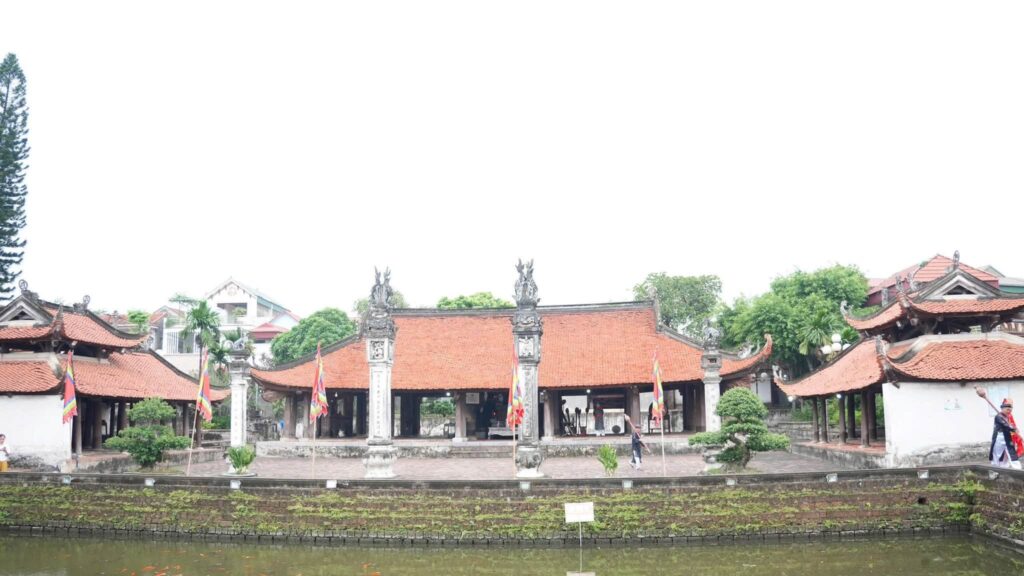
Traditional tiled roofs, wooden columns, stone monuments, and landscaped courtyards contribute to an atmosphere of dignity and reflection.
The stele garden is therefore both a protected historical collection and a cultural space that expresses the importance of education in Vietnamese society.
UNESCO Recognition and the Continuing Relevance of the Doctoral Steles
In recognition of their outstanding historical, educational, cultural, calligraphic, and artistic values, the 82 doctoral steles at the Temple of Literature – Imperial Academy were inscribed under UNESCO’s Memory of the World Programme.
In 2010, the collection was entered into the Memory of the World Asia-Pacific Regional Register.
In 2011, the steles were subsequently inscribed on the Memory of the World International Register.
International recognition acknowledged the collection as an exceptional body of original documentary evidence relating to Vietnam’s educational history, imperial examinations, and political philosophy.
In 2015, the Prime Minister of Vietnam recognized the 82 doctoral steles as a National Treasure, further affirming their importance within the country’s cultural heritage.
What makes these monuments particularly distinctive is that they do more than preserve the names of successful examination candidates.
They also communicate ideas about education, moral responsibility, the selection of officials, and the relationship between intellectual achievement and national development.
Through their inscriptions, later generations can understand how Vietnamese rulers and scholars evaluated talent, organized examinations, and emphasized the ethical responsibilities of educated officials.
The collection therefore possesses significance far beyond its physical form as a group of historical monuments.
For researchers, the steles provide evidence for studying imperial examinations, regional history, genealogy, historical figures, calligraphy, and stone-carving traditions.
For students and the wider public, they offer a tangible connection to Vietnam’s longstanding respect for learning, teachers, and intellectual accomplishment.
Within Hanoi’s cultural life, the Temple of Literature – Imperial Academy remains an important destination for historical education and cultural exploration.
Many students visit the complex before important examinations to learn about its scholarly traditions, pay respect to distinguished intellectuals, and seek inspiration from the achievements of earlier generations.
However, the protection of the original monuments must remain a priority.
Touching or rubbing the turtle sculptures and engraved stone surfaces can gradually damage their details, particularly after centuries of exposure and preservation challenges.
Visitors are therefore encouraged to follow conservation regulations, appreciate the monuments visually, and use interpretive materials rather than making physical contact with the original artifacts.
Alongside conservation, digitization, transcription, translation, and multilingual interpretation can make the inscriptions more accessible to Vietnamese and international audiences.
Educational programmes, thematic exhibitions, and historical research can also help younger generations understand the ideas preserved in these centuries-old texts.
From the classical Chinese inscriptions to the enduring symbolism of the stone turtles, the doctoral steles communicate a central principle of Vietnamese intellectual history: knowledge and talented individuals are essential foundations of a prosperous nation.
Nearly six centuries after the first steles were erected, the collection remains a powerful symbol of Vietnam’s respect for education, appreciation of intellectual achievement, and enduring commitment to cultivating talent.
Quick Information
| Item | Details |
|---|---|
| Heritage name | Stone Steles of Doctoral Laureates at the Temple of Literature |
| Vietnamese name | Bia đề danh Tiến sĩ tại Văn Miếu – Quốc Tử Giám |
| Location | Temple of Literature – Imperial Academy, Hanoi, Vietnam |
| Address | Quoc Tu Giam Street, Hanoi |
| Heritage type | Documentary heritage; engraved stone inscriptions |
| Number of steles | 82 |
| Number of examinations recorded | 82 |
| Number of doctoral laureates commemorated | 1,304, according to commonly published figures |
| Examination period | 1442–1779 |
| Period of stele construction | 1484–1780 |
| Initiating ruler | Emperor Le Thanh Tong |
| Associated dynasties | Early Le, Mac, and Restored Le |
| Writing system | Classical Chinese |
| Material | Stone |
| Distinctive features | Inscribed stone slabs supported by carved stone turtles |
| Outstanding values | Educational history, imperial examinations, philosophy of talent cultivation, calligraphy, and stone sculpture |
| UNESCO regional inscription | 2010 |
| UNESCO international inscription | 2011 |
| National designation | National Treasure of Vietnam |
| National Treasure recognition | 2015 |