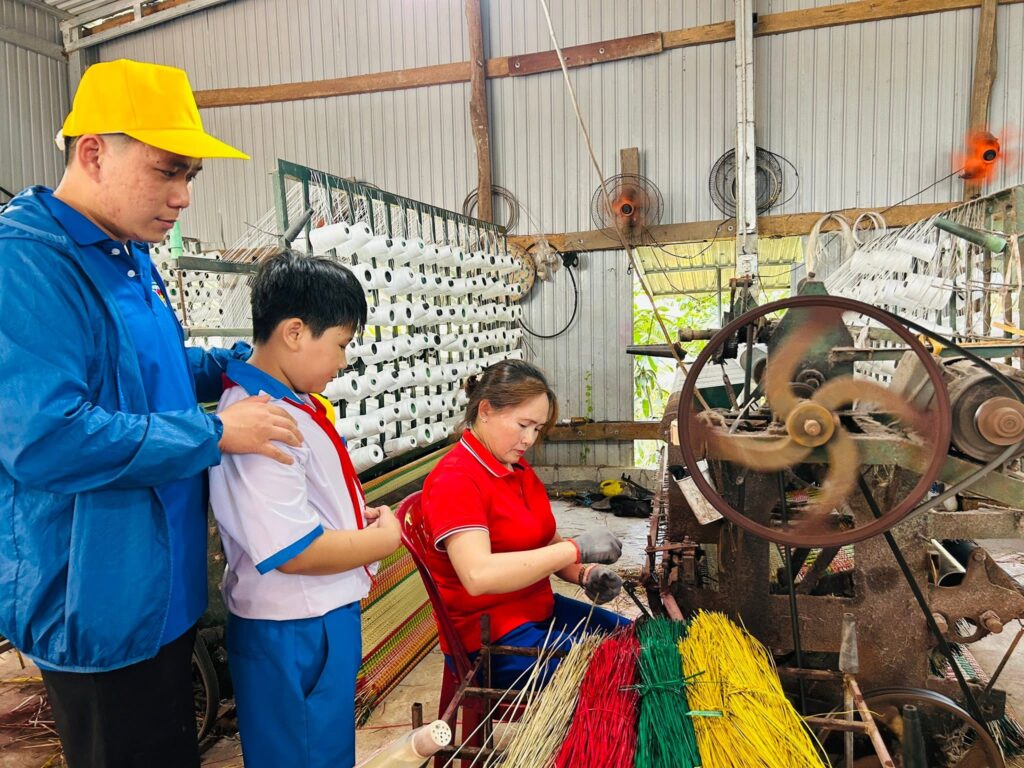
Along the rural landscapes of Da Nang, traditional mat weaving offers a glimpse into the everyday culture of Central Vietnam. From the alluvial banks of the Thu Bon River to sedge-growing fields in the southern part of the city, artisans split, dry, dye, and weave sedge fibers into mats that have served generations of Vietnamese families. Behind these humble products lies a wealth of traditional knowledge, memories of local livelihoods, and the rhythms of communities that have long lived along the river.
Mat weaving in Da Nang is more than the production of an everyday household item. It reflects the history of village settlement, the adaptation of local communities to riverine environments, and their creativity in transforming natural materials into useful and decorative objects.
Traditional Mat-Weaving Villages Along the Thu Bon River
Cam Kim Mat-Weaving Village, Hoi An Tay Ward
Located beside the Thu Bon River, Cam Kim retains the peaceful atmosphere of a traditional riverside community, with rice fields, village lanes, and old-style houses. Mat weaving was once a familiar occupation for farmers and fishermen during agricultural off-seasons, particularly in the rainy months when farming and river-based activities slowed down.
Visitors to Cam Kim can discover a different side of Hoi An, where life moves at a gentler pace and traditional work remains connected to the daily routines of the countryside. Beside the weaving frame, stories of sedge fibers intertwine with those of the river, seasonal harvests, and families who have lived on the alluvial land for generations.
Tra Nhieu and Ban Thach Mat-Weaving Villages, Nam Phuoc Commune
The Ban Thach mat-weaving area developed within the river system formed by the Thu Bon, Ly Ly, and Truong Giang rivers. Its extensive sedge-growing areas once provided abundant raw materials for the craft. Traditional products included plain mats, floral mats, chiếu trổ, patterned mats, and raised-pattern mats.
At selected workshops in Ban Thach and Tra Nhieu, visitors may observe the production process or try simple activities such as splitting sedge, drying fibers, dyeing them, and weaving small products. Tea-pot mats, sitting mats, and small woven pieces make thoughtful souvenirs that carry the colors and stories of local craftsmanship.
Thach Tan Sedge Mat-Weaving Village, Ban Thach Ward
Thach Tan preserves a visible connection between local raw materials and the production process. Sedge is grown in the surrounding area, harvested, split into narrow strands, dried, dyed, and then woven on traditional frames.
Bundles of colorful sedge spread across courtyards, women sitting opposite one another at weaving frames, and newly completed floral mats create a vivid picture of village life. Mat-weaving experiences can also be connected with the historical and ecological values of the Thach Tan, Ky Anh, and Song Dam area.
Cam Ne Mat-Weaving Village, Hoa Tien Commune
Located southwest of central Da Nang, Cam Ne is closely associated with generations of traditional mat weaving. Its mats are known for their vivid colors, firm surfaces, and carefully prepared materials.
According to local source material, Cam Ne mats are handmade on traditional weaving frames. Although fewer households remain engaged in the craft than in the past, memories of sunlit sedge-drying yards and the rhythmic sounds of weaving frames remain an important part of the cultural landscape of Hoa Tien.
From Sedge Plants to Woven Mats
Mat weaving in Da Nang developed within a broader cultural landscape shaped by land reclamation, village settlement, and the movement of communities along the Thu Bon River basin.
Historical material on mat weaving in Hoi An indicates that mats were already common household items in Dang Trong, the southern Vietnamese realm, by the early 17th century. Long-established weaving areas such as Ban Thach, An Phuoc, and Triem Tay are mentioned as having influenced the development of craft settlements around Hoi An. As women moved to their husbands’ home villages or families relocated to new settlements, mat-weaving skills traveled with them, establishing specialized craft communities along the riverbanks.
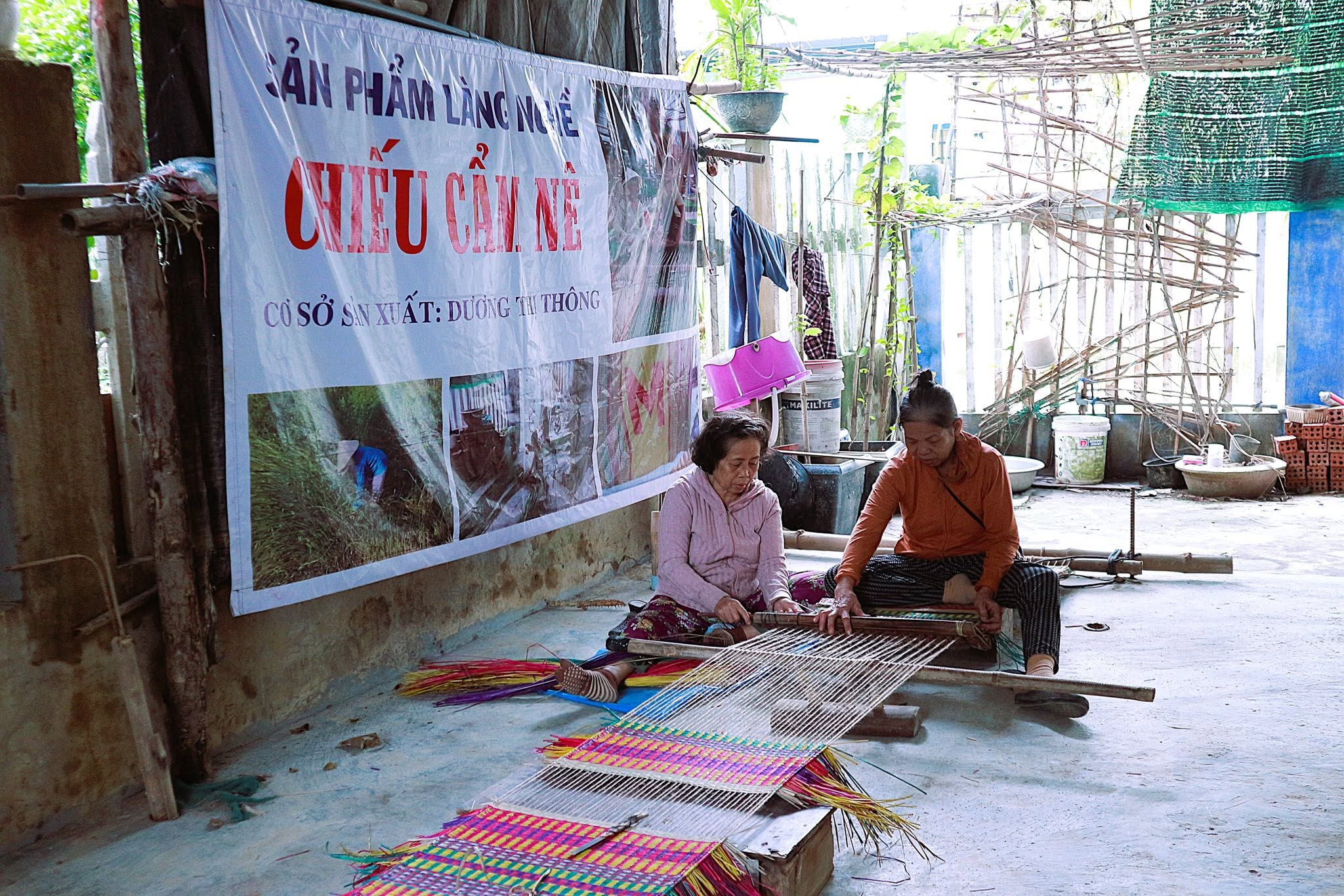
Each village has its own story, but the process begins with materials drawn from nature. Sedge, locally known as lát or cói, forms the surface of the mat. Jute fibers are split into thin strands and joined to create long cords known as dây sân, which hold the sedge fibers in place during weaving.
Traditional tools also carry simple, distinctive names, including khổ, lụi, con ngựa, đòn ngáng, and kẹo chắp sân. Most are made from mature bamboo, wood, areca-palm trunks, and other materials readily available in rural life.
A finished mat may appear smooth and simple, but its production involves several days of preparation, coordinated work between two artisans, and countless small movements learned through observation, practice, and inherited experience.
Preparing and Dyeing the Sedge Fibers
After harvesting, sedge is brought home and sorted to remove stalks that are too young or too old. Each stalk is then split lengthwise into narrow fibers. This stage requires steady, practiced hands: the fibers must be fine enough to remain flexible during weaving while retaining sufficient strength to resist breaking.
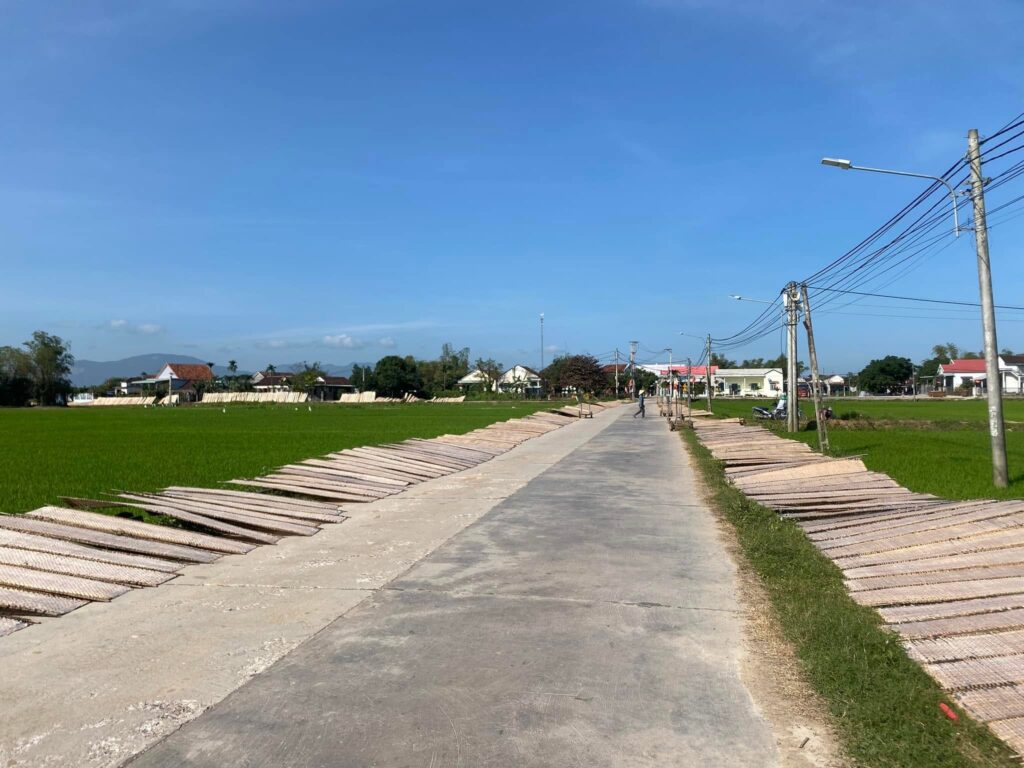
The freshly split fibers, still green and moist, are spread out to dry in the sun. Artisans pay close attention to the weather because sunlight directly affects the fibers’ dryness, color, and durability. The sedge must be turned regularly to ensure even drying, prevent mold, and keep the strands relatively straight.
For plain mats, the dried sedge may be taken directly to the weaving frame. For decorative mats, the fibers are dyed and dried again. Red, green, yellow, and purple strands spread across courtyards, creating colorful patterns against the brown earth and surrounding vegetation.
The Rhythm of the Weaving Frame and the Art of Color
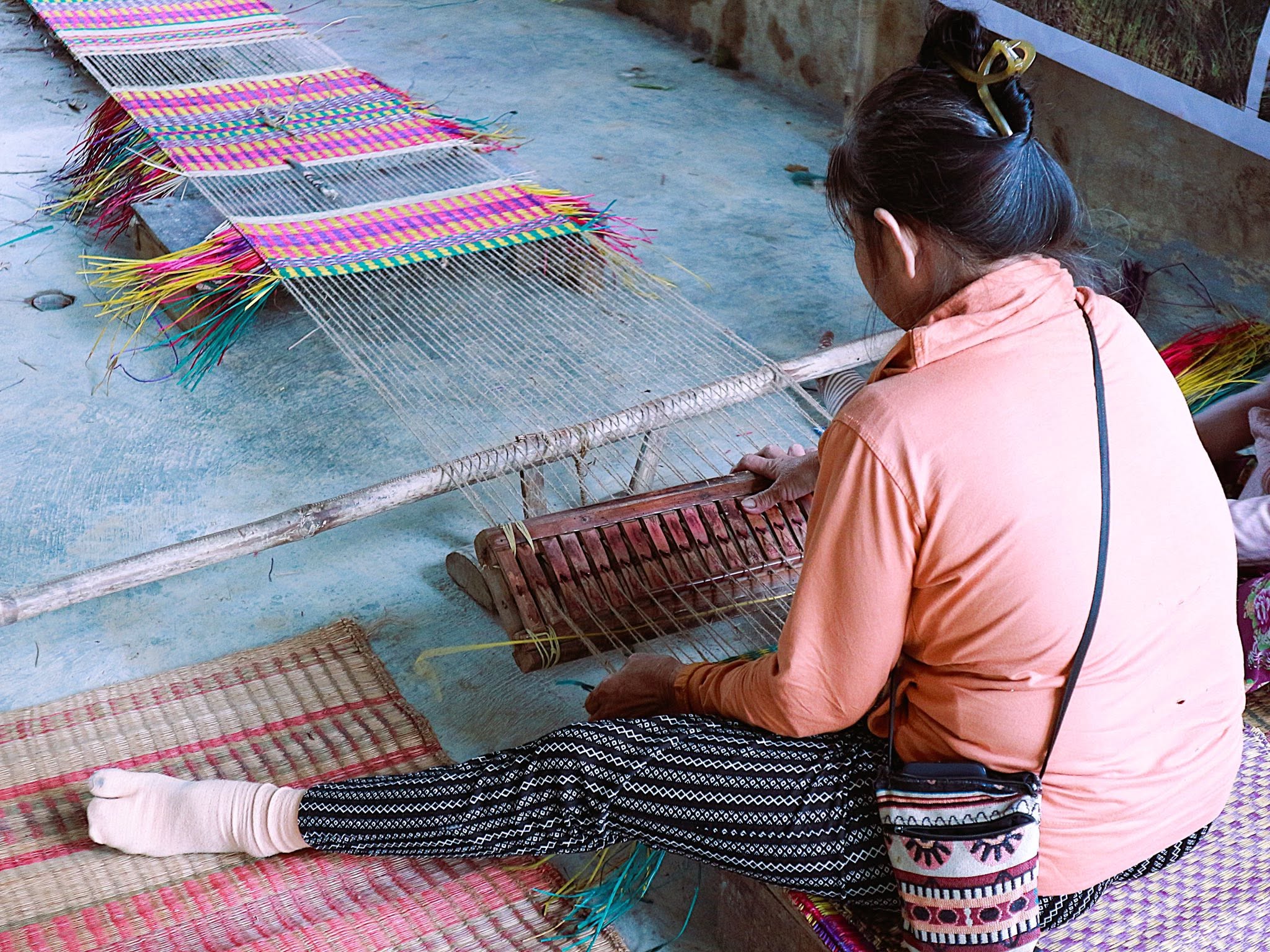
In Thach Tan, the traditional process begins in the sedge fields and continues through splitting, drying, dyeing, and weaving. Each frame generally requires two people working together. One passes the sedge horizontally through the rows of warp cords, while the other operates the wooden beater, known as the khổ, to press each woven row firmly into place.
The lụi carries the sedge from one side to the other. The khổ is raised and brought down again. Strand by strand, the fibers settle closely together until a complete mat surface gradually takes shape. The person feeding the sedge must select the correct color and position quickly, while the person operating the beater maintains even pressure to prevent the surface from becoming uneven.
The sound of bamboo and wooden tools striking together creates the distinctive rhythm of the craft. Each repeated movement requires concentration and coordination. Through this steady process, a finished product slowly emerges.
Traditional mats are not limited to the natural white color of sun-dried sedge. By combining colored fibers, artisans create floral mats, decorative patterned mats, and raised-pattern designs featuring stripes, squares, and repeating geometric motifs.
Ban Thach was once known for mats with smooth surfaces, harmonious colors, and lasting durability. These products traveled by boat and road to many regions, becoming familiar household items for families across the country.
The colors are not intended to be extravagant. Red, green, purple, and yellow complement the natural color of sedge, brightening living spaces, kitchen verandas, and rural courtyards. Every colored line must be planned before the fibers enter the frame, because correcting individual details becomes difficult once the weaving has progressed.
Sedge Mats in Family and Community Life
A mat is one of the most familiar objects in a Vietnamese household. It provides a place to rest after a day of work, brings family members together, and serves as the setting for many ordinary moments of daily life. For this reason, mat weaving produces more than a practical household item. It also preserves family memories and elements of local culture.
In many weaving families, skills are not passed down through written manuals. Children grow up beside the frame, watching their grandmothers split sedge and their mothers prepare the warp cords. Gradually, they learn how to pass the fibers through the frame and maintain the weaving rhythm. Knowledge develops through observation and practice, progressing from simple movements to more advanced techniques involving colors and patterns.
Women have traditionally formed the main workforce. They balance household responsibilities, farming, and river-based activities with weaving during quieter periods of the agricultural calendar. In some areas around Hoi An, more weaving frames were traditionally put to use during the rainy season and the final months of the year, when farming and fishing activities slowed down. Production generally took place within individual households, sometimes through a cooperative arrangement in which two artisans shared the work.
Mat weaving is therefore also a way for family members to support one another, supplement seasonal income, and maintain connections between generations.
How Mat Weaving Is Adapting to Modern Life
Today, sedge fibers are used not only for traditional sleeping mats but also for smaller products such as table mats, sitting mats, handbags, hats, decorative lamps, and souvenirs.
Some younger people returning to their villages have explored new color combinations, expanded the range of sedge colors, and organized handicraft workshops for visitors. These efforts create opportunities for traditional products to reach new customers while retaining the distinctive character of their materials and techniques.
Nevertheless, the craft faces significant challenges. Raw-material supplies have become more limited, the work is labor-intensive, incomes can be modest, and industrial products create strong competition. As a result, some traditional weaving frames have gradually fallen silent. According to the source material, many hand-operated frames in Ban Thach now function mainly during agricultural off-seasons or when orders are available.
In response, local producers are exploring new sizes, designs, and product lines while incorporating visitor activities into the craft village environment. This approach allows mats to be appreciated not only as practical objects but also as expressions of local culture.
When an artisan leaves the frame, the village risks losing more than a worker. It may also lose a body of knowledge that is difficult to replace: how to read the weather, select sedge, combine colors, maintain consistent pressure, and create decorative patterns. These skills require years of practice and cannot be fully recovered simply by preserving finished products.
Safeguarding the craft is therefore not merely about maintaining an old livelihood. It is also about preserving village memory and the ability to tell the story of a place through materials that grow from its own landscape.
Experiencing Mat Weaving in Da Nang
A visit to a mat-weaving village becomes more meaningful when visitors have the opportunity to participate rather than simply observe.
Visitors may sit beside a weaving frame, take a dyed sedge strand, and pass it through the warp cords. This seemingly simple movement requires focus, coordination, and patience. By trying the process themselves, visitors gain a clearer understanding of why handmade mats take time to produce and how even small mistakes can affect the finished surface.
Talking with artisans about sedge selection, learning the names of traditional tools, watching the splitting process, or purchasing a small handmade item are other ways to connect with village life. Each purchase can help support local craft households and maintain a place for handmade products in contemporary life.
Weaving activities may vary according to the agricultural calendar, weather conditions, and available orders. Visitors are therefore advised to contact a workshop or local tourism operator in advance to arrange a visit and confirm whether artisans are available to demonstrate or teach the craft.
Visitors may leave with no more than a small table mat or a sedge handbag. Yet the lasting memories may be the colors of the fibers spread under the sun, the scent of dried sedge beside a house, and the steady rhythm of a weaving frame in a quiet rural afternoon.
In Da Nang’s riverside mat-weaving villages, heritage does not exist only in completed products. It remains present in every strand that is split, every bundle that is dyed, and every row that is woven by people who continue to care for their traditional craft.
Basic Information
| Item | Details |
|---|---|
| Topic | Traditional Mat-Weaving Villages in Da Nang |
| Villages and areas mentioned | Cam Kim, Tra Nhieu, Ban Thach, Thach Tan, and Cam Ne |
| Cultural setting | The Thu Bon River basin and rural areas in southern Da Nang |
| Main materials | Sedge and jute |
| Main production stages | Splitting, drying, dyeing, weaving, and finishing |
| Traditional products | Plain mats, floral mats, decorative patterned mats, and raised-pattern mats |
| Expanded product range | Table mats, sitting mats, handbags, hats, decorative lamps, and souvenirs |
| Cultural values | Traditional knowledge, family culture, community livelihoods, and cultural tourism |