


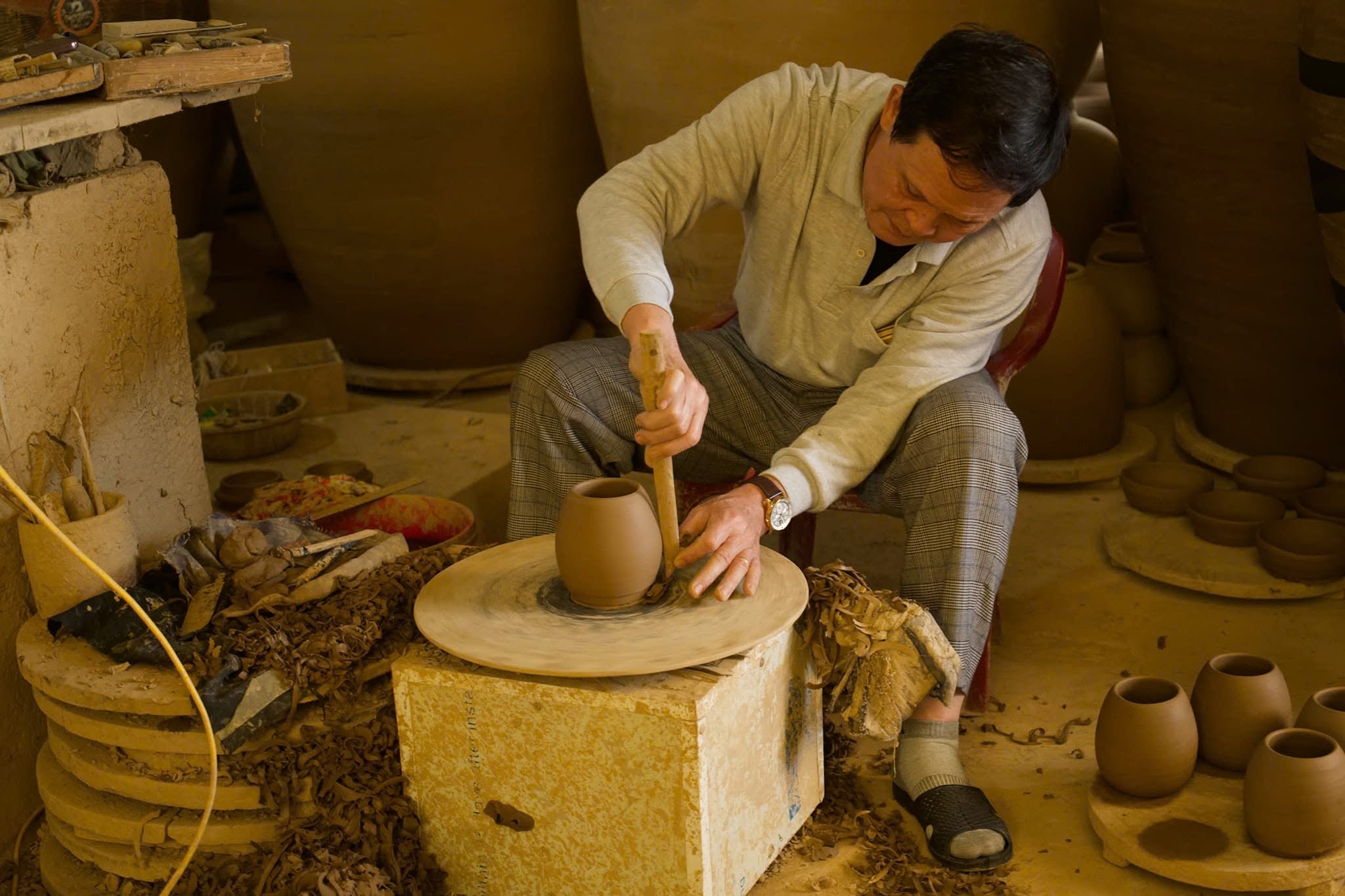
Gia Thuy pottery making, practiced in Gia Tuong Commune, Ninh Binh Province, is a traditional Vietnamese craft with a history spanning more than 50 years. Known for its rustic appearance, durability, and distinctive local clay, Gia Thuy pottery reflects the craftsmanship and cultural traditions of the region.
Over the decades, pottery making has become an important part of the local economy, helping preserve traditional skills while providing employment and income for many families.
Unlike ceramic traditions celebrated for elaborate decorative glazes, Gia Thuy pottery is distinguished by the natural beauty of its clay, earthy colors, and simple yet carefully crafted forms. From large earthenware jars and storage vessels to household and decorative items, each piece reflects the experience, patience, and skill of local artisans.
The History and Development of Gia Thuy Pottery
The traditional pottery-making community of Gia Thuy is located in present-day Gia Tuong Commune, Ninh Binh Province, an area where agriculture and traditional handicrafts have long played an important role in local life.
According to local craft village materials, pottery making in Gia Thuy developed more than 50 years ago. In its early stages, production primarily served the everyday needs of local households.
Using naturally available clay, artisans created earthenware jars, storage containers, large pots, and other practical household objects. These products were handmade with an emphasis on durability, functionality, and suitability for the daily activities of communities in northern Vietnam.
Over time, techniques for selecting clay, preparing raw materials, shaping vessels, and firing pottery were refined and passed down through generations.
Pottery gradually became an important source of employment and income, supporting the livelihoods of local families.
Despite changing consumer preferences and increasing competition from modern household products, Gia Thuy artisans have continued to maintain their traditional craft while adapting their designs and production methods to market demand.
According to local descriptions, pottery production has provided employment for hundreds of workers and contributed to the economic development of the surrounding community.
Today, Gia Thuy pottery products are sold in domestic markets and have also reached overseas customers, helping introduce this traditional Ninh Binh craft to a wider audience.
Gia Thuy Clay – The Natural Material Behind a Distinctive Pottery Tradition
One of the most important characteristics of Gia Thuy pottery is the natural clay found in the local area.
According to the experience of local artisans, Gia Thuy clay has a distinctive yellowish-brown color, a fine texture, strong binding properties, and good heat resistance.
These qualities make the clay suitable for shaping pottery and contribute to the strength and natural appearance of finished products.
The availability of this local resource has played an important role in the establishment and development of the craft.
However, transforming freshly collected clay into a workable material requires several careful preparation stages.
After being collected, the clay is first dried and broken into smaller pieces before being placed in soaking tanks.
Water is added, and the mixture is stirred mechanically until the clay becomes evenly dispersed.
The liquid clay is then passed through a sieve to remove stones, grit, and other impurities that could affect the quality of the finished pottery.
Once the mixture has settled, excess water is carefully removed, leaving behind a concentrated layer of clay.
The clay is subsequently dried until it reaches the appropriate moisture level for shaping.
Although this stage may appear straightforward, it requires considerable experience and attention.
If the clay becomes too dry, it loses flexibility and may crack during shaping. If it remains too wet, it becomes difficult to maintain the desired form.
Artisans must therefore monitor the clay regularly, adjusting the drying time according to its condition and the surrounding environment.
After the initial preparation, the clay is brought into the workshop and kneaded further to improve its smoothness, plasticity, and consistency.
This careful treatment of the raw material is essential to producing pottery with the desired strength, shape, and finish.
For Gia Thuy artisans, the quality of a ceramic product begins long before it reaches the potter’s wheel or kiln.
The Traditional Pottery-Making Process in Gia Thuy
Creating a finished piece of Gia Thuy pottery involves several interconnected stages, including clay preparation, shaping, surface finishing, drying, and firing.
Each step requires patience, technical knowledge, and practical experience.
Once the clay has been thoroughly kneaded and reaches the appropriate consistency, artisans begin shaping it according to the intended product.
For larger vessels, such as traditional storage jars and earthenware containers, the clay is often formed into long, rounded coils of suitable thickness.
These coils are placed on a rotating wheel and gradually joined together to form the body of the vessel.
As the wheel turns, the artisan uses carefully controlled hand movements to connect, smooth, and shape the clay.
The curves of the vessel, the opening, the body, and the base must all be balanced to ensure both functionality and structural stability.
Even a small mistake during shaping can affect the appearance or durability of the finished product.
For experienced potters, this stage is more than a technical procedure. It is an expression of craftsmanship, aesthetic judgment, and years of accumulated knowledge.
Under skilled hands, an ordinary mass of clay gradually becomes a well-proportioned vessel with smooth contours and the recognizable character of Gia Thuy pottery.
After shaping, the products are left to dry until they reach a suitable moisture level for firing.
This step is essential because excessive moisture can cause cracking or damage when pottery is exposed to high temperatures.
Kiln firing is one of the most decisive stages in determining the quality of Gia Thuy pottery.
In the traditional wood-fired process described in local craft materials, artisans must carefully monitor the flames, regulate the amount of firewood, and maintain appropriate temperatures throughout the firing cycle.
If the temperature rises too quickly, becomes uneven, or does not suit the characteristics of the clay, the products may warp, crack, or become deformed.
When the firing process is properly controlled, the finished pottery develops the desired hardness, durability, and natural coloration.
Successful firing requires a thorough understanding of the clay, the kiln’s structure, and how heat changes during different stages of production.
The combination of careful clay selection, skilled shaping, and precise heat control gives Gia Thuy pottery its distinctive rustic beauty and practical strength.
Cultural Heritage and Tourism Potential of Gia Thuy Pottery Village
Gia Thuy pottery represents more than a collection of traditional household products. It reflects the cultural values, practical knowledge, and everyday life of the local community.
Earthenware jars and storage vessels have long been associated with Vietnamese domestic traditions, serving purposes such as storing water, preserving food, and supporting daily household activities.
Through generations of production, pottery making has become part of the community’s working culture, illustrating the close relationship between people, natural resources, and traditional knowledge.
One of the most valuable aspects of Gia Thuy pottery is the continued use of handcrafted shaping and firing techniques at a time when many traditional earthenware products have been replaced by modern materials.
Local artisans have responded to changing demand by developing new designs and improving their products while maintaining the distinctive characteristics of the craft.
According to local craft village materials, Gia Thuy pottery has been distributed across Vietnam and exported to international markets.
The industry has helped create employment, improve household incomes, and sustain a traditional craft that remains closely connected to local identity.
Ninh Binh is widely known for major attractions such as the Trang An Scenic Landscape Complex, Hoa Lu Ancient Capital, Tam Coc – Bich Dong, and Bai Dinh Pagoda.
Alongside these famous destinations, traditional craft villages offer visitors a different perspective on the region, highlighting the skills, livelihoods, and cultural practices of local communities.
Gia Thuy Pottery Village has the potential to develop cultural tourism activities centered on traditional craftsmanship, pottery production, and locally made products.
At workshops that welcome visitors, travelers may have opportunities to observe the preparation of clay, the shaping of vessels on a potter’s wheel, and the various stages of finishing and production.
Workshop visits should be arranged in advance to confirm whether visitors can be accommodated and which activities are available.
For travelers interested in Vietnamese culture, learning about Gia Thuy pottery provides a deeper appreciation of traditional craftsmanship and the considerable effort involved in producing even the simplest household object.
Every finished piece is the result of multiple stages of work, combining technical skill with the artisan’s experience and judgment.
Preserving and developing Gia Thuy pottery requires continued training for younger craftsmen, improvements in product design and quality, and opportunities to reach new markets.
Connecting traditional pottery production with cultural tourism could also help introduce the village’s heritage to a wider audience while supporting local livelihoods.
With more than half a century of development, Gia Thuy pottery making continues to reflect the dedication, experience, and resilience of local artisans. From the yellowish-brown clay of Ninh Binh, skilled hands create durable earthenware products that preserve the practical traditions and cultural identity of a Vietnamese craft community.
Quick Information
| Item | Details |
|---|---|
| Craft name | Gia Thuy Pottery Making |
| Vietnamese name | Nghề làm gốm Gia Thủy |
| Location | Gia Tuong Commune, Ninh Binh Province, Vietnam |
| Craft type | Traditional pottery and earthenware production |
| History | More than 50 years, according to local craft materials |
| Distinctive raw material | Locally sourced yellowish-brown clay |
| Clay characteristics | Fine texture, strong binding properties, and good heat resistance |
| Main products | Earthenware jars, storage vessels, household pottery, and decorative items |
| Traditional techniques | Clay preparation, kneading, hand shaping, potter’s wheel forming, and kiln firing |
| Economic contribution | Employment for hundreds of local workers, according to local accounts |
| Markets | Domestic distribution and reported overseas exports |
| Cultural significance | Traditional craftsmanship, local livelihoods, and cultural heritage preservation |







