Hoa Vang Martyrs’ Cemetery (Nghĩa trủng Hòa Vang) is a significant historical site associated with the resistance against the French-Spanish allied forces in Da Nang between 1858 and 1860. It serves as the final resting place of more than one thousand Vietnamese soldiers, volunteer fighters, and civilians who lost their lives during the early resistance to foreign invasion. The site stands as a lasting testament to the patriotism, solidarity, and tradition of honoring those who sacrificed their lives for their homeland.
Despite several relocations resulting from historical changes and the expansion of Da Nang Airport, the cemetery has preserved an ancient stone stele inscribed with the four Chinese characters meaning “Hoa Vang Nghia Trung”, along with two stone pillars bearing traditional parallel inscriptions.
These surviving artifacts preserve the memory of an important chapter in Vietnam’s history and reflect the respect shown by earlier generations toward those who died defending their country.
Historical Background and Establishment of Hoa Vang Martyrs’ Cemetery
In the early morning of September 1, 1858, French and Spanish allied forces attacked the coastal defenses of Da Nang, marking the beginning of the colonial invasion of Vietnam.
Faced with the advancing foreign forces, the Nguyen Dynasty’s army, together with local military units, militia members, volunteer fighters, and civilians, mounted determined resistance to defend the region.
During nearly 19 months of intense fighting, thousands of people lost their lives.
The determined resistance of Vietnamese troops and local communities prevented the allied forces from rapidly occupying Da Nang as originally planned.
On March 23, 1860, French forces withdrew from Da Nang, marking an important turning point in the resistance campaign on this front.
Because of wartime conditions, many of those killed in battle were initially buried in temporary graves near the places where they had fallen.
In the years that followed, efforts were made to collect their remains and establish communal burial grounds, allowing the deceased to be laid to rest together.
These burial sites, traditionally known as nghĩa trủng, reflected a deeply rooted Vietnamese tradition of honoring those who had sacrificed their lives for the country.
According to the historical materials provided, in 1864, following a proposal by Dang Huy Truoc, the Provincial Administrative Commissioner of Quang Nam, Emperor Tu Duc ordered the collection and reburial of the remains of soldiers, volunteer fighters, and civilians who had died during the fighting in Da Nang.
The order also included the remains of those buried in unidentified or unclaimed graves.
The remains were to be gathered at two communal burial sites, one in Phuoc Ninh Village and the other in Nghi An Village.
The cemetery established in Nghi An Village was originally known as Hoa Vinh Nghia Trung, according to an inscription on a surviving sandstone stele.
Historical accounts indicate that approximately 1,300 graves were gathered at this burial ground.
Over time, the site became widely known as Hoa Vang Martyrs’ Cemetery.
Relocations and Present-Day Location
Hoa Vang Martyrs’ Cemetery was originally established in 1866 in Nghi An Village, Phuoc Tuong Canton, Hoa Vang District.
As Da Nang developed and its infrastructure expanded, the cemetery underwent several relocations.
During the construction of Da Nang Airport by the French colonial authorities between 1925 and 1926, the cemetery was moved from its original location to the Ba Garden area of Khue Trung Village, in what later became Khue Trung Ward.
In 1962, when Da Nang Airport was expanded again, the cemetery was relocated to its present site.
According to the supplied materials, the memorial grounds cover approximately 4,000 square meters and are located in Cam Le Ward, Da Nang, Vietnam.
The cemetery commemorates more than one thousand soldiers, volunteer fighters, and patriotic civilians who died during the resistance against the French-Spanish allied forces between 1858 and 1860.
Although the site has been moved several times, it has retained important historical artifacts, particularly the ancient stone stele and two stone pillars inscribed with parallel verses.
These surviving objects provide valuable physical evidence of the cemetery’s origins and its longstanding commemorative significance.
They also demonstrate the determination of successive generations to preserve the memory of those who sacrificed their lives.
The Ancient Stone Stele of Hoa Vang Nghia Trung
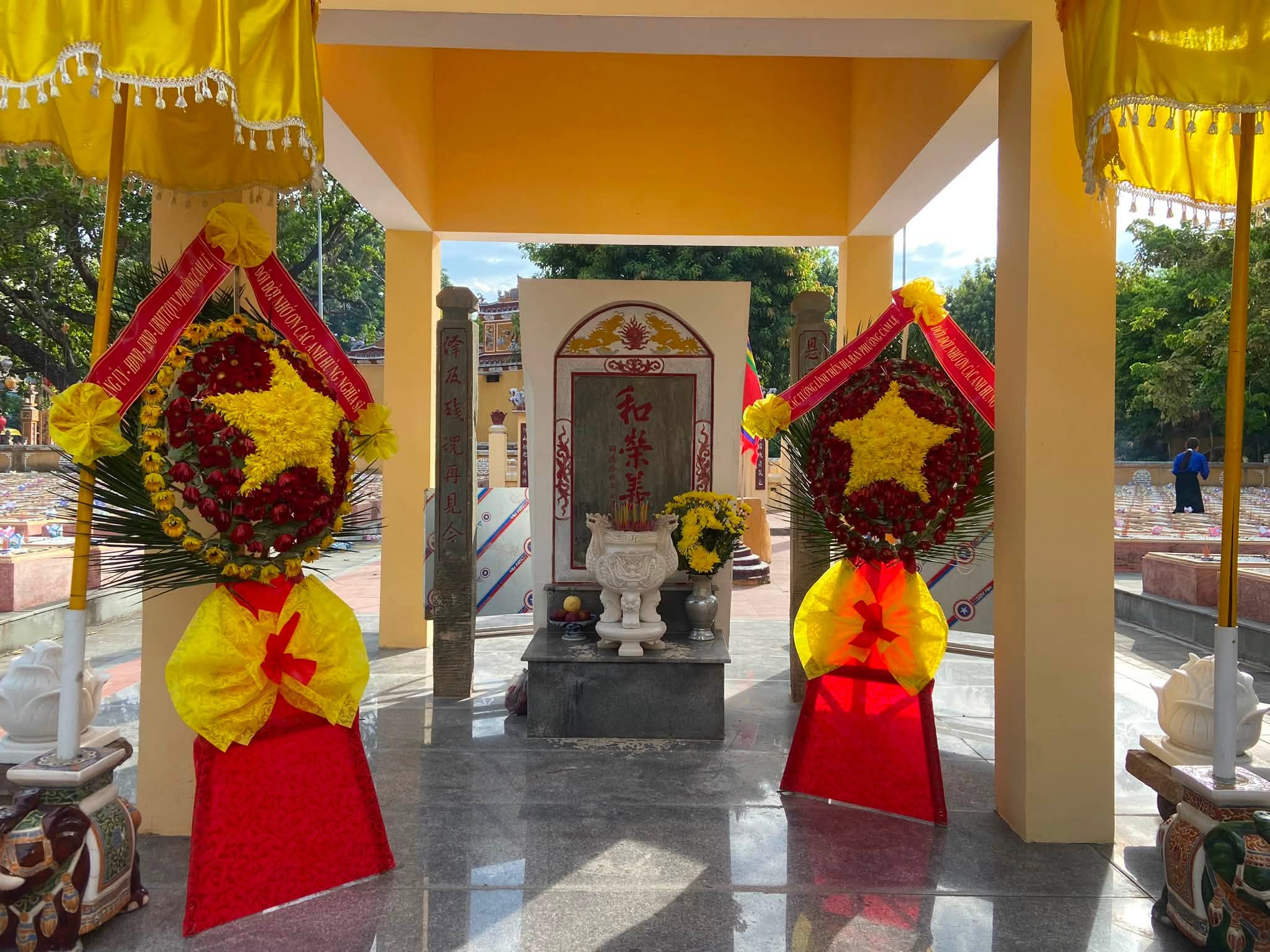
The ancient stone stele is the most distinctive historical artifact preserved at Hoa Vang Martyrs’ Cemetery.
It was erected in 1866, the 19th year of Emperor Tu Duc’s reign, and bears the four Chinese characters identifying the burial ground as Hoa Vang Nghia Trung.
The inscription records the name of the cemetery dedicated to those who died in the service of their country.
Carved from sandstone, the stele has survived the cemetery’s repeated relocations.
Its continued preservation is significant not only because it identifies the historical site but also because it reflects the efforts of earlier generations to collect, bury, and commemorate the victims of war.
Beside the stele stand two stone pillars bearing a traditional pair of parallel inscriptions:
Ân triêm khô cốt di truyền cổ
Trạch cập tàn hồn tái kiến kim
A contextual English rendering of the verses is:
Imperial grace gathered the fallen bones, preserving the memory of the past.
Compassion reached the departed souls, allowing their remembrance to endure.
The inscriptions express the significance of gathering human remains, preserving historical traces, and honoring those who died.
They also reflect a deeply humanistic principle in Vietnamese culture: even after war has ended, those who sacrificed their lives for their homeland remain worthy of remembrance and gratitude.
The stele and stone pillars are therefore important not only as historical artifacts but also as expressions of traditional Vietnamese commemorative culture.
Surrounding Historical and Cultural Heritage Sites
The historical significance of Hoa Vang Martyrs’ Cemetery extends beyond the burial grounds themselves.
According to the supplied materials, the surrounding area is associated with several historical, architectural, and religious sites representing different periods of local history.
These include:
- Hoa Que Tower Ruins: Remains of Cham architectural structures that provide evidence of the region’s earlier cultural and settlement history.
- Ancient Cham Well: A square-shaped well with walls constructed from large sandstone slabs, reflecting traditional Cham construction techniques.
- Cham Tower Ruins: Surviving architectural fragments, including bricks and sandstone blocks associated with historical Cham structures.
- Miếu Bà (Lady Shrine): A traditional religious site associated with the spiritual practices of the local community.
- Hoa Que Village Founding Ancestors’ Temple: A place dedicated to commemorating those who contributed to the establishment and development of Hoa Que Village.
Within this group of sites, the founding ancestors’ temple and Lady Shrine are also associated with the history of revolutionary activities in the locality.
According to the historical materials, these locations were once used as discreet meeting or operating places by revolutionary cadres.
The presence of heritage sites representing different historical periods adds another dimension to the significance of the Hoa Vang cemetery area.
The landscape preserves not only memories of the nineteenth-century resistance against foreign invasion but also traces of Cham culture, local religious traditions, and the formation of Vietnamese village communities.
Together, these sites illustrate the cultural diversity and historical continuity of the Da Nang region.
Traditions of Commemorating the Fallen
Hoa Vang Martyrs’ Cemetery is an important expression of the Vietnamese tradition of remembering and honoring those who came before us.
The collection of remains, establishment of graves, and erection of commemorative monuments for those who died in battle represented both an official responsibility and a compassionate act by the communities of the time.
These practices reflected the belief that people who sacrificed their lives for the country deserved a dignified resting place and lasting remembrance.
According to the supplied materials, commemorative ceremonies are traditionally held at the site during the third lunar month, in association with the Khue Trung Village Festival.
Local authorities and community representatives participate in ceremonies honoring those who died during the early resistance against the French-Spanish allied forces.
The activities also commemorate the village’s founding ancestors and those who contributed to the establishment and development of the local community.
Through traditional rituals, incense offerings, and collective remembrance, the cemetery continues to connect historical events with contemporary community life.
These ceremonies help preserve collective memory and provide opportunities for younger generations to learn about the patriotism and sacrifices of earlier generations.
They also encourage local residents to reflect on the history of their homeland and the responsibilities involved in preserving historical heritage.
Historical and Cultural Significance
Hoa Vang Martyrs’ Cemetery is an important historical witness to the resistance against the French-Spanish allied forces in Da Nang from 1858 to 1860.
Its establishment was closely associated with the collection and reburial of the remains of soldiers, volunteer fighters, and civilians who died during the conflict.
The cemetery therefore represents both the sacrifices made during the resistance and the determination of later generations to honor those who had fallen.
The ancient sandstone stele and two inscribed stone pillars are valuable sources for the study of local history, commemorative traditions, and historical stone inscriptions.
Meanwhile, the nearby Cham remains, ancient well, Lady Shrine, and founding ancestors’ temple reflect additional layers of cultural heritage.
The site’s significance consequently extends beyond military history.
It also lies in the relationship between memories of war, community religious practices, and the enduring tradition of gratitude toward those who sacrificed their lives.
Hoa Vang Martyrs’ Cemetery reminds present and future generations of the importance of protecting historical sites and preserving the memories associated with them.
Recognition as a National Historical Relic
In recognition of its historical and cultural significance, Hoa Vang Martyrs’ Cemetery was designated a National Historical Relic in 1999 by Vietnam’s cultural authorities.
This designation acknowledged the site’s importance within Da Nang’s cultural heritage and provided a basis for its preservation, protection, and educational use.
Today, Hoa Vang Martyrs’ Cemetery remains a meaningful destination for visitors interested in the history of Da Nang, particularly the resistance against foreign invasion during the mid-nineteenth century.
The site also offers insight into Vietnamese traditions of remembrance, collective burial, and respect for those who sacrificed their lives for their homeland.
Through its historical artifacts, commemorative ceremonies, and surrounding cultural landscape, Hoa Vang Martyrs’ Cemetery continues to preserve an important chapter of the city’s history.
Quick Information
| Item | Details |
|---|---|
| Heritage name | Hoa Vang Martyrs’ Cemetery |
| Vietnamese name | Nghĩa trủng Hòa Vang |
| Historical name | Hoa Vinh Nghia Trung |
| Location in the supplied materials | Cam Le Ward, Da Nang, Vietnam |
| Original establishment | 1866 |
| Original location | Nghi An Village, Phuoc Tuong Canton, Hoa Vang District |
| Historical context | Resistance against the French-Spanish allied forces in Da Nang, 1858–1860 |
| Number of graves | Approximately 1,300 at the original site; more than 1,000 in descriptions of the memorial |
| Approximate area | 4,000 m² |
| Major relocations | 1925–1926 and 1962 |
| Main historical artifacts | Ancient stone stele inscribed “Hoa Vang Nghia Trung” and two inscribed stone pillars |
| Associated heritage sites | Hoa Que Tower Ruins, ancient Cham well, Cham tower ruins, Lady Shrine, and Hoa Que Village Founding Ancestors’ Temple |
| Traditional commemorative period | Third lunar month |
| National Historical Relic designation | 1999 |
| Outstanding values | History of resistance, remembrance of the fallen, traditional stone inscriptions, and community commemorative culture |