


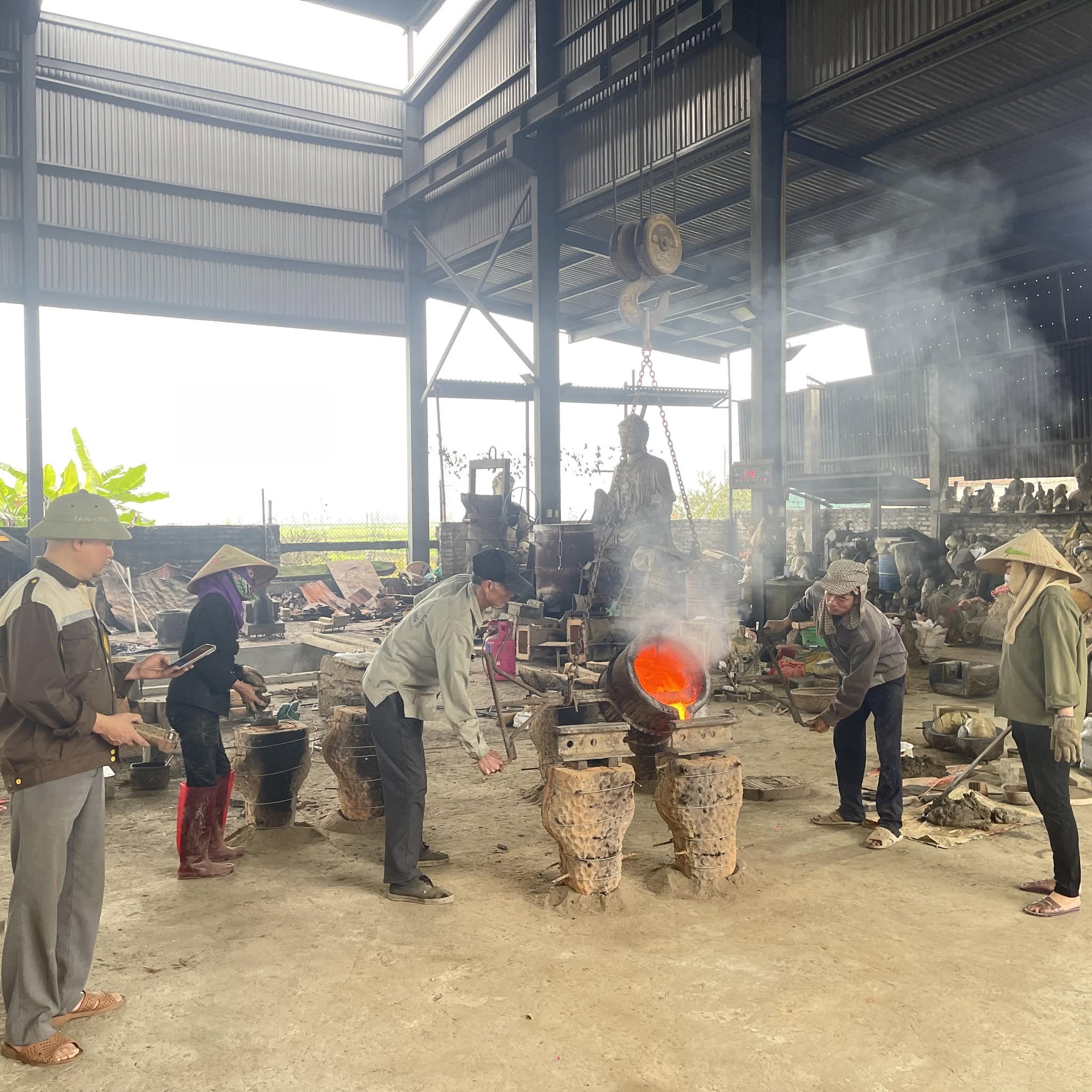
Van Diem Bronze Casting Village, located in Y Yen Commune, Ninh Binh Province, formerly part of Y Yen District in Nam Dinh Province, is one of the traditional handicraft villages associated with the long-established bronze casting industry of northern Vietnam. Together with the nearby Tong Xa Bronze Casting Village, Van Diem contributes to a renowned regional center of bronze production, where metal casting, decorative engraving, and traditional craftsmanship have been preserved and developed over many generations.
With a craft tradition commonly described as dating back nearly 900 years, Van Diem is known for its diverse bronze products, ranging from religious objects and ceremonial vessels to bronze statues, decorative artworks, and ornamental items. These products serve not only practical and spiritual purposes but also contribute to architectural decoration, cultural spaces, and interior design.
One of the village’s defining characteristics is the combination of traditional bronze casting techniques with sophisticated artistic skills. From selecting materials and preparing models to making molds, melting metal, casting, engraving, and polishing, every stage requires technical knowledge, precision, and the experience of skilled artisans.
Today, Van Diem continues to maintain its traditional products while adapting to changing market demands. Local workshops produce a wide variety of bronze handicrafts, including customized sculptures, decorative objects, and religious items. Production activities become particularly busy during the final months of the lunar year, when demand for altar accessories, gifts, and decorations increases ahead of the Vietnamese Lunar New Year, known as Tet.
Beyond its economic significance, Van Diem Bronze Casting Village represents an important part of the cultural heritage of the Red River Delta. Its workshops, traditional techniques, and artisan community offer opportunities to explore the relationship between craftsmanship, artistic expression, and the everyday life of a Vietnamese traditional craft village.
History and Development of Van Diem Bronze Casting Village
Van Diem Bronze Casting Village is situated in the historic craft-producing area of Y Yen, a region associated with longstanding traditions of metalworking and handicraft production. Together with Tong Xa and other nearby communities engaged in metal craftsmanship, Van Diem forms part of a distinctive cultural and economic landscape in the Red River Delta.
According to descriptions of the village’s history, the local bronze casting tradition is believed to have developed over nearly 900 years. This figure is commonly used to illustrate the longstanding nature of the craft and its continuity through successive generations. However, the exact date when bronze casting first appeared in Van Diem requires further confirmation through specialized historical documentation.
In its earlier stages, bronze casting was closely associated with the production of household objects and items used in religious ceremonies. Craftsmen employed traditional methods to prepare molds, melt metal, and create objects in different shapes and sizes. Over time, accumulated experience enabled artisans to improve the quality, durability, and decorative sophistication of their products.
As economic conditions changed and demand for bronze products expanded, workshops gradually diversified their production. Alongside traditional ceremonial objects, artisans began producing bronze statues, decorative panels, ornamental sculptures, and customized handicrafts for a wider range of customers.
The development of the craft was supported by the transmission of practical knowledge between generations. Techniques involving material selection, alloy preparation, mold making, temperature control, and surface finishing were traditionally learned through direct participation in workshop activities.
Apprentices often began with relatively simple tasks before gradually developing the skills required for more complex operations. This approach helped preserve specialized knowledge while allowing younger generations to adapt traditional methods to new production requirements.
Bronze casting has also played an important role in shaping the identity of the local community. The relationships among artisan families, workshops, suppliers, and bronze handicraft businesses have created a network of production and trade that supports the continuation of the craft.
Despite changes in technology and market conditions, Van Diem remains associated with traditional bronze craftsmanship. Its workshops, engraving facilities, and bronze handicraft businesses demonstrate the adaptability of a longstanding craft tradition within a modern economic environment.
Traditional Bronze Casting Techniques and Distinctive Products of Van Diem
The bronze products of Van Diem are characterized by their diversity in design, size, decorative style, and finishing techniques. Depending on their intended purpose, artisans may create small ornamental pieces, traditional religious objects, or large and technically demanding sculptures.
Religious Objects and Traditional Bronze Handicrafts
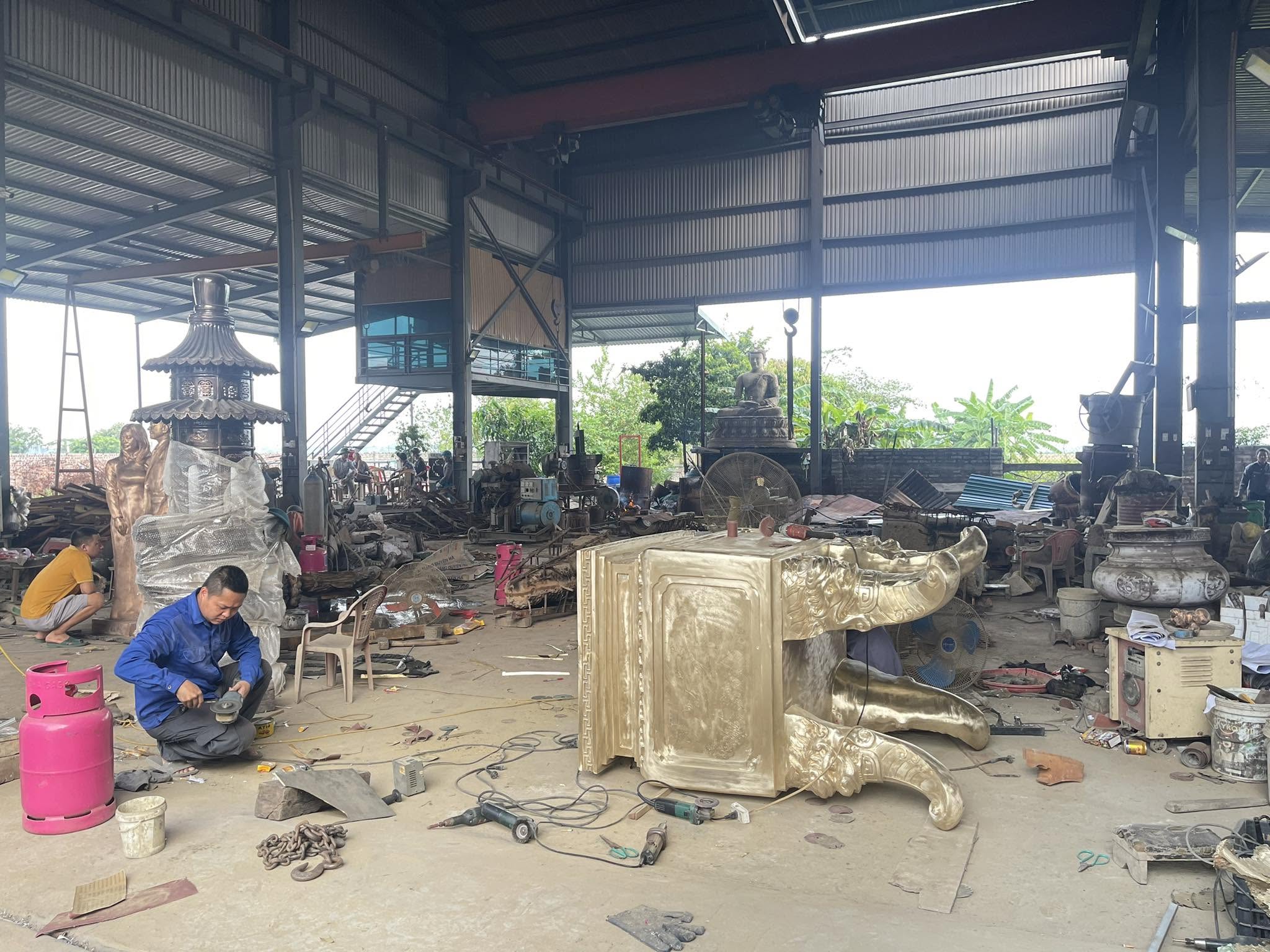
One of Van Diem’s most recognizable product categories is bronze religious and ceremonial objects. Local workshops manufacture incense burners, ceremonial vessels, crane-shaped altar ornaments, candlesticks, and other accessories used in family ancestral worship, clan temples, communal houses, pagodas, and religious buildings.
These objects often feature decorative motifs associated with Vietnamese traditional art, including dragons, phoenixes, lotus flowers, clouds, and stylized floral patterns. Craftsmen pay particular attention to proportion, symmetry, and the relationship between decorative elements and the overall form of the object.
Depending on the design, patterns may be produced through raised carving, recessed engraving, or specialized surface-finishing techniques. Such details contribute to the solemn and refined appearance of traditional bronze ceremonial objects.
In addition to religious products, Van Diem workshops create decorative bronze panels, relief sculptures, mythical animal figures, artistic statues, and ornamental items used in homes and architectural spaces.
The value of these products varies considerably according to their dimensions, materials, complexity, and finishing methods. Smaller handicrafts may cost several million Vietnamese dong, while large sculptures and highly elaborate commissioned works can reach tens or hundreds of millions of dong. These figures represent broad indicative price ranges rather than fixed or verified market quotations.
Bronze Portrait Sculptures and Customized Artistic Works
Another notable area of production in Van Diem is bronze sculpture, including historical figures, decorative statues, and customized portrait sculptures.
Portrait sculpture is particularly demanding because the finished work must capture the recognizable features and expression of a specific person. In many cases, the artisan works from photographs, drawings, or other reference materials provided by the customer.
The model-making stage requires careful consideration of facial proportions, contours, posture, and expression. When only a limited number of photographs are available, the craftsman must interpret two-dimensional references and translate them into a convincing three-dimensional form.
Once the model is complete, the sculpture proceeds through mold preparation, casting, mechanical processing, and surface finishing. Details such as the eyes, nose, mouth, hair, and clothing may require additional refinement to achieve the intended appearance.
Unlike standardized decorative objects, customized portrait sculptures are usually produced individually. Their completion time and cost depend on the size of the statue, the complexity of the design, the selected materials, and the desired finishing techniques.
This type of work illustrates the close relationship between technical casting knowledge and artistic interpretation. The final result depends not only on the successful transformation of molten metal into a solid object but also on the sculptor’s ability to convey character and expression.
Decorative Engraving and Metal Inlay Techniques
Beyond casting, Van Diem is also associated with bronze products featuring intricate decorative engraving and metal inlay.
These techniques enhance the artistic value of bronze objects and create distinctive visual effects through the use of detailed patterns, textures, and contrasting materials.
In decorative engraving, craftsmen use specialized tools to create lines, shapes, and ornamental motifs on the surface of a bronze object. Designs may be prepared in advance or developed directly on the metal by experienced artisans.
The depth, clarity, and arrangement of engraved details influence the appearance of the finished work. Complex compositions require precise control and a strong understanding of decorative balance.
Metal inlay involves incorporating materials with different colors or visual characteristics into the surface of a bronze object. Traditional Vietnamese decorative techniques include tam khi, commonly associated with three-metal inlay, and ngu sac, referring to multicolored metal decoration.
The process typically requires preparing the decorative design, working the metal surface, fitting the inlaid materials, and carefully finishing the completed patterns.
These operations demand patience and accuracy, especially when the design includes fine lines or numerous small decorative elements.
Because engraved and inlaid products require additional labor, specialized materials, and technical expertise, they are often more expensive than comparable objects with simpler finishes.
Such decorative methods contribute to the distinctive character of Van Diem bronze handicrafts and demonstrate how traditional metalworking can combine practical production with artistic expression.
The Bronze Casting Process and the Busy Lunar New Year Production Season
Creating a finished bronze product involves several interconnected stages, each requiring technical precision and practical experience. From the initial design to the final surface treatment, the quality of the finished object depends on the successful coordination of multiple production processes.
Model Making and Mold Preparation
The process begins with the preparation of a model. Depending on the product, this may be developed from a drawing, photograph, existing design, or traditional pattern.
For objects with complex forms, such as portrait statues, artistic sculptures, or highly decorated ceremonial vessels, model making requires careful attention to proportions and three-dimensional composition.
After the model is completed, the craftsman prepares the casting mold. The mold must be structurally stable, capable of withstanding the casting conditions, and sufficiently detailed to reproduce the intended design.
Mold quality has a direct influence on the finished product. Imperfections at this stage may result in dimensional inaccuracies, incomplete details, or surface defects that require additional correction.
Melting and Pouring the Metal
The selected metal is prepared and placed in a furnace. Depending on the alloy composition, it is heated until it reaches an appropriate molten state.
Copper and many copper-based alloys require very high processing temperatures, which may exceed 1,000°C depending on the material and casting conditions.
This stage demands careful attention and strict safety procedures. Operators must monitor the melting conditions, assess the state of the molten metal, and ensure that the mold is properly prepared before pouring.
Incorrect temperatures or pouring techniques can cause casting defects, including trapped gas, incomplete mold filling, and irregularities in the finished shape.
The duration of melting and pouring varies according to the quantity of metal, alloy composition, furnace capacity, and technical requirements. There is no single fixed processing time applicable to every bronze product.
Removing the Mold and Finishing the Product
After pouring, the molten metal must solidify and cool sufficiently before the casting can be removed from the mold.
Cooling time depends on the size, weight, shape, and material characteristics of the object. Once the casting has been removed, it is inspected and prepared for further processing.
Excess metal is trimmed away, surface imperfections are corrected, and unfinished details are refined. Additional work may include grinding, engraving, polishing, coloring, and specialized decorative treatments.
For products with elaborate patterns or customized artistic requirements, finishing can take significantly longer than the initial casting process.
Bronze portraits and other commissioned sculptures may require repeated inspection and refinement to ensure that the final object closely follows the approved model.
Only after the technical and aesthetic requirements have been met is the product prepared for delivery.
A Busy Production Season Before Tet
One of the distinctive characteristics of bronze production in Van Diem is the seasonal increase in demand toward the end of the lunar year.
As Tet approaches, families, religious establishments, and individual customers often purchase new ceremonial objects, replace existing altar accessories, or order decorative bronze products and gifts.
Descriptions of local production activities indicate that many workshops begin concentrating on Tet orders around the tenth lunar month. Popular products during this period include incense burners, ceremonial vessels, bronze crane ornaments, statues, and decorative objects.
Because each product requires several stages of production, careful scheduling becomes especially important. Customized sculptures and complex decorative works may require longer lead times, encouraging workshops to accept orders well before the holiday.
During the final months of the lunar year, activities such as model making, mold preparation, casting, engraving, and polishing often become more intensive as workshops work to meet delivery deadlines.
This seasonal rhythm reflects the close connection between traditional craft production and Vietnamese cultural practices. The demand for bronze ceremonial objects during Tet demonstrates the continuing importance of ancestral worship, religious customs, and decorative traditions in contemporary life.
Cultural Heritage, Craft Village Tourism, and the Future of Van Diem
Beyond its economic contribution, Van Diem Bronze Casting Village preserves important cultural values associated with traditional handicrafts in the Red River Delta.
The knowledge accumulated by local artisans includes mold-making techniques, metal casting methods, engraving skills, decorative inlay, and the artistic principles used in bronze sculpture.
These skills represent a form of practical cultural heritage transmitted through generations of workshop experience.
In many artisan families, learning begins through observation and participation in everyday production activities. Younger workers gradually become familiar with the properties of different materials, the use of tools, and the requirements of individual manufacturing stages.
As their experience grows, they may take on more demanding tasks involving model making, mold preparation, detailed engraving, and artistic finishing.
This gradual transmission of skills helps preserve the craft while allowing new generations to introduce fresh ideas and adapt production methods to contemporary requirements.
Although modern machinery has become increasingly important in metalworking, traditional manual expertise remains essential for products requiring detailed artistic interpretation.
Discovering the Workshops of Van Diem
For travelers interested in traditional Vietnamese crafts, Van Diem offers opportunities to explore the production environment of a longstanding bronze casting community.
The village’s workshops, finishing facilities, and bronze handicraft businesses provide insight into the different stages involved in creating decorative and ceremonial objects.
At workshops that are able to welcome visitors, travelers may have opportunities to observe model preparation, mold making, mechanical processing, and ornamental engraving.
Seeing objects at different stages of production helps visitors understand the time and skill required to transform raw materials into finished bronze works.
One particularly interesting aspect is the artistic finishing process. Decorative lines, engraved motifs, sculptural contours, and surface textures may appear relatively simple when viewed on a completed object, yet their creation can require extensive manual work.
Observing these details reveals the relationship between technical expertise and artistic judgment.
Visitors may also explore the different categories of bronze products made in the village, from traditional religious vessels to contemporary decorative pieces and customized sculptures.
Each category reflects particular choices of material, design, casting technique, and finishing method.
Bronze handicrafts may also appeal to travelers seeking locally made souvenirs or decorative gifts. When selecting a product, buyers should consider its material composition, dimensions, manufacturing technique, surface finish, and maintenance requirements.
However, bronze casting involves industrial processes that may present safety hazards. Furnaces, molten metal, lifting equipment, and mechanical machinery should only be approached by trained personnel.
Travelers are advised to contact workshops in advance, confirm whether visits are permitted, and follow all instructions provided by the facility.
Visitors should remain within designated areas and avoid participating in production activities unless appropriate supervision and safety equipment are available.
Expanding Markets and Promoting Traditional Bronze Products
Alongside conventional workshop sales and local trading networks, bronze handicraft businesses in the Y Yen area have increasingly explored digital channels to introduce their products.
Websites, social media platforms, and online communication tools allow potential customers to view designs, compare product categories, and contact producers more conveniently.
Digital promotion can help workshops reach customers beyond their immediate region and introduce traditional bronze craftsmanship to wider markets.
At the same time, changing consumer preferences encourage producers to develop new designs, customized products, and decorative objects suitable for contemporary interiors.
The Tet season remains an important commercial period, with demand for religious objects, gifts, ornamental products, and zodiac-themed decorations associated with the coming lunar year.
These seasonal trends provide opportunities for workshops to develop new product collections while maintaining traditional decorative techniques.
Product quality, transparent information about materials, reliable delivery arrangements, and distinctive craftsmanship are increasingly important in building customer confidence.
Preserving Traditional Skills and Supporting Sustainable Development
As industrial manufacturing continues to evolve, Van Diem faces the challenge of improving productivity while preserving the knowledge and skills that define its traditional craft.
Modern equipment can improve precision and production capacity, but manual model making, decorative engraving, metal inlay, and artistic finishing remain valuable aspects of the village’s heritage.
Supporting apprenticeships and practical training is therefore essential for maintaining the continuity of specialized skills.
Environmental management and occupational safety are equally important. Bronze casting may generate heat, dust, emissions, noise, and industrial waste, depending on the materials and technologies used.
Appropriate equipment, safer working practices, emissions management, and proper waste treatment are necessary considerations for the sustainable development of the craft.
Craft village tourism also offers potential opportunities when organized responsibly. Workshop demonstrations, handicraft exhibitions, product displays, and opportunities to learn about traditional techniques can help introduce Van Diem’s cultural heritage to a broader audience.
Such activities should be designed to protect visitors, respect the needs of working workshops, and provide meaningful benefits to the local artisan community.
In the long term, the village’s development will depend on maintaining a balance between traditional craftsmanship, technological innovation, product quality, environmental responsibility, and effective market promotion.
By combining these priorities, Van Diem can continue to strengthen its role as a bronze handicraft center while preserving the cultural traditions that have shaped its identity.
Van Diem Bronze Casting Village is a distinctive destination within the traditional metalworking region of Y Yen, Ninh Binh Province. With a longstanding craft heritage, a diverse range of products, and specialized skills in bronze casting, engraving, and metal inlay, the village represents the creativity and technical expertise of Vietnamese artisans. From familiar religious objects to bronze portraits and elaborate decorative works, its products reflect generations of accumulated knowledge and craftsmanship. As the village continues to adapt to modern markets, Van Diem remains an important example of how traditional Vietnamese handicrafts can preserve their cultural identity while developing new opportunities for the future.
Quick Information
| Item | Details |
|---|---|
| Village name | Van Diem Bronze Casting Village |
| Vietnamese name | Làng đúc đồng Vạn Điểm |
| Current location | Y Yen Commune, Ninh Binh Province, Vietnam |
| Former administrative location | Y Yen District, Nam Dinh Province |
| Heritage type | Traditional craft village |
| Main craft | Bronze casting and decorative bronze craftsmanship |
| Craft history | Commonly described as a tradition spanning nearly 900 years |
| Related craft village | Tong Xa Bronze Casting Village |
| Traditional products | Incense burners, ceremonial vessels, bronze crane ornaments, candlesticks, and altar accessories |
| Decorative products | Bronze panels, relief sculptures, ornamental figures, and decorative objects |
| Sculptural products | Artistic statues, historical figures, and customized bronze portraits |
| Main techniques | Model making, mold preparation, melting, casting, engraving, and finishing |
| Decorative techniques | Raised carving, recessed engraving, three-metal inlay, and multicolored metal inlay |
| Materials | Copper and suitable copper-based alloys |
| Indicative product prices | From several million to hundreds of millions of VND, depending on the product |
| Peak production season | Final months of the lunar year, before Tet |
| Popular Tet products | Altar accessories, bronze gifts, sculptures, and decorative objects |
| Marketing channels | Traditional workshop sales, local businesses, websites, and social media |
| Cultural significance | Traditional metalworking knowledge, craftsmanship, and intergenerational skill transmission |
| Tourism potential | Workshop visits, learning about bronze casting, and exploring handcrafted products |
| Visitor advice | Arrange visits in advance and follow workshop safety regulations |
| Development priorities | Craft preservation, product quality, environmental protection, and market promotion |







