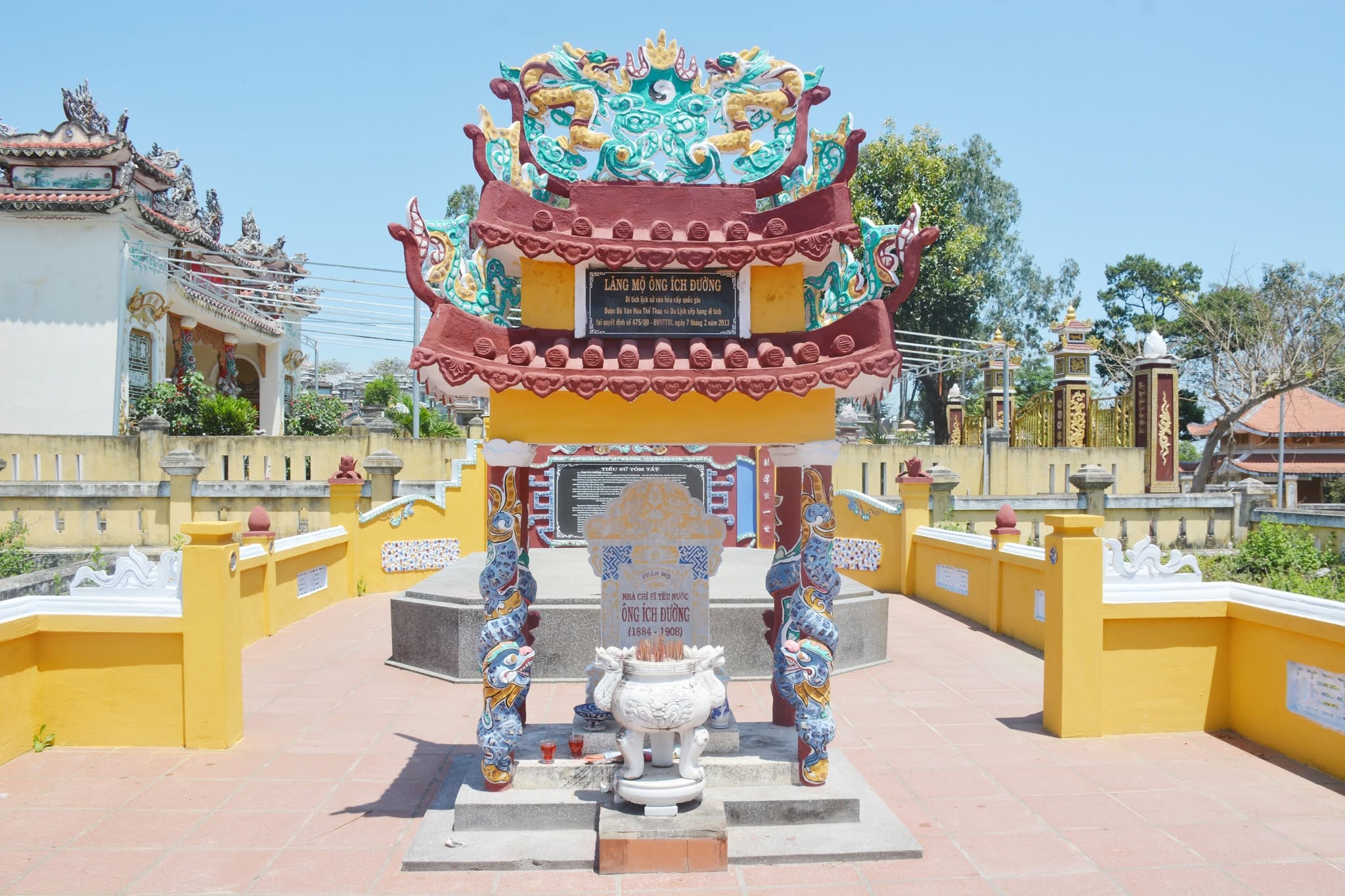
The Tomb and Shrine of Ong Ich Duong are historical sites associated with the life and sacrifice of a prominent Vietnamese patriot from the former Quang Nam region, now part of Da Nang. As the grandson of the renowned military commander Ong Ich Khiem, Ong Ich Duong demonstrated a strong sense of patriotism, determination, and concern for the welfare of disadvantaged communities from an early age. He actively participated in the Duy Tan Reform Movement and became one of the notable figures in the 1908 Anti-Tax Movement in Hoa Vang District.
Although his life ended at a young age, Ong Ich Duong’s courage and commitment to social justice left a lasting impression on the local community. His tomb, shrine, and memorial stele serve not only as places of remembrance but also as important historical landmarks that help preserve the traditions of patriotism, courage, and responsibility toward society.
Location and Origins of the Historical Sites
Ong Ich Duong was born in 1884 in Phong Le Village, Hoa Vang District, formerly part of Quang Nam Province. He was the fourth son of Ong Ich Kieng, also known as Tan Nhi, a patriotic fighter associated with the Can Vuong Movement, and a grandson of the distinguished military commander Ong Ich Khiem.
The historical sites associated with Ong Ich Duong include his tomb, a shrine dedicated to his memory, and a commemorative stele.
According to the supplied historical materials, following several relocations, his remains were reinterred in 2008 at Group 12, formerly Hoa Tho Tay Ward, in the Cam Le area of Da Nang.
The shrine dedicated to him is located in the former Hoa Phong area of Hoa Vang.
These sites are associated with two important locations in his life and in the community’s remembrance of him.
Phong Le was his birthplace and the village to which his remains were returned for burial. The Tuy Loan area was where he was executed and where local residents later established a shrine in his honor.
Despite historical changes and repeated relocations, descendants of the Ong family and local residents have continued to preserve these memorial sites, expressing their respect for a young patriot who sacrificed his life for his beliefs.
Early Life and Patriotic Character
Ong Ich Duong was born in the Year of the Wood Monkey, 1884, and died on the 12th day of the fourth lunar month in the Year of the Earth Monkey, 1908, according to the traditional dating recorded in the supplied materials.
From an early age, he was known for his intelligence, academic ability, literary talent, calligraphy, martial arts skills, and strong personal ambitions.
According to local oral traditions, he possessed unusual physical characteristics, including hair and facial hair said to grow in an unconventional direction, as well as an exceptionally energetic manner of walking.
Such descriptions may reflect elements of folklore and the admiration that local communities held for a figure remembered for his extraordinary determination.
What made Ong Ich Duong especially respected, however, was not simply his talent but his willingness to defend vulnerable members of society.
He was known for standing up for poor and disadvantaged villagers who faced exploitation or mistreatment by powerful local figures.
As a result, residents affectionately called him “Cau Duong,” a familiar and respectful form of address.
His sympathy for ordinary people and opposition to social injustice helped shape his involvement in the reform and resistance movements of the early twentieth century.
Participation in the Duy Tan Reform Movement
In the early twentieth century, the Duy Tan Reform Movement, associated with prominent Vietnamese reformers such as Phan Chau Trinh, spread across many localities.
The movement promoted education, social reform, public awareness, and national renewal as ways of strengthening Vietnamese society under French colonial rule.
According to the supplied historical accounts, Ong Ich Duong became actively involved in the movement during 1905–1906.
He reportedly accompanied Phan Chau Trinh on journeys to different areas, encouraging local communities to participate in reform activities and spreading ideas about social improvement.
Some accounts also suggest that he traveled with Phan Chau Trinh to the Phon Xuong resistance base in Yen The, Bac Giang, a location associated with the activities of the anti-colonial leader Hoang Hoa Tham.
The purpose of this journey was reportedly to learn about methods of resistance against French colonial rule.
After returning to his homeland, Ong Ich Duong organized martial arts training for young people in Phong Le and neighboring communities, including Cam Toai, Cam Le, Thach Nham, and Tuy Loan.
These activities reflected his desire to strengthen both public awareness and the capacity of local people to defend themselves during a period of political and social unrest.
Ong Ich Duong also became one of the notable local leaders of the 1908 Anti-Tax Movement in Hoa Vang District.
The movement emerged amid widespread dissatisfaction with taxation policies and oppressive conditions under the colonial administration and the existing political system.
By participating in public mobilization and resistance activities, Ong Ich Duong gained the trust of many local residents.
His increasingly visible role in the movement also attracted the attention of the authorities.
Execution at Tuy Loan Market
During the anti-tax protests of 1908, Ong Ich Duong was arrested and executed at Tuy Loan Market, in what is now the Hoa Vang area of Da Nang.
According to oral accounts preserved within the community, the execution was carried out while the market was crowded, apparently as a warning intended to intimidate local residents.
Despite facing death, Ong Ich Duong was remembered as remaining calm and refusing to abandon his convictions.
Local tradition attributes the following words to him:
“Dân nước Nam như cỏ cú, giết Đường này còn có trăm nghìn Đường khác. Bao giờ hết mía mới hết Đường!”
A contextual English translation is:
“The people of Vietnam are like resilient wild grass. Kill this Duong, and hundreds of thousands of others will rise. Only when sugarcane disappears will there be no more Duong!”
The statement uses a play on the Vietnamese word đường, which is both his given name and the word for sugar.
The saying has been passed down as a declaration that the determination of a people cannot be extinguished by the death of a single individual.
His execution deeply affected the local community and became a powerful symbol of courage and patriotism in the Quang Nam region.
According to stories preserved through local oral tradition, many people at Tuy Loan Market purchased white cloth to mourn him.
Tran Thi Diep, a cloth seller at the market, is remembered as having torn white fabric into pieces and distributed them to people who wished to express their grief.
Following his death, local residents established a shrine in his memory, known as Mieu Cau Duong, or Cau Duong Shrine.
The shrine became a place where the community could commemorate a young man who had sacrificed his life while participating in the struggle against oppression.
Relocation and Preservation of His Tomb
Following Ong Ich Duong’s execution, his family brought his remains back to his native village of Phong Le for burial.
A tomb and commemorative stele were established to honor his memory.
However, the burial site underwent several relocations because of historical developments and changes in local land use.
In 1966, the original burial area was cleared for the construction of military fortifications by the government of the Republic of Vietnam.
His family subsequently relocated the grave to the Cam area and rebuilt the tomb.
In 1976, during a broader relocation and consolidation of graves, his remains were transferred again to the Go Mo area.
After several decades and multiple relocations, descendants of the Ong family reinterred his remains at the present site in 2008, according to the supplied materials.
Throughout this process, family members and local residents made efforts to preserve the historical places and objects associated with Ong Ich Duong.
These include the shrine, memorial stele, tomb, and family-held historical documents.
Among the noteworthy materials are four photographs reportedly documenting the day of his execution.
According to the supplied account, these photographs were collected in 2010 by historian Dr. Ngo Van Minh.
They were carefully preserved by the family of Ong Van Ngoc, a descendant of the Ong lineage, and regarded as treasured historical keepsakes.
The preservation of photographs, artifacts, family records, and oral traditions contributes to the historical understanding of Ong Ich Duong’s life.
These materials also help maintain the connection between the historical events of 1908 and the collective memory of later generations.
Annual Commemoration and the Tradition of Remembrance
Every year, on the 12th day of the fourth lunar month, descendants of the Ong family, local residents, and representatives of community organizations gather to commemorate Ong Ich Duong.
According to local historical materials, this date is associated with the anniversary of his death.
Commemorative activities include incense offerings at his tomb, shrine, and memorial stele.
Participants come from Phong Le, the former Hoa Phong area, and neighboring communities.
Teachers and students also visit the sites to pay their respects and learn about his life, activities, and contributions to the local patriotic movement.
The ceremonies are generally solemn and respectful, reflecting the community’s gratitude toward a historical figure remembered for his courage and commitment to public welfare.
They also provide opportunities for different generations to share historical stories and reflect on the importance of responsibility toward their homeland.
Through these activities, the tomb, shrine, and memorial stele continue to hold significance beyond the Ong family.
They have become part of the shared historical memory of the local community.
Historical and Cultural Significance
Ong Ich Duong was among the notable participants in the early twentieth-century movements against oppression in the Hoa Vang region.
Although his life was brief, he left a lasting mark on local history through his involvement in social reform, public mobilization, the 1908 Anti-Tax Movement, and his efforts to defend disadvantaged communities.
According to an assessment attributed in the supplied materials to the Vietnam Institute of History, his activities, though short-lived, made a meaningful contribution to the history of resistance against French colonial rule in Quang Nam.
The assessment recognized him as a patriotic figure whose life and sacrifice deserve remembrance within Vietnam’s modern history.
The historical significance of the memorial sites can be understood through several dimensions.
His tomb provides a place for honoring an important local historical figure.
The shrine reflects the enduring respect of the community and the development of a tradition of remembrance.
The memorial stele and preserved family documents offer valuable materials for studying patriotic movements in the region.
The story of Ong Ich Duong also demonstrates that the movements for reform and social justice in early twentieth-century Vietnam were not shaped solely by nationally prominent leaders.
They also depended on young people from rural communities who were willing to organize, educate, and defend their fellow citizens.
Ong Ich Duong’s life illustrates the contribution of such individuals to the broader history of Vietnamese patriotism and social resistance.
Recognition as a Historical Relic
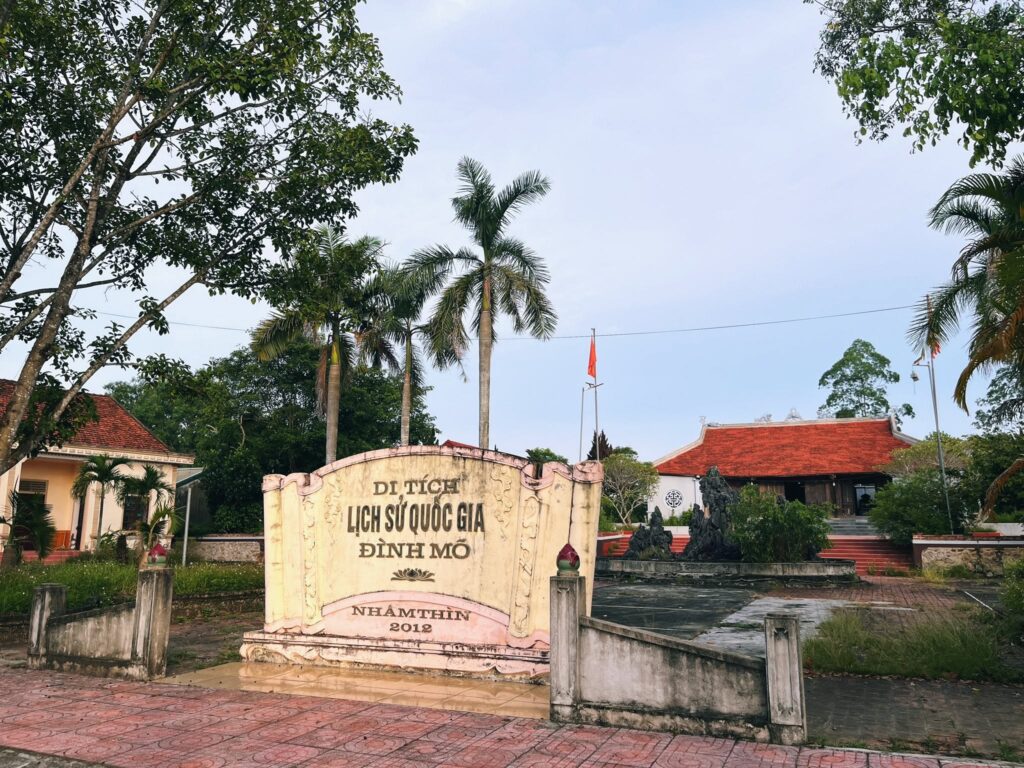
In 2009, the tomb, shrine, and memorial stele of Ong Ich Duong were recognized by the Da Nang People’s Committee as a city-level historical relic.
According to the supplied historical materials, on February 7, 2013, the Minister of Culture, Sports and Tourism signed a decision recognizing the tomb in the former Hoa Tho Tay area and the shrine in the former Hoa Phong area as a National Historical Relic.
This designation acknowledged the historical and cultural importance of the sites associated with Ong Ich Duong’s life.
It also provided a foundation for heritage conservation, historical education, and the promotion of local patriotic traditions.
Ong Ich Duong’s name has additionally been given to a road in Da Nang.
According to the supplied materials, the road extends for more than 1,500 meters.
Naming a public road after him represents another way in which his memory continues to be preserved within the modern urban landscape.
Today, the tomb and shrine of Ong Ich Duong remain meaningful destinations for visitors interested in the history of Quang Nam and Da Nang, particularly the Duy Tan Reform Movement and the Anti-Tax Movement of 1908.
These memorial sites preserve the story of a young patriot whose courage and concern for ordinary people continue to be remembered.
The Tomb and Shrine of Ong Ich Duong are more than commemorative landmarks. They preserve the memory of a young Vietnamese patriot who devoted his life to reform, social justice, and resistance against oppression. Through the continued care of his descendants and the local community, these historical sites remain important places for remembrance, cultural heritage preservation, and the education of future generations.
Quick Information
| Item | Details |
|---|---|
| Heritage name | Tomb and Shrine of Ong Ich Duong |
| Vietnamese name | Mộ và Miếu thờ Ông Ích Đường |
| Heritage category | National Historical Relic |
| Commemorated figure | Ong Ich Duong (1884–1908) |
| Family background | Grandson of military commander Ong Ich Khiem |
| Birthplace | Phong Le Village, formerly Hoa Vang District, Quang Nam Province |
| Tomb location in historical materials | Group 12, former Hoa Tho Tay Ward area, Da Nang |
| Shrine location in historical materials | Former Hoa Phong area, Da Nang |
| Historical movements | Duy Tan Reform Movement and 1908 Anti-Tax Movement |
| Place of execution | Tuy Loan Market |
| Traditional shrine name | Mieu Cau Duong |
| Final recorded tomb relocation | 2008 |
| City-level historical recognition | 2009 |
| National Historical Relic designation | February 7, 2013, according to the supplied materials |
| Annual commemoration | 12th day of the fourth lunar month |
| Associated historical materials | Memorial stele, family records, and photographs reportedly documenting his execution |
| Outstanding significance | Patriotic history, social reform, anti-tax resistance, and traditions of remembrance |