


Van Lam Embroidery Village, located in Van Lam Hamlet, Nam Hoa Lu Ward, Ninh Binh Province, is one of Vietnam’s renowned traditional handicraft villages, celebrated for its delicate hand embroidery, intricate lacework, and centuries-old craftsmanship. Situated within the picturesque Tam Coc – Bich Dong Tourist Area, the village offers visitors an opportunity to discover an important part of Vietnam’s artistic heritage while exploring the spectacular limestone landscapes of Ninh Binh.
According to local tradition, embroidery has been practiced in Van Lam for more than 700 years. Generations of artisans have preserved and refined their skills, transforming simple threads and fabrics into beautifully crafted tablecloths, bed linens, pillowcases, curtains, embroidered paintings, traditional garments, and decorative textiles.
Over time, Van Lam’s embroidery products have reached customers in Vietnam and international markets, helping introduce Vietnamese traditional craftsmanship to a wider audience.
In 2007, Van Lam was recognized as one of Vietnam’s 12 outstanding traditional craft villages at the national level, marking an important milestone in the preservation and development of its embroidery heritage.
Today, surrounded by the limestone mountains, rice fields, and waterways of Tam Coc, Van Lam continues to maintain its distinctive cultural identity while adapting its traditional craft to contemporary lifestyles and tourism.
History and Origins of Van Lam Embroidery Village
Van Lam is located in an area rich in history and cultural traditions, closely associated with the heritage of the Tran dynasty and the natural landscape of Tam Coc – Bich Dong.
Before administrative restructuring, the village belonged to Ninh Hai Commune, Hoa Lu District, Ninh Binh Province. Under the updated administrative arrangement, it is part of Nam Hoa Lu Ward, Ninh Binh Province.
According to local elders, embroidery in Van Lam originated during the Tran dynasty, more than seven centuries ago.
Local folklore connects the introduction of embroidery to Tran Thi Dung, the wife of Grand Chancellor Tran Thu Do, an influential figure during the early Tran dynasty.
Tradition holds that when members of the Tran royal court came to this region, Tran Thi Dung taught embroidery techniques to local residents, providing them with an additional livelihood alongside farming.
From these beginnings, embroidery gradually became an established craft, passed down through families and developed into an important part of village life.
The story of Tran Thi Dung holds considerable cultural significance, reflecting the community’s respect for the person traditionally credited with introducing the craft.
However, details about the exact time and circumstances of her involvement belong primarily to local oral tradition rather than fully documented historical records.
As the craft developed, Van Lam artisans gradually incorporated new techniques into their work.
During the French colonial period, European-style lace-making and drawn-thread embroidery techniques were introduced to Vietnam, creating opportunities for traditional embroidery villages to diversify their products.
According to local craft village accounts, two brothers, Dinh Van Xoang and Dinh Van Henh, played an important role in introducing lace-making and drawn-thread techniques to Van Lam.
Their contributions helped expand the village’s craftsmanship beyond conventional embroidery, allowing artisans to create more elaborate decorative patterns and textile designs.
The combination of traditional Vietnamese embroidery and newer techniques gradually shaped Van Lam’s distinctive artistic style.
Despite historical changes and economic challenges, local families continued to preserve embroidery as both a source of income and an expression of cultural identity.
Knowledge of fabric selection, thread colors, pattern design, embroidery frames, and stitching techniques has been transmitted through generations, providing the foundation for the village’s continued development.
The Art of Van Lam Embroidery and Its Exquisite Handmade Products
The defining characteristic of Van Lam embroidery is the elegance, precision, and fluidity of its stitches.
Artisans are known for creating graceful patterns, delicate textures, and finely detailed designs that give embroidered fabrics a distinctive artistic quality.
Producing a high-quality embroidered item requires several stages, including selecting suitable fabrics, preparing designs, choosing thread colors, and carefully executing different embroidery techniques.
Depending on the intended product, artisans first transfer a design onto the fabric and stretch the material over an embroidery frame.
Traditional patterns often draw inspiration from nature and Vietnamese cultural imagery, including lotus flowers, chrysanthemums, birds, rural landscapes, foliage, and ornamental motifs.
Each stitch must be carefully placed to create a harmonious composition, with attention to shape, texture, color, and overall balance.
For embroidered paintings, artisans also use subtle variations in thread color to suggest light, shadow, depth, and movement.
Lace-making and drawn-thread work require a different set of skills.
These techniques involve carefully manipulating or removing selected threads from the fabric to create decorative openwork patterns, often arranged in symmetrical or repeating designs.
The process demands accuracy and patience, particularly when working with fine fabrics or intricate motifs.
Depending on their size and complexity, handmade embroidered products may take many hours, several days, or considerably longer to complete.
The time invested in each piece contributes to the artistic and cultural value of Van Lam’s craftsmanship.
Over the years, the village has expanded its range of products to meet changing consumer preferences.
Its traditional and contemporary products include:
- Embroidered tablecloths and napkins: Decorative household textiles featuring floral patterns, lace borders, and delicate hand-stitched details.
- Bed linens and pillowcases: Functional textile products combining traditional embroidery with modern interior design.
- Curtains and home decorations: Embroidered and lace-trimmed fabrics used to enhance residential and hospitality spaces.
- Handkerchiefs and textile accessories: Small handcrafted items that demonstrate the precision of traditional needlework.
- Embroidered paintings: Artistic works depicting landscapes, flowers, birds, architecture, and scenes inspired by Vietnamese culture.
- Embroidered garments: Decorative embroidery for traditional clothing and international fashion styles, including kimono and hanbok-inspired products.
This diversity reflects the village’s ability to preserve traditional techniques while responding to modern design trends.
Alongside classic Vietnamese motifs, artisans have developed new patterns and styles suitable for contemporary homes, fashion, and international markets.
Van Lam embroidery products have been introduced to customers in countries such as Japan, South Korea, France, Germany, Italy, the United Kingdom, and the United States.
Access to international markets has provided opportunities for local producers while helping promote Vietnamese embroidery traditions beyond the country’s borders.
Important Milestones in the Development of Van Lam Embroidery Village
Throughout its history, Van Lam has achieved several notable milestones in the preservation and promotion of traditional embroidery.
One of the most significant occurred in 2007, when the village was recognized as one of 12 outstanding traditional craft villages at the national level.
This recognition acknowledged the contributions of Van Lam’s artisans and residents to preserving traditional skills, developing distinctive products, and maintaining the village’s cultural identity.
Another remarkable achievement came during the celebrations marking the 1,000th anniversary of Thang Long – Hanoi in 2010.
For this occasion, Van Lam artisans created a monumental hand-embroidered artwork titled “Coi Xua” (Ancient Roots).
According to local introductory materials, the artwork measured approximately 5.5 meters high and 31 meters long.
The piece was created to express love for the homeland, celebrate Vietnamese cultural traditions, and contribute to the commemorative activities surrounding the millennium of Thang Long – Hanoi.
It has been described in local accounts as an exceptionally large hand-embroidered artwork in Vietnam.
Creating a work of this scale required extensive craftsmanship, careful coordination, and considerable artistic dedication.
Beyond its dimensions, the artwork symbolized the collective skills and cultural pride of the Van Lam embroidery community.
It also demonstrated how traditional embroidery could be used not only for everyday textiles but also for ambitious artistic projects.
In addition to major cultural achievements, Van Lam has continued developing products for domestic and international markets.
Since 2019, several embroidery products from the village have received four-star ratings under Vietnam’s OCOP (One Commune One Product) Program.
The program supports the development of distinctive local products, encouraging improvements in quality, presentation, branding, and market access.
OCOP ratings apply to individual products and specific certification periods, however, rather than automatically covering every item produced in the village.
Van Lam artisans and businesses have also participated in trade fairs, exhibitions, and promotional events in Vietnam and abroad.
These activities have helped strengthen the reputation of Van Lam embroidery and introduce its products to new customers.
According to local reports, more than 700 households were involved in traditional embroidery and lace-making in Van Lam at the time of the reported figures.
This number illustrates the historical importance of the craft to the community, although it should not be treated as a verified current household count.
The participation of so many families demonstrates the important role embroidery has played in local livelihoods, community life, and cultural continuity.
Exploring Van Lam Embroidery Village in Tam Coc – Bich Dong
One of Van Lam’s greatest advantages is its location within the Tam Coc – Bich Dong Tourist Area, one of the most celebrated destinations in Ninh Binh.
The surrounding landscape is characterized by dramatic limestone mountains, the Ngo Dong River, expansive rice fields, and natural caves.
Amid this remarkable scenery, Van Lam offers a different kind of cultural experience, allowing visitors to discover traditional craftsmanship alongside the natural beauty of the region.
A visit to the village provides an opportunity to learn about the history of embroidery, the local legend of Tran Thi Dung, and the evolution of the craft across generations.
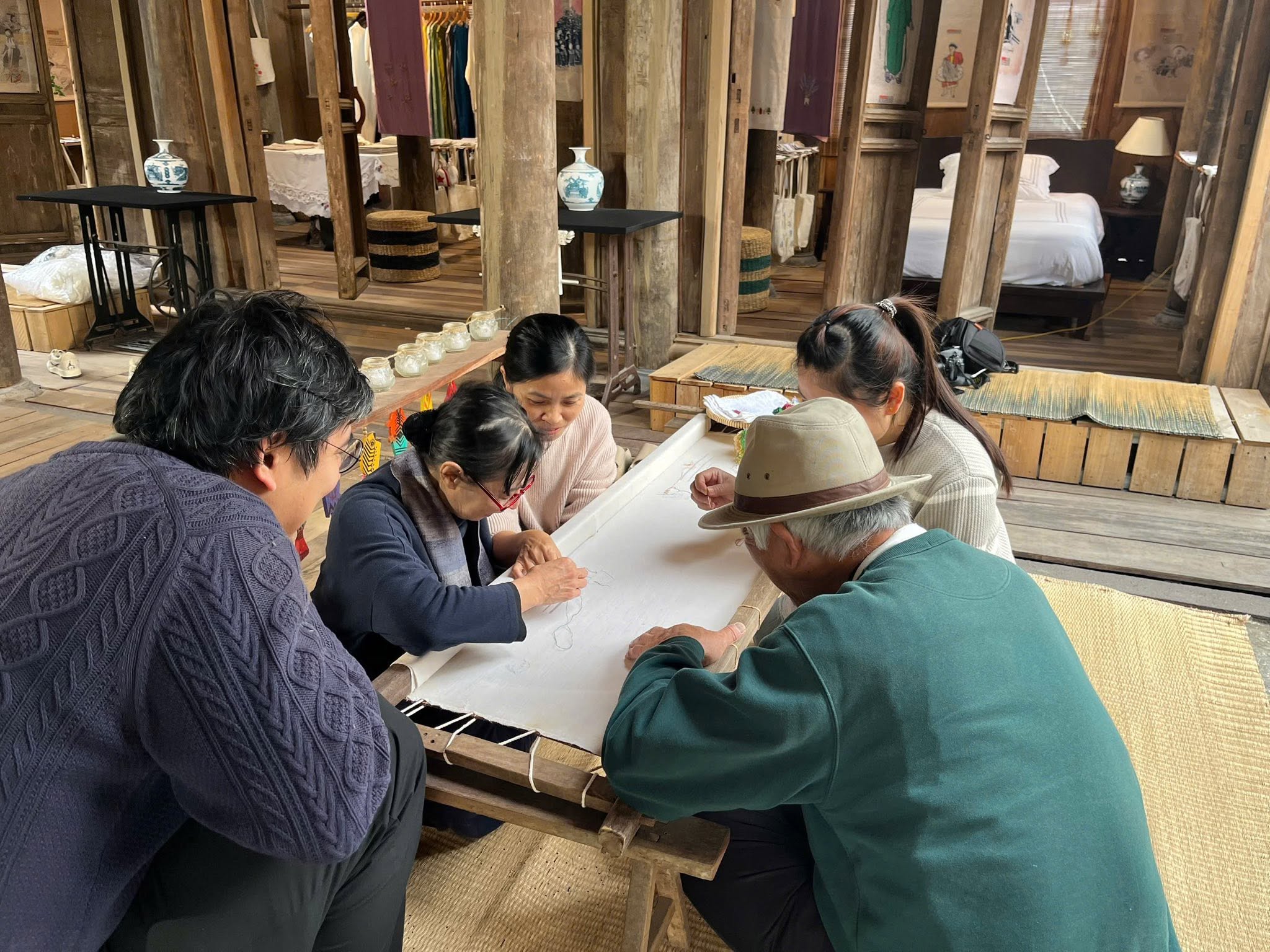
At workshops that welcome visitors, travelers may observe artisans working with embroidery frames, colorful threads, and carefully prepared fabric patterns.
Watching skilled embroiderers create intricate designs stitch by stitch offers a deeper appreciation of the patience and precision involved in traditional needlework.
Even a relatively small handmade item can require considerable time and attention, depending on the complexity of the pattern.
For travelers interested in hands-on cultural experiences, some workshops or locally organized programs may offer opportunities to meet artisans and learn basic embroidery techniques.
Such activities should be arranged in advance, as workshop access and visitor programs may vary.
Visitors can also explore the village’s range of handcrafted products and purchase embroidered souvenirs.
Handkerchiefs, tablecloths, pillowcases, decorative textiles, and embroidered paintings make meaningful gifts that reflect the artistic heritage of Ninh Binh.
Each handmade piece represents not only a practical or decorative object but also the time, knowledge, and dedication of the artisan who created it.
A visit to Van Lam can easily be combined with other attractions in the Tam Coc – Bich Dong area.
Travelers can enjoy a traditional boat trip along the Ngo Dong River, explore the limestone caves of Tam Coc, visit Bich Dong Pagoda, and discover nearby historical and cultural sites.
Combining natural scenery with traditional craftsmanship offers a more complete experience of Ninh Binh’s heritage.
For the local community, craft village tourism can create additional opportunities to promote handmade products, generate income, and encourage younger generations to learn traditional skills.
At the same time, tourism development should respect local daily life and support the preservation of authentic embroidery techniques.
In an era when many textile products are mass-produced, Van Lam’s handmade embroidery continues to stand out for its individuality, craftsmanship, and artistic detail.
With a history of more than 700 years according to local tradition, Van Lam Embroidery Village remains a living expression of Vietnam’s handicraft heritage. From delicate stitches on everyday textiles to monumental embroidered artworks, the village continues to preserve traditional skills while offering visitors a memorable cultural experience in the heart of Tam Coc – Bich Dong.
Quick Information
| Item | Details |
|---|---|
| Craft village | Van Lam Embroidery Village |
| Vietnamese name | Làng nghề thêu ren Văn Lâm |
| Location | Van Lam Hamlet, Nam Hoa Lu Ward, Ninh Binh Province, Vietnam |
| Former administrative location | Van Lam Hamlet, Ninh Hai Commune, Hoa Lu District, Ninh Binh Province |
| Geographical setting | Tam Coc – Bich Dong Tourist Area |
| Craft type | Traditional handicraft village |
| Main crafts | Hand embroidery, lace-making, drawn-thread embroidery |
| History | More than 700 years according to local tradition |
| Legendary founder | Tran Thi Dung |
| Figures associated with lace-making development | Dinh Van Xoang and Dinh Van Henh |
| Major recognition | One of 12 outstanding traditional craft villages at the national level |
| Recognition year | 2007 |
| Notable artwork | “Coi Xua” (Ancient Roots) |
| Artwork dimensions | Approximately 5.5 × 31 meters |
| Artwork occasion | 1,000th anniversary of Thang Long – Hanoi, 2010 |
| OCOP products | Selected products received four-star ratings from 2019 |
| Signature products | Embroidered paintings, tablecloths, napkins, pillowcases, bed linens, curtains, handkerchiefs, and embroidered garments |
| International markets | Japan, South Korea, and selected European and North American markets |
| Cultural significance | Traditional hand embroidery, lace-making, drawn-thread techniques, and artisanal knowledge |
| Nearby attractions | Tam Coc, Bich Dong Pagoda, Ngo Dong River |
| Tourism potential | Craft village visits, embroidery demonstrations, artisan interactions, and handmade souvenir shopping |







