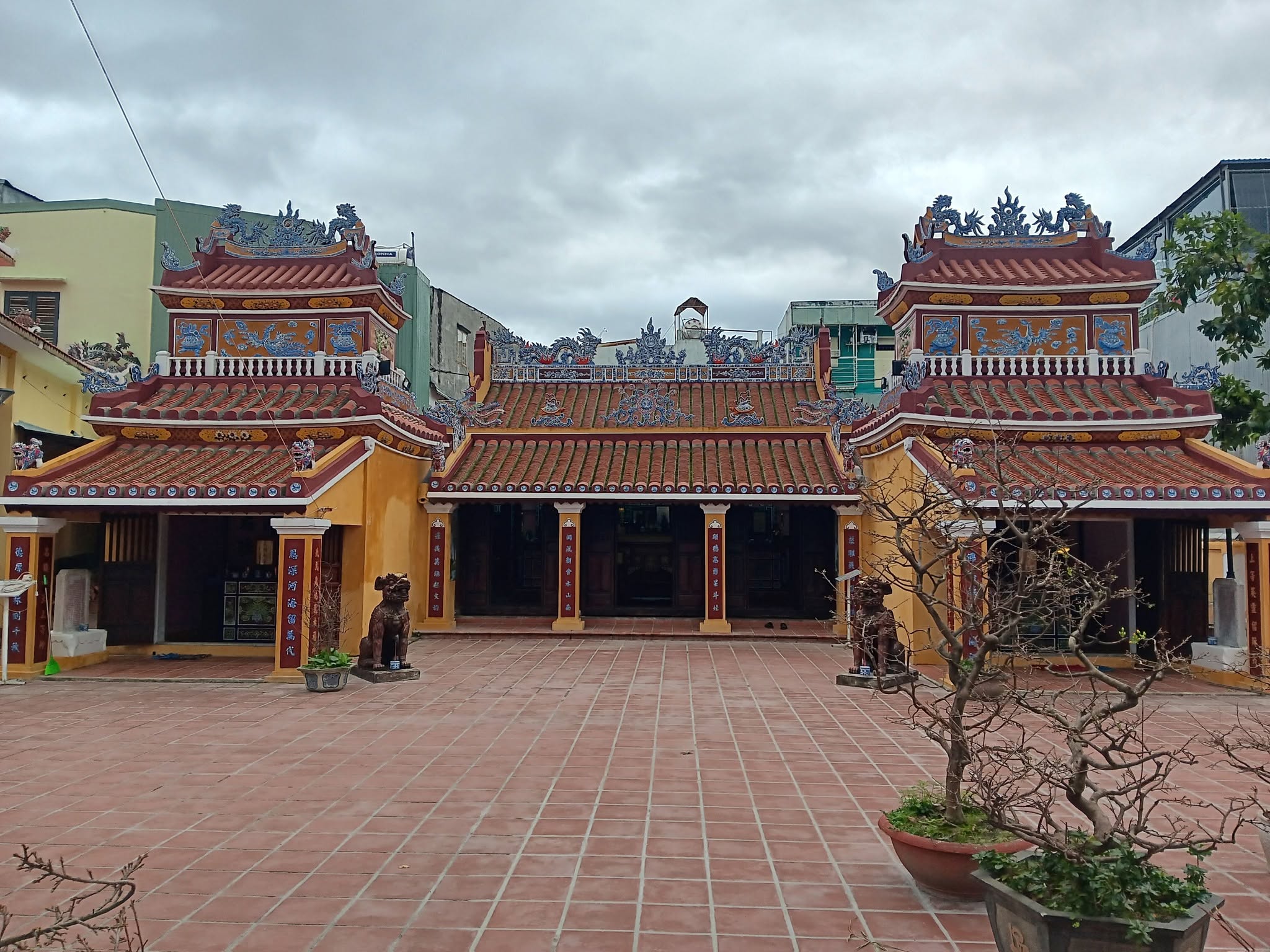
Thac Gian Communal House (Dinh Thac Gian) is one of the most significant traditional communal houses in Da Nang, located in Thanh Khe Ward. Distinguished by its traditional yin-yang tiled roofs, elaborate decorative motifs, and well-preserved architectural features, the site also houses valuable historical documents that reveal the development of Da Nang’s communities over several centuries.
Established many generations ago and restored numerous times throughout its history, Thac Gian Communal House has long been associated with the spiritual, cultural, and communal life of local residents. It is dedicated to the village’s tutelary deity, General Nguyen Phuc, and the pioneering ancestors who contributed to the settlement and development of Thac Gian Village.
One of the site’s most remarkable features is its collection of 18 royal investiture decrees and 38 imperial edicts and directives dating from Vietnam’s Later Le and Nguyen dynasties. These documents provide important historical evidence of traditional religious practices, village administration, and the relationship between local communities and the imperial court.
On August 27, 2007, Thac Gian Communal House was officially recognized as a National Monument, acknowledging its outstanding historical, architectural, and cultural significance.
Today, the communal house remains an important place of worship and community identity, while also offering visitors an opportunity to explore the architectural heritage and traditional village culture of Da Nang.
History and Development of Thac Gian Communal House
According to historical records and local traditions, the Thac Gian area was first settled around the middle of the 15th century, during the early development of Vietnamese communities in what is now Da Nang.
The village was originally known as Thac Gian with the historical spelling Thạc Giản, and was also recorded under alternative names such as Thạch Giản and Thạch Gián. Over time, the present-day name, Thac Gian, became widely established.
Local accounts recognize Huynh Van Phuoc as the pioneering settler who led a group of migrants from northern Vietnam to reclaim land and establish a community in this area.
He was followed by ancestors from several family lineages, including the Nguyen, Le, Ngo, Pham, Truong, and Tran clans. Through generations of settlement, cultivation, and community development, Thac Gian gradually became a prosperous and densely populated village.
Historically, Thac Gian occupied a much larger area than the neighborhood associated with its name today.
By the early 19th century, its eastern boundary adjoined Hai Chau Village and extended toward the Vung Rong area. To the west, it bordered Xuan Dan Village and Da Nang Bay, while its southern boundary met the villages of Binh Thuan and Lien Tri.
These historical boundaries illustrate the importance of Thac Gian in the development of traditional settlements across the Da Nang region.
As the community expanded, residents built houses, cultivated land, established local institutions, and constructed a communal house to serve as a place of worship, meetings, and important ceremonies.
According to local tradition, the earliest communal house was a modest structure made primarily from bamboo, thatch, and other readily available materials.
During the reign of Emperor Minh Mang, the building was reconstructed using timber, although its roof remained thatched. This improvement reflected the increasing stability and prosperity of the village community.
In 1854, the seventh year of Emperor Tu Duc’s reign, the communal house was rebuilt with brick walls and traditional yin-yang roof tiles, creating a more substantial and durable structure.
Further renovations took place in 1909, during the third year of Emperor Duy Tan’s reign, and again in 1916, the first year of Emperor Khai Dinh’s reign.
These improvements were funded through contributions from local villagers, demonstrating the community’s longstanding commitment to preserving its shared place of worship.
In 2009, Thac Gian Communal House underwent another major restoration, supported by more than VND 4 billion from the Da Nang municipal budget.
The project contributed to the preservation of the site’s architectural structures and historical character.
Despite centuries of change, the communal house continues to retain important characteristics of traditional Central Vietnamese architecture, while preserving memories of the settlement and development of Thac Gian Village.
Traditional Architecture and Distinctive Features
Thac Gian Communal House is a representative example of traditional communal architecture in Central Vietnam, combining timber structures, brick walls, yin-yang tiled roofs, and decorative elements rooted in Vietnamese folk art.
The complex consists of several interconnected structures with distinct ceremonial and practical functions.
Its principal buildings are the main sanctuary and rear shrine. Other features include a decorative screen, a pair of kneeling elephant sculptures, a shrine dedicated to wandering spirits, a traditional meeting hall, a kitchen building, and an ancient well.
The roof is covered with traditional am duong tiles, commonly known as yin-yang tiles, which are arranged in alternating curved layers.
This roofing system is characteristic of traditional Vietnamese architecture and helps channel rainwater while creating the distinctive appearance of historic communal houses, temples, and ancestral buildings.
Along the main roof ridge is an elaborate ceramic mosaic depicting “two dragons facing the moon” (luong long trieu nguyet).
This traditional decorative motif frequently appears in Vietnamese religious architecture and symbolizes dignity, harmony, and auspicious values.
The roof corners feature images of turtles and phoenixes, two symbolic creatures associated with longevity, nobility, and good fortune in Vietnamese culture.
Another distinctive detail is the use of blue-and-white Hue ceramic plates along the eaves, demonstrating the integration of ceramic decoration into traditional architectural design.
The main sanctuary occupies the central position within the complex.
Its layout follows the traditional three-bay, two-wing architectural arrangement, supported by four principal timber truss frames.
The structural system consists of five rows of columns, each containing six columns.
The columns rest on two-layer stone bases, with octagonal upper sections and lower sections shaped like gourds or pumpkins.
These carefully crafted stone bases provide structural support while demonstrating the technical knowledge and aesthetic sensibilities of traditional builders.
The interior of the main sanctuary is arranged to accommodate worship and important village ceremonies.
Connected directly behind the main sanctuary is the rear shrine, constructed from brick and lime mortar.
Its vaulted architectural form creates an elevated, tower-like appearance, distinguishing it from the timber-framed structure in front.
The rear shrine is dedicated to the village’s tutelary deity and General Nguyen Phuc, traditionally honored under the title Phi Van Tuong Quan.
The connection between the main sanctuary and rear shrine creates a continuous ceremonial arrangement while maintaining the traditional distinction between different sacred spaces.
Another remarkable feature is the pair of kneeling elephants positioned in front of the communal house, on either side of the decorative screen.
Constructed from brick and lime mortar, the elephants face the main sanctuary in a posture of respect.
Their presence contributes to the solemn atmosphere of the entrance and represents a distinctive feature of the site’s architectural decoration.
To the northeast stands a shrine dedicated to wandering spirits, reflecting traditional Vietnamese beliefs concerning remembrance of the deceased and the spiritual responsibilities of the community.
Together, these structures demonstrate that Thac Gian Communal House was designed not merely as a place of worship but as a comprehensive center of religious, ceremonial, and communal life.
Traditional Meeting Hall, Kitchen, and Ancient Well
In addition to its principal religious buildings, Thac Gian Communal House preserves several supporting structures that provide valuable insights into the daily and ceremonial activities of a traditional Vietnamese village.
Among the most notable are the nha hoi huong, or traditional meeting hall, the communal kitchen, and the ancient well.
Located behind the main communal house, the meeting hall was constructed with brick walls, timber roof frames, a wooden ridge beam, yin-yang roof tiles, and a brick-paved floor.
Historically, this building served as a gathering place for village elders, respected community members, and local officials.
Seating arrangements reflected the traditional social hierarchy of the village.
Participants were seated in the left or right sections according to age, seniority, social standing, and ceremonial responsibilities.
This arrangement illustrates the importance of social order and established customs within traditional Vietnamese village administration.
The meeting hall also served as a preparation area for ceremonial participants, including chief officiants, assistant officiants, ritual attendants, and others responsible for conducting worship ceremonies.
Before entering the main sanctuary, they would gather here to prepare ceremonial clothing and coordinate their duties.
After the ceremonies, the hall could be used for communal meals, allowing villagers to gather, exchange news, and strengthen social relationships.
Adjacent to the meeting hall, on its left side, stands the nha tru, or communal kitchen.
This relatively simple structure, built with brick walls and a tiled roof, was used to prepare food for religious ceremonies, festivals, and communal gatherings.
The presence of a dedicated kitchen demonstrates the importance of shared meals and collective preparations in traditional village celebrations.
Next to the kitchen is an ancient well, one of the site’s most historically significant supporting features.
According to elderly residents, it was once the first and only masonry-built well in the village.
The well was reportedly very deep and provided clear water, making it an important source for both ceremonial and domestic purposes.
In addition to supplying the communal house, villagers traditionally collected water from the well for use during festivals, Lunar New Year celebrations, and family ancestral memorial ceremonies.
Its water therefore held significance beyond everyday domestic needs, becoming associated with traditional rituals and ideas of ceremonial purity.
According to local recollections, the Thac Gian well was one of three ancient wells in the former Binh Thoi Ha administrative district.
The other two were Bong Well in Binh Thuan Village, historically associated with the Binh Hien area, and the well at Tu Van Pagoda, located in the former Vinh Trung area.
These wells represent important traces of historical settlement patterns, water management, and community life in Da Nang.
Preserving the meeting hall, kitchen, and ancient well helps maintain the architectural integrity of Thac Gian Communal House.
Together, these structures allow visitors to understand how traditional communal houses functioned as centers of worship, administration, food preparation, and social interaction.
Royal Decrees, Historical Documents, and Heritage Significance
One of the most valuable features of Thac Gian Communal House is its collection of historical documents written in classical Chinese and Sino-Vietnamese literary traditions.
According to descriptions of the monument, the communal house preserves 18 royal investiture decrees and 38 imperial edicts and directives associated with the Later Le and Nguyen dynasties.
These documents are important sources for researching local history, village religious practices, and the relationship between the imperial administration and traditional communities.
Among the recorded royal investiture decrees, the earliest dates to 1826, the seventh year of Emperor Minh Mang’s reign, while the latest dates to 1935, the tenth year of Emperor Bao Dai’s reign.
This historical span reflects the continuity of religious practices and the changing relationship between the village and the imperial court across different periods.
In traditional Vietnamese society, a royal investiture decree, known as a sac phong, was an official document issued by the emperor.
Such decrees often recognized or conferred honorary titles upon deities worshipped in communal houses, temples, and shrines.
For local communities, these documents held considerable religious and administrative significance because they represented official recognition of established village beliefs and worship traditions.
Royal decrees were generally preserved with great care and displayed only on important ceremonial occasions, according to local customs.
Imperial edicts and directives also provide valuable evidence concerning administrative practices, historical language, and the documentary traditions of Vietnam’s dynastic periods.
The survival of such a substantial collection at Thac Gian Communal House is an important factor contributing to the monument’s historical significance.
Beyond their documentary value, these records help researchers understand the development of local communities, the worship of village tutelary deities, and the connections between Thac Gian Village and the administrative institutions of earlier periods.
The communal house also preserves traditions associated with the worship of its tutelary deity, General Nguyen Phuc, and the pioneering ancestors who established the settlement.
The worship of village tutelary deities is an important element of Vietnamese traditional culture.
These deities were regarded as spiritual protectors of the community, associated with hopes for peace, favorable weather, successful harvests, and collective prosperity.
Meanwhile, the remembrance of pioneering ancestors expresses gratitude toward those who reclaimed land, established settlements, and laid the foundations for future generations.
Through its religious practices, historical documents, and ceremonial traditions, Thac Gian Communal House serves as a repository of collective memory for the local community.
Recognizing these historical, architectural, and cultural values, the competent national cultural authority designated Thac Gian Communal House as a National Monument on August 27, 2007.
This recognition affirmed the site’s importance within Vietnam’s cultural heritage system and provided an essential foundation for its continued conservation.
Thac Gian Communal House Festival and Community Traditions
Throughout its history, Thac Gian Communal House has served as an important center for religious ceremonies, traditional festivals, and cultural activities.
Historical accounts mention several recurring ceremonies, including the Thu Nhi Ky seasonal ritual, observances during the Thanh Minh period, memorial ceremonies honoring the village’s pioneering ancestors, and activities associated with the Lunar New Year.
The communal house was also a venue for traditional cultural performances and community events, including ceremonial recitation competitions, classical Vietnamese opera known as tuong, and various folk activities.
These traditions helped maintain relationships among local families and clans while strengthening the community’s shared identity.
Communal house festivals were traditionally organized to pray for national peace, favorable weather, agricultural prosperity, and the well-being of local residents.
They also provided opportunities to honor ancestors, village founders, and individuals who had contributed to the development of the community.
In traditional Vietnamese society, the communal house was often the center of village life, serving as a place for religious ceremonies, important meetings, and collective celebrations.
After periods of interruption or changes in festival practices, the Thac Gian Communal House Festival was revived on April 17, 2011, corresponding to the tenth day of the third lunar month.
This marked the first major revival of the festival under the restored ceremonial program, representing an important step toward preserving local cultural traditions.
On April 19, 2013, the former Thanh Khe District authorities organized the second revived festival, further promoting the cultural heritage of Thac Gian among residents and visitors.
The festivals featured a variety of traditional ceremonies, cultural performances, and folk competitions.
The ceremonial program included rituals honoring the pioneering ancestors, offerings to the village’s tutelary deity, and prayers for peace and prosperity.
Cultural activities included calligraphy competitions, beautiful handwriting contests, flower arrangement, fruit displays, bai choi performances, stick-pushing contests, arm wrestling, and other traditional games.
These activities helped recreate elements of historical village celebrations while encouraging younger generations to learn about local customs.
Of particular interest is bai choi, a traditional performing art of Central Vietnam that combines singing, storytelling, folk games, and audience participation.
Its inclusion in communal festivals creates a connection between architectural heritage and living cultural traditions.
Thac Gian’s festival activities have also been organized in connection with the Hai Chau Communal House Festival, helping introduce the distinctive traditions of Da Nang’s historic communities.
Today, preserving and promoting communal house festivals remains important for maintaining local cultural identity, educating younger generations, and strengthening connections among residents.
Thac Gian Communal House is therefore not simply a historic building containing ancient artifacts.
It is also a living cultural space where traditional customs, collective memories, and community relationships continue to be passed down through generations.
Visiting Thac Gian Communal House: Travel Information and Visitor Guide
Thac Gian Communal House is located in Thanh Khe Ward, Da Nang City, making it a worthwhile destination for visitors interested in the city’s early settlement history, traditional architecture, and religious heritage.
During a visit, travelers can explore the architectural layout of the communal house, including its yin-yang tiled roofs, decorative roof ridges, main sanctuary, and rear shrine.
The dragon-and-moon motif, turtle and phoenix decorations, and ceramic mosaic details provide fascinating examples of traditional Central Vietnamese architectural ornamentation.
Inside the main sanctuary, the timber columns, structural trusses, and intricately shaped stone column bases are particularly noteworthy for visitors interested in historic construction techniques.
The supporting structures, including the traditional meeting hall, kitchen, and ancient well, offer further insights into the organization of communal life.
These buildings illustrate how the communal house once served multiple purposes, functioning as a place of worship, a meeting venue, and a center for village celebrations.
For history enthusiasts, the collection of royal decrees and imperial documents is among the site’s most significant cultural assets.
However, access to original historical materials may be restricted to ensure their preservation and should follow the regulations of the site management.
Visitors arriving during a traditional festival may have the opportunity to observe ceremonial rituals, enjoy folk performances, and experience the cultural atmosphere of the local community.
As festival dates and activities may vary from year to year, travelers should confirm the schedule before planning their visit.
Appropriate clothing and respectful behavior are recommended when entering the communal house.
Visitors should maintain a quiet atmosphere in worship areas and avoid touching historical artifacts, sacred objects, or original architectural components.
Photography inside the main sanctuary and rear shrine should follow the instructions of the custodians or site management.
Research groups, students, and visitors seeking a more detailed understanding of the monument’s history and architecture are encouraged to make arrangements in advance.
Quick Information About Thac Gian Communal House
| Category | Information |
|---|---|
| Heritage site | Thac Gian Communal House |
| Vietnamese name | Đình Thạc Gián |
| Current address | Thanh Khe Ward, Da Nang City, Vietnam |
| Historical village names | Thạc Giản, Thạch Giản, Thạch Gián |
| Initial settlement | Around the middle of the 15th century |
| Recognized pioneering settler | Huynh Van Phuoc |
| Major founding lineages | Nguyen, Le, Ngo, Pham, Truong, Tran |
| Heritage type | Historical, architectural, and religious monument |
| Original construction | Bamboo and thatch |
| Renovation under Minh Mang | Timber structure with a thatched roof |
| Major reconstruction | 1854, with brick walls and yin-yang roof tiles |
| Later restorations | 1909, 1916, and 2009 |
| 2009 restoration budget | More than VND 4 billion, according to historical descriptions |
| Main architecture | Three-bay, two-wing main sanctuary and rear shrine |
| Principal worship | Village tutelary deity, General Nguyen Phuc, and pioneering ancestors |
| Notable features | Decorative screen, kneeling elephants, spirit shrine, meeting hall, kitchen, and ancient well |
| Historical documents | 18 royal investiture decrees and 38 imperial edicts and directives |
| Earliest recorded royal decree | 1826, seventh year of Minh Mang’s reign |
| Latest recorded royal decree | 1935, tenth year of Bao Dai’s reign |
| Heritage designation | National Monument |
| Recognition date | August 27, 2007 |
| Festival revival | April 17, 2011 |
| Cultural activities | Traditional ceremonies, ancestor remembrance, calligraphy, bai choi, and folk games |
| Visiting hours | Contact site management for current arrangements |
| Admission | No confirmed information available |
After centuries of historical change, Thac Gian Communal House remains one of Da Nang’s valuable examples of traditional communal architecture.
From its yin-yang tiled roofs, timber structures, and decorative motifs to its royal decrees, historical documents, and ceremonial traditions, every part of the complex contributes to the story of Thac Gian Village and the development of the surrounding region.
More than an architectural monument, the communal house preserves memories of pioneering ancestors, traditional tutelary deity worship, and the customs that shaped Vietnamese village society.
Its continued preservation and the revival of traditional cultural activities play an important role in maintaining local identity amid the rapid development of modern Da Nang.
For travelers exploring the cultural heritage of Central Vietnam, Thac Gian Communal House offers a meaningful opportunity to discover the history, architecture, and living traditions of one of Da Nang’s oldest communities.